Skin Barrier Lipids: What They Are and How They Work
When skin feels tight after cleansing, catches on a towel, or becomes suddenly reactive to products that once felt comfortable, the problem is often not a lack of moisture alone.
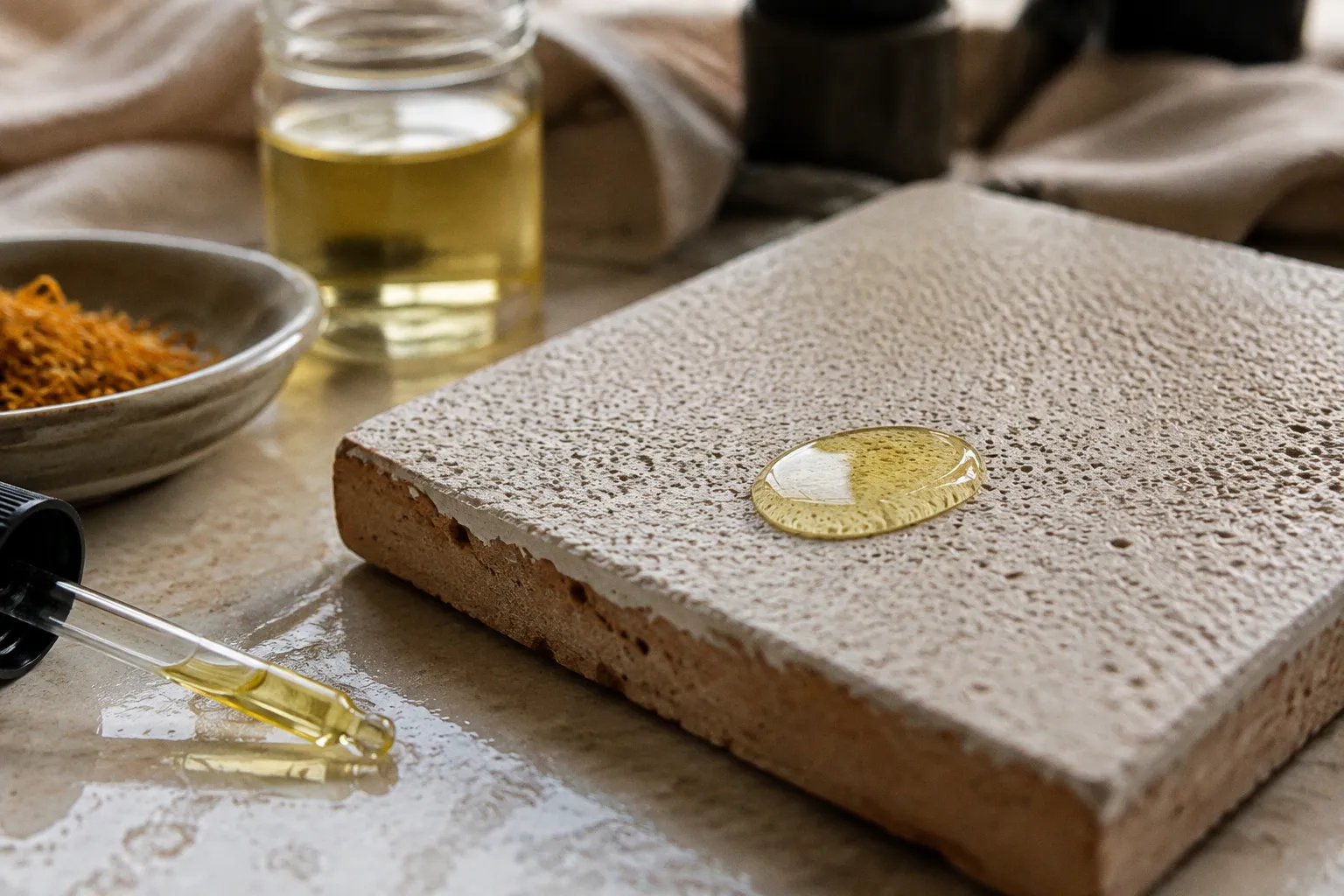
The deeper issue may be the condition of the lipid structure that holds the outermost layer of skin together. These fats create a quiet, protective architecture: they soften the surface, slow water loss, and help keep irritants from moving too easily through the barrier.
So, what are skin barrier lipids in skincare? They are the organized fats found between the cells of the stratum corneum, the outer layer of the epidermis. In a healthy barrier, they are not simply sitting on the skin as an oily film. They form layered structures that help regulate how water leaves the skin and how external stressors enter it.
This distinction matters when choosing botanical oils, raw butters, or a barrier-focused cream. A product can feel beautifully rich and still fail to support the deeper organization of the barrier. Another can feel light, almost silky rather than greasy, while offering a more balanced combination of lipids and water-binding ingredients.
The Bricks and Mortar Model: Understanding the Stratum Corneum
The stratum corneum is often described through a simple but useful image: skin cells act as the bricks, while lipids act as the mortar between them.
Dermatologist Peter Elias introduced this “bricks and mortar” model in 1983. The bricks are corneocytes, mature skin cells filled with structural proteins. The mortar is the intercellular lipid matrix surrounding those cells. Together, they form the first meaningful line of defense against excessive water loss, friction, pollutants, and many everyday irritants.
The image is helpful, but it can also make the skin barrier sound more static than it is. This outer layer is constantly changing. Cells are shed from the surface while new cells move upward. Lipids are produced, arranged, modified, and gradually removed. The quality of the barrier depends not only on how much lipid is present, but on whether those lipids are arranged in a coherent, flexible pattern.
A compromised barrier may show up as:
- Persistent tightness, especially after washing
- Flaking that returns even after applying oil
- Burning or stinging from otherwise gentle products
- Rough, papery texture
- Increased sensitivity to fragrance, acids, retinoids, or essential oils
- Redness that appears more easily in cold, dry, or windy conditions
- A cycle of applying more and more products without feeling comfortable
Dryness and dehydration are related, but they are not identical. Dehydrated skin lacks sufficient water in the outer layers. Dry skin often has difficulty maintaining a comfortable lipid environment. The two conditions can appear together, which is why a water-based serum alone may provide only temporary relief. Water needs a supportive structure around it, and that structure depends partly on skin barrier lipids.
A healthy barrier is not a thick layer of oil. It is an organized lipid structure that helps the skin hold on to water without feeling sealed beneath a heavy coating.
The Lipid Triad: Ceramides, Cholesterol, and Fatty Acids
The three major lipid classes in the stratum corneum are ceramides, cholesterol, and free fatty acids. They work together rather than as isolated ingredients, and their proportions influence how effectively the barrier can recover and function.
By weight, the barrier lipid matrix is composed approximately of:
- Ceramides: about 50%
- Cholesterol: about 25%
- Free fatty acids: about 10–15%
These figures describe the lipid composition of the skin barrier, not a universal formula recommendation for every cream, balm, or facial oil.
Ceramides: the structural organizers
Ceramides are waxy lipid molecules made from a fatty acid joined to a sphingoid base. Their structure allows them to sit within the layered lipid matrix and help create a stable, low-permeability environment.
In skincare, ceramides are usually associated with barrier-supportive moisturizers because they can replenish or complement lipids that are reduced when the barrier is disrupted. They are particularly relevant when skin feels persistently rough, fragile, or reactive.
Yet more ceramide does not automatically mean better repair. A formula must deliver the ingredient in a compatible system, alongside other lipid classes and supporting components. The surrounding emulsion, the form of the ceramide, and the balance of the formula all influence how the product behaves on skin.
Cholesterol: flexibility within the barrier
Cholesterol is another essential component of the stratum corneum lipid matrix. In this context, it is a skin lipid, not a reference to blood cholesterol or dietary cholesterol.
Its role is partly structural and balancing. Cholesterol helps the lipid layers remain sufficiently organized while preserving the flexibility needed for the barrier to function during movement, temperature changes, and daily exposure. A barrier made from only one lipid type would not behave like healthy skin.
This is one reason a product that advertises a single star ingredient may be less meaningful than a quieter formula built around a complementary lipid system.
Free fatty acids: the often-overlooked part of the blend
Free fatty acids contribute to the organization and permeability of the barrier. They also influence the acidity and physical behavior of the outer skin layer.
The phrase “fatty acid” covers a broad family of molecules with different chain lengths and degrees of saturation. Their behavior in a formula can vary considerably. Some contribute to a softer, more cushioning feel. Others support a lighter, more fluid texture. Their balance affects both the sensory experience and the way the lipid system arranges itself.
This is where botanical oils become interesting, but also where simple claims become unreliable. A plant oil contains a profile of fatty acids and other unsaponifiable compounds; it is not a direct substitute for the full lipid matrix of the stratum corneum.
Lamellar Bilayers: How Lipids Prevent Transepidermal Water Loss
To understand how skin barrier lipids work, it helps to move beyond the idea of an oily surface film.
Within the stratum corneum, barrier lipids form stacked lamellar bilayers. These are thin, layered arrangements in which water must travel through a more complex path rather than evaporating directly from the surface. This organized structure helps reduce transepidermal water loss, commonly abbreviated as TEWL.
A simple oil can reduce the feeling of dryness because it softens rough corneocytes and slows evaporation at the surface. That is valuable. But occlusion and barrier repair are not the same action.
An occlusive layer sits over the skin and helps limit water escape. A lipid-replenishing formula aims to support the organization of the barrier itself. Some products can do both, particularly richer emulsions and balms, but the mechanisms remain different.
Why the texture of a product tells only part of the story
A buttery balm may feel restorative because it reduces friction and creates a protective veil. A light lotion may feel less dramatic while providing water, humectants, and a carefully structured lipid phase. Neither texture is automatically superior.
The skin often needs several forms of support at once:
1. Water-binding ingredients help attract and retain water in the outer layers.
2. Emollient lipids smooth rough spaces between surface cells.
3. Occlusive materials reduce water escape from the surface.
4. Barrier-compatible lipids help support the organized structure between corneocytes.
Plant oils and butters tend to be strongest in the emollient and occlusive parts of this picture. They can be deeply comforting for dry skin, but they do not necessarily provide ceramides, cholesterol, and free fatty acids in the same arrangement found in the skin.
That does not make them ineffective. It simply gives us a more precise way to understand what they are doing.
The 3:1:1:1 Ratio: Why Proportions Matter More Than Concentration
Early barrier-repair research identified an optimal molar ratio of 3:1:1:1 for a lipid blend containing:
- Ceramides
- Cholesterol
- Essential fatty acids
- Non-essential fatty acids
The purpose of this ratio is not to create a marketing shorthand. It reflects the idea that barrier lipids function as a coordinated system, and that the relationship between them may be more important than increasing one ingredient in isolation.
That principle is easy to lose in the language of clean beauty, where a single raw material often becomes the entire story: shea butter for repair, jojoba for balance, rosehip oil for renewal, or a ceramide complex for resilience. Each may have a valuable place, but the skin barrier is more nuanced than one hero ingredient.
The 3:1:1:1 ratio should also be interpreted carefully. It does not mean every successful barrier product must reproduce this exact composition. Nor does it prove that a facial oil can repair a damaged barrier simply because its fatty acid profile sounds similar. The delivery system, concentration, stability, and overall formulation all matter.
In daily skincare formulas, total barrier lipid concentration commonly falls within the range of 1–5%. Within that range, the way the lipids are arranged and delivered can matter more than the total amount alone.
A very rich product is not necessarily a very effective barrier product. Conversely, a modestly textured emulsion may offer better support because it combines compatible lipids with water and humectants in a form that spreads evenly and remains comfortable.
A practical comparison
| Lipid-focused option | What it can do well | What it may not provide on its own |
|---|---|---|
| Ceramide moisturizer | Supports a formula designed around barrier lipids and daily moisture retention | Does not guarantee repair if the overall lipid system is poorly balanced |
| Plant oil | Softens, smooths, and reduces surface friction; may provide useful fatty acids and antioxidants | Usually does not reproduce the complete ceramide-cholesterol-fatty acid matrix |
| Raw plant butter | Creates a cushioning, protective layer and helps reduce the feel of roughness | May feel heavy and may not supply water or a structured emulsion |
| Barrier balm | Combines emollient and occlusive actions, often useful during dry weather or irritation | Can trap heat or feel excessive on oily or congested skin |
| Lightweight lipid emulsion | Can combine water, humectants, and a measured lipid phase | May not feel immediately as rich or comforting as a balm |
The most useful question is not whether a product is natural or synthetic, rich or light, but whether its action matches what the skin is asking for at that moment.
Botanical Lipids and the Future of Barrier Repair Formulations
Plant oils are often described as “natural lipids,” which is broadly true, but the word lipid includes many different molecules. Botanical oils may contain triglycerides, wax esters, fatty acids, phytosterols, tocopherols, and other minor compounds. Their composition depends on the plant, the growing conditions, the extraction method, and how the finished oil is stored.
This is why cold-pressed botanical oils can feel so different from one another. One may glide easily and disappear quickly. Another may leave a dense, enveloping finish. A third may have a distinct green, earthy, or nutty aroma and a more fragile shelf life.
For dry skin, plant lipids can be especially useful when they are introduced as part of a calm, uncomplicated routine. They soften the surface and reduce the abrasive feeling that often comes with flaking. They can also make a moisturizer feel more restorative without requiring a large amount of product.
Shea butter: cushioning rather than magic
Unrefined shea butter is rich, dense, and naturally aromatic, with a soft botanical scent that some people find grounding. Its strength is largely sensory and protective: it creates a cushioning layer, reduces the feeling of roughness, and helps limit surface water loss.
It does not contain the full barrier lipid triad in the same pattern as human skin. Think of it as a supportive outer layer rather than a complete replacement for the stratum corneum matrix.
A small amount warmed between the fingertips can be pressed over a moisturizer on dry cheeks, hands, elbows, or areas exposed to cold air. Applied too generously, it may feel waxy or uncomfortable, particularly on skin that already feels congested.
Jojoba oil: a distinctive botanical wax ester
Jojoba oil is technically a liquid wax ester rather than a conventional triglyceride oil. This gives it a different slip and a lighter, more satin-like finish than many rich plant oils. It can be a comfortable option when the skin wants softness without a heavy coating.
Jojoba is often used as a carrier oil because it blends smoothly with other botanical ingredients and has a relatively stable feel. Still, “non-comedogenic” should not be treated as a universal promise. Pore response varies between individuals, and the rest of the formula matters as much as the named oil.
Cold-pressed oils and oxidation
Cold pressing helps preserve the character of the raw material, but it does not make an oil invulnerable. Oils rich in polyunsaturated fatty acids can oxidize more readily when exposed to heat, light, oxygen, or repeated opening.
Oxidized oils may develop an unpleasant odor and can become less elegant on the skin. A practical storage ritual is simple:
- Keep the bottle tightly closed.
- Store it away from direct sunlight and heat.
- Use clean, dry hands or a dropper rather than introducing water into the container.
- Choose smaller sizes when the oil is especially delicate.
- Pay attention to changes in scent, color, or texture.
Freshness is part of clean formulation. An ingredient list can be beautifully minimal while the handling of the finished product determines whether it remains pleasant and stable.
Botanical oils can comfort a compromised barrier, but comfort is not the same as structural repair. The most restorative formula is usually the one that respects both.
How to Build a Barrier-First Botanical Routine
A lipid-focused routine works best when it reduces friction rather than adding more steps. Skin that is stinging, flaky, or easily flushed usually benefits from a slower rhythm and fewer variables.
1. Cleanse without leaving the skin stripped
Use lukewarm water and a gentle cleanser, especially in the morning or during colder weather. Long, hot rinses can leave the skin feeling unusually tight because heat and repeated cleansing disturb surface comfort.
The goal is not a squeaky finish. That sensation often means the skin has been stripped of too much of its surface support.
2. Apply water-based products while the skin is slightly damp
A hydrating lotion, mist, or serum can be applied while the skin still holds a trace of moisture. This gives humectants and lightweight ingredients a more comfortable starting point.
Do not layer several strongly active products simply because the skin feels dry. A compromised barrier may interpret intensity as irritation rather than benefit.
3. Follow with a balanced moisturizer
Look for a product that combines humectants, emollients, and a purposeful lipid phase. Ceramides, fatty acids, cholesterol, and supportive botanical oils can all appear in a well-designed moisturizer, but their presence on the label does not reveal the entire performance of the formula.
Spread the moisturizer with slow, light movements. Pressing and smoothing are usually more comfortable than vigorous rubbing when the surface is rough or sensitive.
4. Seal only where the skin needs it
A thin veil of shea butter, balm, or another occlusive layer can be pressed over the driest areas. There is no need to cover the entire face in a dense layer if only the cheeks or around the mouth feel tight.
This localized approach also makes it easier to notice whether the product is soothing or contributing to congestion.
5. Keep fragrance separate from barrier repair
Essential oils are aromatic concentrates, not interchangeable with botanical carrier oils. Their scent can be beautiful and ritualistic, but fragrance-sensitive or already irritated skin may not tolerate them well.
For a restorative routine, I prefer to keep the barrier formula simple and let scent come from a separate, low-risk part of the ritual: an unscented balm paired with a diffuser, a botanical tea, or a gentle bath product used away from the most reactive facial areas.
If essential oils are used in skincare, dilution, product location, and individual sensitivity all matter. Applying a concentrated essential oil directly to compromised skin is not a gentle shortcut.
Common Mistakes With Skin Barrier Lipids
The most persistent mistakes are usually not dramatic. They are small mismatches between what the skin needs and what the routine keeps providing.
Mistake 1: Treating every oil as a barrier-repair treatment
An oil can reduce roughness and water loss without rebuilding the organized lipid matrix. If the skin remains tight beneath the oil, add a well-formulated moisturizer rather than repeatedly increasing the amount of oil.
Mistake 2: Choosing the richest texture available
A dense butter may be ideal for elbows and hands but excessive around the nose or forehead. Texture should follow the area and the climate. Dry winter cheeks may welcome a balm; humid-weather skin may prefer a lighter emulsion with a small amount of oil pressed over the top.
Mistake 3: Chasing a single percentage
A high amount of one lipid does not guarantee a better result. Barrier formulas depend on the relationship between ingredients, their delivery system, and how they behave on the skin.
Mistake 4: Exfoliating through the discomfort
Flaking can tempt people to reach for scrubs, acids, or cleansing brushes. When the skin is already burning or tight, removing more surface cells rarely creates the calm, smooth result intended. It often increases the sense of exposure.
Mistake 5: Changing several products at once
When five new botanical extracts, oils, and actives arrive in the same week, the skin has no quiet space in which to respond. Introduce one meaningful change at a time, especially if sensitivity is already present.
Mistake 6: Assuming “natural” means universally gentle
Natural fragrance, essential oils, raw plant materials, and concentrated extracts can all be biologically active. Clean ingredients still require thoughtful formulation and respectful use.
When a Botanical Oil Is Enough—and When It Is Not
A botanical oil may be enough when the skin is generally comfortable but feels a little rough, dry, or exposed after cleansing. It can be a lovely finishing step, especially over a simple moisturizer or on damp body skin after bathing.
It is less likely to be enough when the skin is persistently burning, cracking, or reacting to nearly every product. In that situation, the priority is usually a simplified routine with a bland, well-tolerated moisturizer and minimal fragrance. A lipid-rich emulsion may offer more complete support than an oil used alone because it can provide both water and a structured blend of emollient ingredients.
The most elegant routine is not the one with the longest ingredient list. It is the one that gives the barrier enough support to return to its own steady rhythm.
Skin barrier lipids work quietly. They do not need to produce an immediate dramatic sensation to be useful. Over time, their benefits may appear as less tightness after cleansing, fewer uncomfortable dry patches, and a surface that feels supple rather than fragile.
A warm balm, a carefully chosen cold-pressed oil, or a ceramide-containing moisturizer can each have a place in that process. The essential point is to understand their roles: some soften, some seal, some replenish, and the best formulas coordinate these actions rather than asking one ingredient to do everything.
When the skin feels stressed, give it less friction, fewer competing actives, and a slower ritual. Barrier care is not about forcing the complexion into submission. It is about restoring the conditions in which skin can protect itself again.