Cold-Pressed Carrier Oils: What to Check on the Label
Cold pressing describes an extraction method, not a complete quality assessment. Mechanical pressing without added heat or chemical solvents can help preserve the original lipid profile, but the…
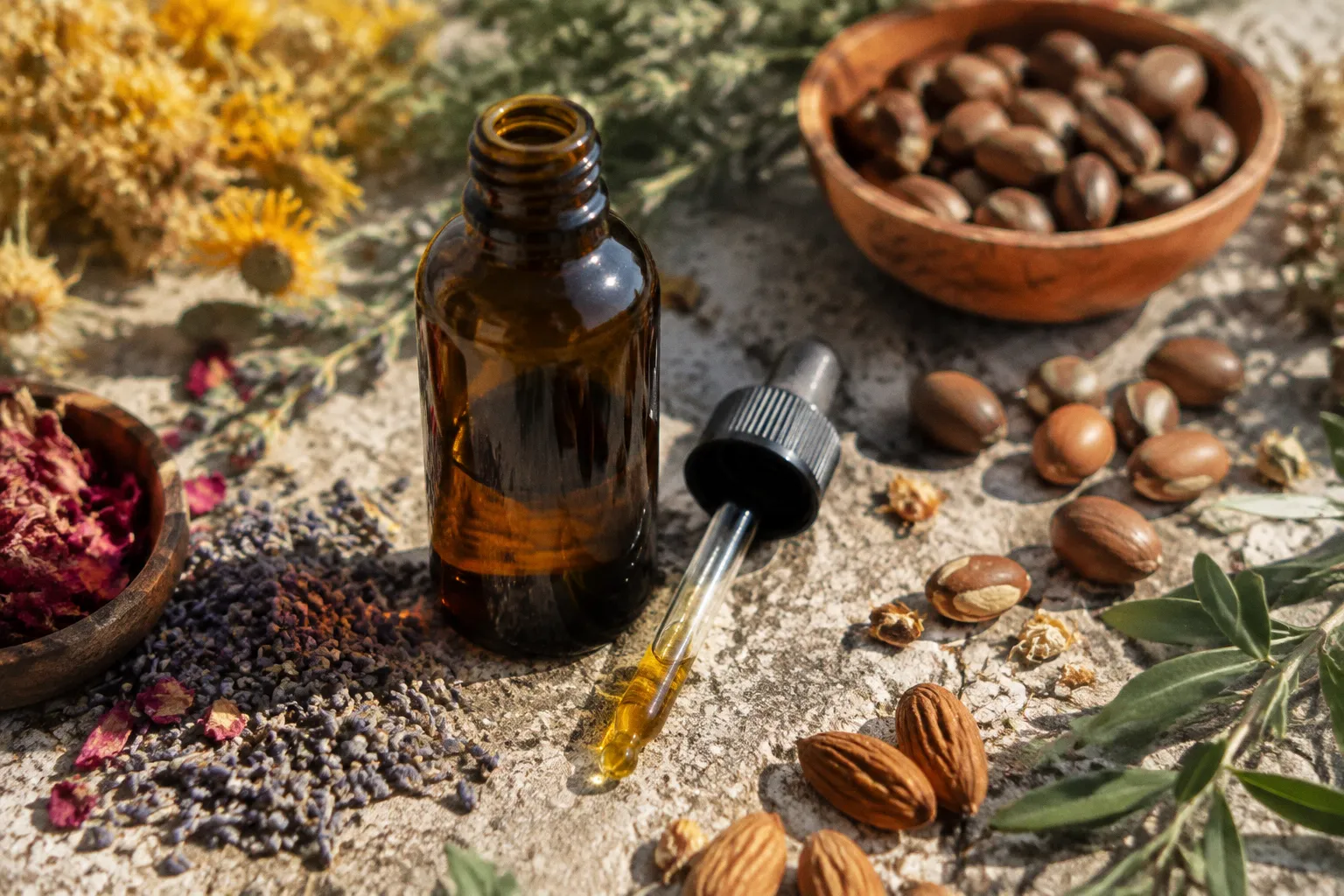
Cold pressing describes an extraction method, not a complete quality assessment. Mechanical pressing without added heat or chemical solvents can help preserve the original lipid profile, but the finished oil can still vary in botanical identity, oxidation state, packaging quality, and traceability.
That is why the phrase “cold pressed” is insufficient on its own. The relevant question is whether the label provides enough information to verify the oil’s origin, extraction method, handling, and chemical identity. These are the practical cold pressed botanical oils quality criteria that separate a traceable raw material from a bottle marketed primarily through vague purity language.
1. Separate quality information from marketing language
Carrier oil labels often combine useful data with claims that sound technical but have no standardized meaning. The first step is to classify each statement.
Some terms describe the product in a verifiable way. Others describe the seller’s positioning.
Claims that require caution
The following phrases are not standardized quality classifications regulated by official certification bodies:
- “Therapeutic Grade”
- “100% Pure”
- “Certified Pure Tested Grade”
- “Professional Grade”
- “Ultra-Pure”
- “Pharmaceutical Grade,” when no recognized regulatory or testing context is provided
These expressions may appear alongside a well-made oil. They do not prove that the oil is authentic, unoxidized, solvent-free, or superior to another product.
“100% pure” usually means that no other ingredient has been intentionally added. It does not, by itself, establish the botanical species, plant part, country of origin, harvest date, storage history, or fatty acid composition. A pure oil can still be poorly documented or degraded by light and oxygen.
The same distinction applies to “therapeutic” language. Carrier oils can have useful emollient, occlusive, or skin-conditioning properties, but a marketing label is not a clinical efficacy assessment. The term should not be treated as evidence of a specific dermatological outcome.
A quality claim is only useful when it can be connected to a measurable property, a traceable batch, or a defined processing step.
What a meaningful label should communicate
A transparent label gives you information that can be checked against the material itself or against the supplier’s technical documentation. At minimum, look for:
- The complete botanical Latin name.
- The plant part used.
- The country of origin.
- The cultivation method, if claimed.
- The extraction method.
- An expiration or best-before date.
- A batch or lot number.
- Packaging that limits light exposure.
This does not guarantee perfect quality. It establishes a minimum level of accountability.
For handmade skincare, traceability matters because carrier oils are not chemically interchangeable. Jojoba oil, for example, is composed primarily of liquid wax esters rather than the triglycerides that dominate most vegetable oils. Shea butter has a different fatty acid and unsaponifiable fraction from a liquid seed oil. Replacing one with another changes the formulation’s viscosity, spread, occlusivity, oxidation behavior, and sensory profile.
A label that says only “botanical oil” gives you no reliable basis for formulation decisions.
2. Read the botanical identity, not just the common name
Common names are convenient for consumers and insufficient for technical identification.
The botanical Latin name identifies the species or genus used. This is important because one common name can refer to different plants, while related species can produce oils with different fatty acid profiles and different handling requirements.
For example, “rosehip oil” should not be treated as a complete identity statement. A more useful label identifies the botanical source and, where relevant, the plant material used to produce it. The same principle applies to oils sold under broad names such as “seed oil,” “berry oil,” “nut oil,” or “herbal oil.”
The plant part affects the material
The label should state whether the oil was derived from:
- Seeds
- Kernels
- Fruit pulp
- Nuts
- Leaves
- Flowers
- Roots
This is not a cosmetic detail. Different plant parts contain different proportions of triglycerides, waxes, pigments, sterols, aromatic compounds, and minor lipid components.
A cold-pressed seed oil and a solvent extract from the same plant are not automatically equivalent. They may differ in composition, concentration, color, odor, and suitability for leave-on skincare.
The plant part also helps distinguish a fixed carrier oil from an essential oil or botanical extract. These categories should not be collapsed into one label. A carrier oil is generally used as a lipid phase or diluent. An essential oil is a concentrated volatile fraction. A botanical extract may be carried in oil but can contain a different set of constituents and a different concentration.
Country of origin is a traceability marker
The country of origin does not function as a simple quality ranking. It does, however, provide useful traceability.
A transparent label should identify where the crop was grown or where the raw material originated. If the product has been pressed, filtered, blended, or bottled in another location, the supplier should distinguish these stages where relevant.
Origin information becomes particularly useful when combined with a batch number and technical data. It allows a manufacturer or formulator to connect a finished bottle to a specific production lot rather than treating the oil as an anonymous commodity.
Cultivation claims need context
Terms such as “organic,” “wildcrafted,” or “sustainably harvested” describe cultivation or sourcing practices, not necessarily oxidation status or fatty acid authenticity.
A cultivation claim does not replace:
- A botanical Latin name.
- An extraction description.
- A production batch.
- Appropriate packaging.
- Laboratory verification.
These attributes answer different questions. Organic status concerns production standards. Cold pressing concerns extraction. FAMEs analysis concerns fatty acid profiling. None of these terms should be used as a substitute for the others.
3. Verify what “cold pressed” actually means
Cold pressing relies on mechanical pressure rather than chemical solvents. The process is intended to extract oil while limiting heat exposure. However, the term does not always communicate a single universal processing standard across every cosmetic market.
For general cold-press processing, the commonly cited upper threshold is below 120°F, or 49°C. European standards for cold-pressed olive oil use a lower temperature limit of below 27°C, or 80°F. These figures should not be casually transferred from olive oil regulation to every botanical oil category.
The practical point is narrower: a credible supplier should be able to describe the extraction process with more precision than simply printing “cold pressed” in large type.
Questions the label or supplier should answer
When evaluating a carrier oil, look for information about:
1. Mechanical extraction
The oil should be described as mechanically pressed rather than extracted with chemical solvents.
2. Heat control
The supplier should clarify whether the temperature was controlled during pressing and whether the stated temperature refers to the press, the raw material, or the finished oil.
3. Filtration
Unfiltered or minimally filtered oils may retain suspended particles and plant material. Filtered oils may be clearer and more stable in use. Neither description automatically establishes higher quality.
4. Refining
Refined oils may undergo processing intended to reduce odor, color, free fatty acids, pigments, or other components. Unrefined oils generally retain more of the original minor constituents, but the label should still disclose the processing status clearly.
5. Blending
A bottle may contain a blend of oils rather than a single botanical source. The ingredient list should make this apparent.
The phrase “first cold pressed” should not be interpreted as proof of a superior modern extraction step. It is not enough to establish authenticity or performance. A standard cold-pressed oil with clear batch documentation and appropriate laboratory data may be more useful than a product carrying elaborate extraction language but offering no verification.
Cold pressed versus refined
The comparison is not a simple hierarchy.
| Label description | What it may indicate | What it does not prove |
|---|---|---|
| Cold pressed | Mechanical extraction with limited heat exposure | That the oil is fresh, authentic, unoxidized, or free from blending |
| Unrefined | Less intensive post-extraction processing and greater retention of native color or odor | A universal legal definition or guaranteed stability |
| Refined | Additional processing to modify color, odor, impurities, or composition | That the oil is inferior or unsuitable for skincare |
| Virgin or extra virgin | A category that may have specific meaning in some food-oil standards | That the same meaning applies uniformly to cosmetic carrier oils |
| 100% pure | No intentionally added secondary ingredient, if accurately declared | Species identity, origin, extraction conditions, or laboratory verification |
For facial oils and handmade balms, the choice between refined and unrefined depends on the formulation objective. A formulator may prefer an unrefined oil for its original color, odor, or minor components. Another may choose a refined material for greater consistency, lower odor, or a more neutral appearance.
The correct decision is not based on the word “natural.” It is based on the desired lipid profile, sensory properties, stability, and compatibility with the rest of the formula.
4. Inspect the label for a complete chain of identity
A label should allow you to reconstruct what the oil is and where it came from. The most useful information is usually distributed across the front label, ingredient declaration, product specification, and batch documentation.
For small-batch skincare production, record the following when purchasing a new oil:
- Product name and botanical Latin name.
- Plant part.
- Extraction method.
- Refining or filtration status.
- Country of origin.
- Lot or batch number.
- Expiration or best-before date.
- Date of opening.
- Packaging type.
- Supplier-provided certificate or laboratory profile, if available.
This record is more valuable than a list of promotional adjectives. If a finished balm develops an unexpected odor or separates during storage, the batch history helps identify whether the issue came from the carrier oil, the formula, or the packaging.
Batch numbers are not decorative
A batch number links a bottle to a specific production run. Without it, a supplier may be unable to identify the raw material’s processing conditions, testing record, or distribution history.
A batch number is especially important for oils prone to oxidation. Oxidation is a chemical deterioration process in which unsaturated lipids react with oxygen. The rate depends on fatty acid composition, light, heat, oxygen exposure, moisture, metal contamination, and storage time.
The date alone does not describe the condition of the oil. Two bottles with the same expiration date can experience different storage conditions after leaving the manufacturer.
Expiration dates have limited meaning without storage information
An expiration or best-before date is useful, but it is not a substitute for proper handling. Oils are sensitive to their environment after opening. Repeated exposure to air increases the oxygen available for oxidation. Transparent bottles allow light to reach the lipid phase. Warm storage accelerates many degradation reactions.
For a small formulation workspace, practical storage is straightforward:
- Keep oils away from direct sunlight.
- Avoid prolonged storage near heat sources.
- Close the cap immediately after dispensing.
- Use clean, dry tools.
- Avoid introducing water into an oil bottle.
- Record the opening date.
- Purchase container sizes that match the expected rate of use.
The last point is often overlooked. A large bottle may have a lower unit cost and a longer period of repeated oxygen exposure after opening. For oxidation-sensitive oils, smaller packaging can be the more rational choice.
5. Treat packaging as part of the formulation system
Packaging protects the oil from the same variables that influence chemical stability: light, oxygen, heat, and contamination.
Dark glass and metal tins are commonly used because they reduce light exposure. Clear glass may be acceptable for some products when stored in secondary packaging, but it provides less protection during display and handling. Plastic packaging can be suitable in specific cases, yet its compatibility with the oil, oxygen permeability, and storage conditions need consideration.
The container should also limit unnecessary headspace. Every opening introduces fresh air. A bottle that remains partly empty for a long period contains a larger air volume above the oil, increasing the opportunity for oxygen transfer.
Signs that packaging information is incomplete
Be cautious when the product:
- Is sold in clear packaging with no storage guidance.
- Has no batch number.
- Provides no expiration or best-before date.
- Uses a dropper that repeatedly exposes the oil to air without explaining storage.
- Lists a common name but no botanical identity.
- Claims cold pressing but provides no extraction details.
- Gives no indication whether the oil is a single source or a blend.
None of these points proves that the oil is defective. They indicate that the buyer has less information with which to assess it.
The container is not separate from oil quality. Light and oxygen continue the extraction story after the bottle leaves the press.
6. Look for laboratory verification of the fatty acid profile
The strongest label claims are supported by testing. For carrier oils, one relevant analytical method is FAMEs analysis: Fatty Acid Methyl Esters testing.
This method is used to profile the fatty acids present in an oil. The resulting pattern can help confirm whether the material’s composition is consistent with the declared botanical source. It may also help identify adulteration or unexpected blending, although interpretation depends on the oil, the reference profile, and the quality of the analytical work.
A reputable supplier may provide:
- A certificate of analysis.
- A fatty acid profile.
- FAMEs results.
- Peroxide or oxidation-related testing.
- Refractive index or other identity parameters.
- Microbiological information where relevant to the material and packaging.
The exact testing package varies by oil. No single certificate answers every quality question.
What FAMEs analysis can and cannot establish
FAMEs testing can provide useful information about:
- The relative distribution of major fatty acids.
- Whether the profile is compatible with the declared oil.
- Potential evidence of substitution or blending.
- Lot-to-lot consistency.
It does not automatically establish:
- That the oil was cold pressed.
- That the oil is fresh at the moment of purchase.
- That the oil was stored correctly after testing.
- That the oil contains no trace contaminants.
- That the product will produce a specific clinical result on skin.
This distinction is important. Identity and stability are related but separate analytical questions. A carrier oil can have an authentic fatty acid profile and still be oxidized because of poor storage. Conversely, a fresh-smelling oil can be inadequately identified.
How to assess a laboratory document
A useful certificate should identify the tested material clearly. Check whether it includes:
- Product name.
- Botanical name.
- Batch number.
- Test date.
- Analytical method.
- Units or percentage ranges.
- Laboratory or testing body.
- Acceptance criteria or reference range.
A document that contains only a generic statement such as “tested for purity” offers limited technical value. The word “tested” is not a result.
For handmade skincare, you do not need to perform every analysis yourself. You do need to distinguish between verifiable analytical information and an unsupported assurance.
7. Apply the label criteria to facial oils and handmade formulas
When choosing cold-pressed facial oils, start with the formulation role rather than the marketing category.
A carrier oil can function as:
- A primary emollient.
- A solvent or diluent for oil-soluble botanical extracts.
- A texture modifier.
- A source of specific fatty acids.
- A component of a balm or body butter.
- A vehicle for essential oil dilution.
The same oil may be appropriate in one role and inconvenient in another. A rich butter can improve structure in an anhydrous balm but may be too viscous for a lightweight facial blend. A highly unsaturated oil may provide a desirable skin feel but require tighter control of oxygen, light, and storage time.
The label therefore needs to support decisions about both identity and behavior.
A practical selection sequence
Use this order when comparing products:
1. Confirm the exact botanical identity.
Reject labels that leave the plant source ambiguous.
2. Confirm the plant part.
Seed, fruit, kernel, and leaf oils are not interchangeable.
3. Identify the extraction method.
Look for mechanical pressing and a clear statement about heat or solvent use.
4. Determine whether the oil is refined, unrefined, or blended.
Choose according to the formulation’s stability and sensory requirements.
5. Inspect the batch and date information.
A traceable lot is more useful than a broad purity claim.
6. Evaluate packaging.
Prefer protection from light and practical control of repeated air exposure.
7. Request laboratory data when consistency matters.
FAMEs analysis is particularly relevant when botanical identity or adulteration is a concern.
8. Store the oil according to its oxidation risk.
The label is only the beginning of quality control.
Common buying errors
The most frequent mistakes are not technical failures in pressing. They are failures in interpretation.
- Choosing the strongest-sounding purity claim instead of the best-documented product.
- Assuming unrefined always means higher quality.
- Treating color or aroma as proof of authenticity.
- Confusing a cold-pressed carrier oil with an essential oil.
- Ignoring the batch number because the bottle appears sealed.
- Buying a large container without considering opening frequency.
- Assuming a laboratory certificate for one batch applies to every future batch.
- Selecting an oil based on a broad skin benefit claim without checking its actual formulation role.
Color and odor can provide clues, but they are not complete analytical methods. Natural variation between harvests is expected. Deodorization and refining can reduce sensory characteristics without making the oil unusable. Oxidation can also be subtle, especially in the early stages.
For this reason, sensory inspection should support documentation, not replace it.
8. Build a short label assessment before purchase
A compact evaluation can prevent most avoidable mistakes. For each oil, answer these questions from the label or supplier documentation:
- Is the botanical Latin name present?
- Is the plant part specified?
- Is the country of origin disclosed?
- Is the extraction method described?
- Is there information about heat or solvent use?
- Is the oil identified as refined, unrefined, filtered, or blended?
- Is the batch number visible?
- Is there an expiration or best-before date?
- Does the packaging reduce light exposure?
- Is laboratory verification available for the specific batch?
- Does the documentation describe a fatty acid profile or FAMEs analysis?
- Are storage conditions stated?
If several answers are unavailable, the product may still be usable for casual personal application, but it is a weaker choice for controlled formulation work. A handmade skincare producer needs repeatability. The more variable the raw material, the harder it becomes to interpret changes in texture, odor, stability, and skin response.
The best carrier oils for handmade skincare are not defined by the most sophisticated front-label language. They are defined by clear identity, controlled handling, suitable packaging, and evidence that the material matches its description.
Final verdict
Cold pressing is a meaningful extraction detail, but it is not a complete quality standard. The reliable assessment comes from combining several independent markers: botanical Latin name, plant part, origin, extraction information, batch traceability, packaging protection, and laboratory verification.
Treat “therapeutic grade,” “100% pure,” and similar phrases as promotional descriptors unless they are supported by specific data. Treat unrefined status as a formulation characteristic, not an automatic quality ranking. Treat FAMEs analysis as evidence about fatty acid identity, not as proof of every other quality attribute.
A well-documented carrier oil gives the formulator something measurable to work with. That is the relevant standard. Not the strongest adjective on the label, but the quality of the evidence behind it.