Essential Oil Dilution: 4 Steps to Calculate Safe Ratios
Essential oils are concentrated mixtures of volatile organic compounds. Applied neat, these compounds evaporate rapidly and contact the skin at a high local concentration.
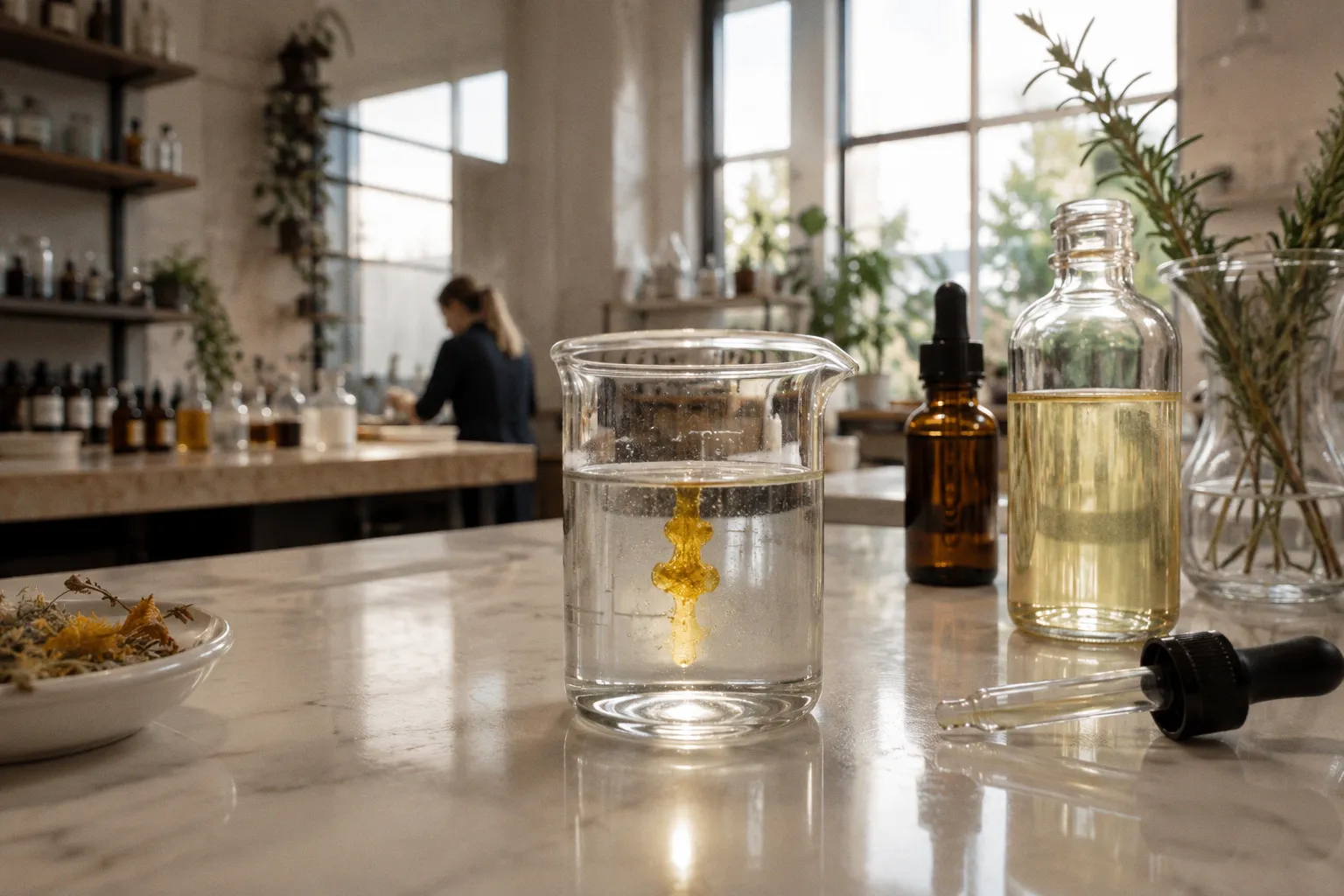
That combination increases the risk of sensitization, contact dermatitis, irritation, and chemical burns.
Essential oil dilution is therefore not a cosmetic preference. It is a concentration-control method. The carrier oil reduces the percentage of volatile material applied to the skin, slows evaporation, and distributes the essential oil through a larger volume. A safe blend begins with a percentage, not with an arbitrary number of drops.
The practical calculation has four steps:
1. Determine the final volume of the blend.
2. Select a dilution percentage for the body area and intended use.
3. Convert that percentage into a volume and then into an approximate drop count.
4. Check the result against the specific essential oil’s dermal limit.
The method is simple. The variables are not. Drop size changes with viscosity, temperature, and dropper design, so drops are a practical approximation rather than a precise unit of mass or volume.
The science of volatility: why neat application creates risk
Essential oils differ from fixed carrier oils in both composition and behavior. A carrier oil is composed primarily of non-volatile lipids. Essential oil contains volatile aromatic compounds that evaporate readily at room temperature.
When an essential oil is applied directly to the skin, several problems follow.
- The volatile compounds are delivered at their full concentration rather than being dispersed through a carrier.
- Evaporation can occur quickly, leaving a changing and uneven concentration on the skin surface.
- A small amount may spread over a larger area than intended.
- Repeated exposure can increase the risk of sensitization.
- Irritating or phototoxic oils can produce a reaction even when the amount appears small.
Sensitization is not the same as immediate irritation. Irritation can occur after a single exposure because the skin is directly affected by a high concentration of a substance. Sensitization involves the development of an immune response that may cause reactions after later exposures. In practical terms, tolerating an undiluted application once does not establish that the practice is safe.
Contact dermatitis may present as redness, itching, burning, swelling, or a rash. The reaction can be delayed. A formulation that feels acceptable immediately is not necessarily well tolerated over the following hours.
A carrier oil changes the exposure profile. It does not make an unsuitable essential oil suitable, and it does not cancel a phototoxic or irritation limit. It simply allows the formulator to control concentration.
Dilution controls exposure. It does not convert a high-risk essential oil into a low-risk one.
The choice of carrier can include jojoba, fractionated coconut oil, sunflower oil, olive oil, or another appropriate botanical oil. The carrier is the continuous phase of the blend. Its role is to hold and distribute the essential oil, not to neutralize its chemistry.
Step 1: Determine the target volume
Start with the amount of finished product you intend to make. The dilution percentage applies to the total blend volume or, in simplified drop-based calculations, to the carrier volume used for the batch.
For small skincare preparations, common working volumes include:
- 10 ml for a trial serum or facial application.
- 30 ml, approximately 1 fluid ounce, for a standard personal blend.
- Larger volumes for body oils, provided the same concentration calculation is maintained.
The most common calculation error is choosing a drop count before deciding how much product is being prepared. Six drops in 10 ml and six drops in 30 ml are not the same concentration.
A 1% blend requires more essential oil in a 30 ml batch than in a 10 ml batch because the target volume is larger. The percentage remains constant only when the amount of essential oil changes in proportion to the batch size.
A useful formulation note: define whether your percentage refers to the final finished volume or the carrier volume. For home blending, the practical convention is often expressed as drops per milliliters of carrier. For more exact professional work, calculate the essential oil volume against the intended final batch volume and measure by weight when possible.
For most personal skincare blends, the difference between these approaches is small at low dilution percentages. The important point is consistency. Do not switch calculation methods halfway through a formula.
Step 2: Match the dilution percentage to the body area
The same essential oil concentration is not appropriate for every application. Facial skin, sensitive skin, adult body skin, and short-term spot applications have different exposure conditions.
For daily facial skincare and sensitive skin, the standard dilution range is 0.5% to 1%. In a 30 ml carrier volume, this corresponds approximately to 3 to 6 drops of essential oil.
For adult body care, standard dilution commonly falls between 1% and 2%. In a 30 ml carrier volume, that is approximately 6 to 12 drops.
Short-term acute spot treatments may use 3% to 5%, or approximately 18 to 30 drops per 30 ml. This is not a daily, whole-body concentration. A higher percentage should be limited in area and duration, and only used when the individual oil’s dermal limit permits it.
The following table shows the practical ranges.
| Intended use | Typical dilution | Approximate amount per 30 ml carrier | Formulation context |
|---|---|---|---|
| Daily facial skincare or sensitive skin | 0.5%–1% | 3–6 drops | Lower exposure range |
| Standard adult body care | 1%–2% | 6–12 drops | General body application |
| Short-term spot treatment | 3%–5% | 18–30 drops | Limited area and duration |
| Neat application | 100% | Undiluted | Not an appropriate routine method |
These are general working ranges, not permission to apply every essential oil at the top of the range. A specific oil may have a lower maximum dermal limit than the intended category allows.
For facial formulations, the lower end is usually the more rational starting point. Facial products are often used repeatedly, applied to thinner or more reactive skin, and left in contact with the surface. The fact that an essential oil is plant-derived does not alter the exposure calculation.
Why repeated use changes the decision
A single application and a leave-on product used every day are different exposure patterns. With repeated use, the total contact time and frequency increase. This is one reason a blend that appears moderate in isolation may be poorly designed for a daily serum.
Before calculating the drops, identify:
- Whether the product is leave-on or rinse-off.
- Whether it is intended for the face or body.
- Whether it will be used once or repeatedly.
- Whether the application is broad or limited to a small area.
- Whether the formula contains one essential oil or several.
If the blend contains multiple essential oils, the dilution percentage applies to the combined total volume of all essential oils. Each oil does not receive a separate full percentage.
For example, a 1% facial blend cannot contain 1% lavender oil plus 1% peppermint oil plus 1% lemon oil. That would produce a total essential oil concentration of 3%. The combined amount must remain within the selected 1% target, and each individual oil must also remain within its own restrictions.
Step 3: Use the essential oil dilution calculation method
The basic volume equation is:
Essential oil volume = final batch volume × dilution percentage
Convert the percentage to a decimal before calculating:
- 0.5% = 0.005
- 1% = 0.01
- 2% = 0.02
- 3% = 0.03
- 5% = 0.05
Example: 1% facial blend in 30 ml
For a 30 ml batch at 1%:
- 30 ml × 0.01 = 0.3 ml of essential oil.
- The remaining volume is carrier oil.
- Using the practical approximation of 20 drops per 1 ml, 0.3 ml equals approximately 6 drops.
The working formula is therefore approximately 6 total drops of essential oil in 30 ml of carrier for a 1% blend.
Example: 0.5% sensitive-skin blend in 30 ml
- 30 ml × 0.005 = 0.15 ml of essential oil.
- 0.15 ml × 20 drops per ml = approximately 3 drops.
This produces the practical ratio of about 3 drops per 30 ml.
Example: 2% body oil in 30 ml
- 30 ml × 0.02 = 0.6 ml of essential oil.
- 0.6 ml × 20 drops per ml = approximately 12 drops.
The result is approximately 12 total drops in 30 ml of carrier.
Example: 1% blend in 10 ml
- 10 ml × 0.01 = 0.1 ml of essential oil.
- 0.1 ml × 20 drops per ml = approximately 2 drops.
At 0.5%, the same 10 ml batch would contain approximately 1 drop.
These calculations explain why small batches can be difficult to formulate accurately. One drop in 10 ml represents approximately 0.5% under the standard 20-drops-per-milliliter approximation. Adding a second drop moves the formula to approximately 1%. The practical change is large because the batch is small.
The four-step calculation in operational form
Use this sequence for each blend:
1. Write the batch size.
Example: 30 ml.
2. Write the target dilution.
Example: 1%.
3. Calculate the essential oil volume.
30 ml × 0.01 = 0.3 ml.
4. Convert to approximate drops and divide between oils.
0.3 ml × 20 = approximately 6 total drops.
If using three essential oils, those six drops are the total for the formula. They might be divided as two drops of each oil, but only after checking the individual limits and the purpose of each ingredient.
In a multi-oil blend, the percentage belongs to the total essential oil phase, not to every bottle in the formula.
Why drop counting has a built-in error
The approximation of 20 drops per 1 ml is useful for household formulation, but it is not universally exact. Drop size varies according to:
- Essential oil viscosity.
- Temperature.
- Dropper aperture.
- Angle and speed of dispensing.
- Surface tension and bottle design.
A thick oil may form a larger drop than a thin oil. Two droppers may produce different volumes from the same essential oil. Consequently, six drops should be read as an approximate practical quantity, not as a laboratory-grade measurement.
For better reproducibility, measure essential oils by mass using a suitable scale. This does not remove the need to know the oil’s dermal restrictions, but it reduces variation between batches. If working with drops, use the same bottle and dropper for the entire formula and record the method.
Step 4: Check individual dermal limits
The final step is not optional. A general facial or body dilution range does not override the maximum dermal limit of a particular essential oil.
Three examples illustrate the issue.
Clove bud oil
Clove bud essential oil has a maximum safe dermal dilution limit of 0.5%. That limit is lower than the standard 1% facial range and lower than many general body-care formulations.
A 30 ml blend containing 1% clove bud oil would exceed the stated maximum. The fact that 1% is often used as a general facial dilution does not make it appropriate for clove bud oil.
Peppermint oil
Peppermint has a recommended maximum dermal limit of 1.5%. A 2% body-care formula may therefore be unsuitable if peppermint is the only essential oil or if the combined formula places peppermint above its limit.
At 30 ml, 1.5% corresponds to approximately 9 drops using the 20-drops-per-milliliter approximation. That is the maximum practical quantity for the entire peppermint component under this calculation method, not an invitation to use the upper end of the range routinely.
Expressed lemon oil
Expressed lemon essential oil has a 2% cap to reduce phototoxicity risk. A body oil containing expressed lemon should not exceed that concentration, particularly when the treated skin may be exposed to sunlight.
The word “expressed” matters because essential oils derived through different processes can have different chemical profiles. Do not assume that every lemon-labeled material has the same phototoxicity profile. Identify the material before calculating the formula.
A practical limit table
| Essential oil | Stated dermal limit | Approximate maximum per 30 ml | Main formulation concern |
|---|---|---|---|
| Clove bud | 0.5% | 3 drops | Strong irritation and sensitization potential |
| Peppermint | 1.5% | 9 drops | Must remain below its specific limit |
| Expressed lemon | 2% | 12 drops | Phototoxicity control |
The drop equivalents are based on the same practical approximation of 20 drops per 1 ml. Actual drop volume may differ.
How to calculate blends with several restricted oils
Assume the target is a 1% total dilution in 30 ml. The total essential oil amount is approximately 6 drops.
If the formula contains clove bud, peppermint, and expressed lemon, all six drops together must remain at or below the 1% total target. The individual quantities must also respect:
- Clove bud: no more than the equivalent of 0.5% of the blend.
- Peppermint: no more than the equivalent of 1.5%.
- Expressed lemon: no more than the equivalent of 2%.
A formula can fail in two ways:
1. The combined essential oil percentage is too high.
2. One ingredient exceeds its own specific limit even though the total percentage appears acceptable.
This is why “natural blend” is not a sufficient safety description. The formula must be evaluated as a concentration system.
Carrier oil selection and blending procedure
Once the percentage and essential oil quantities are established, the physical blending process is straightforward.
1. Select a clean, dry bottle appropriate for the batch size.
2. Add the measured essential oils first.
3. Add the carrier oil to the intended batch volume.
4. Close the bottle and mix by gentle inversion.
5. Label the blend with the carrier, essential oils, dilution percentage, and date of preparation.
Adding the essential oils first can make small quantities easier to distribute through the carrier. The finished blend should be mixed thoroughly without unnecessary agitation that could introduce excess air.
The carrier oil should be suitable for the intended application. Jojoba is commonly used in facial and beard-care formulations because its lipid profile differs from that of many triglyceride-rich oils. Other cold-pressed botanical oils may be appropriate, but their oxidation stability, odor, and skin feel vary.
Oxidation is a separate issue from dilution. A correctly diluted essential oil can still become less suitable over time if the volatile components oxidize. Light, heat, oxygen exposure, and repeated opening can accelerate degradation. Small batches, closed containers, and sensible storage reduce avoidable variation.
Do not compensate for an old or oxidized essential oil by adding more of it. Increasing the concentration raises exposure without restoring the original material profile.
Typical calculation errors
Most failures in home blending are arithmetic or procedural rather than complex chemical problems.
Counting drops without defining volume
Six drops in 10 ml is approximately 3% under the 20-drop-per-milliliter approximation. Six drops in 30 ml is approximately 1%. The drop count has no meaning without the carrier volume.
Applying the same ratio to every body area
A body-oil dilution is not automatically a facial-serum dilution. Facial and sensitive-skin products generally use the lower 0.5%–1% range.
Giving every essential oil its own full percentage
Three oils at 1% each create a 3% blend. The total must be calculated across all essential oils.
Treating “plant-based” as a safety category
Botanical origin does not define dermal safety. Volatility, molecular composition, irritation potential, phototoxicity, oxidation, and exposure pattern are more relevant variables.
Exceeding a specific oil’s cap
A general 2% body-care range cannot override a 0.5% maximum for clove bud oil. The most restrictive relevant limit controls the formula.
Assuming drops are exact
The 20-drop approximation is useful but not universal. A different dropper or a different oil may change the actual volume.
Using water as the primary diluent
Water does not dissolve essential oil. In an oil-in-water mixture without a suitable solubilizer or emulsifier, the essential oil remains in separate droplets. That does not provide reliable dermal dilution.
Water is also not the correct response after an adverse exposure. Essential oils are oil-soluble, so rinsing with water alone may not remove them effectively from the skin.
Emergency protocol: why a plain carrier oil is more useful than water
If neat essential oil or an overly concentrated blend causes burning, redness, or another adverse reaction, remove contaminated clothing or jewelry if relevant and apply a plain carrier oil to the affected area. The carrier oil helps dilute and lift the oil-soluble volatile compounds from the skin.
Water alone is ineffective as the primary removal method because essential oils do not dissolve in water. Flushing with water can spread the material over the surface rather than solubilizing it.
After using a plain carrier oil to remove the essential oil, seek medical advice if the reaction is severe, persistent, widespread, or involves the eyes, mouth, breathing, or significant swelling. Do not apply additional essential oils to counteract the reaction.
This response does not replace appropriate medical care. It is a formulation-specific first measure based on the oil-soluble behavior of essential oils.
A reliable working protocol
For routine skincare or beard-care blending, the following order prevents most avoidable mistakes:
1. Define the application area and whether the product is leave-on or rinse-off.
2. Select a conservative target dilution, usually 0.5%–1% for facial or sensitive-skin use.
3. Establish the carrier volume before counting drops.
4. Calculate the total essential oil amount.
5. Add all essential oils together within that total.
6. Check the individual dermal limit of every oil.
7. Record the formula and account for the approximation of drop size.
8. Prepare a small batch rather than storing a large volume of a volatile blend.
9. Stop use if irritation develops and remove the oil with a plain carrier oil rather than relying on water.
Final assessment
Essential oil dilution is a concentration calculation, not an aesthetic ritual and not a test of tolerance. The relevant controls are the batch volume, the selected percentage, the combined essential oil amount, and the lowest individual dermal limit in the formula.
For most daily facial applications, 0.5%–1% is the appropriate working range. Adult body care commonly uses 1%–2%. Higher concentrations of 3%–5% are limited to short-term, localized use and should never be treated as routine whole-body levels. Clove bud, peppermint, and expressed lemon demonstrate why the individual oil must be checked separately.
The evidence-based verdict is direct: dilute essential oils in a suitable carrier, calculate the total concentration before dispensing, treat drops as approximations, and let the most restrictive ingredient limit determine the final formula.