Whipped Shea Body Butter: How to Spot Quality Formulas
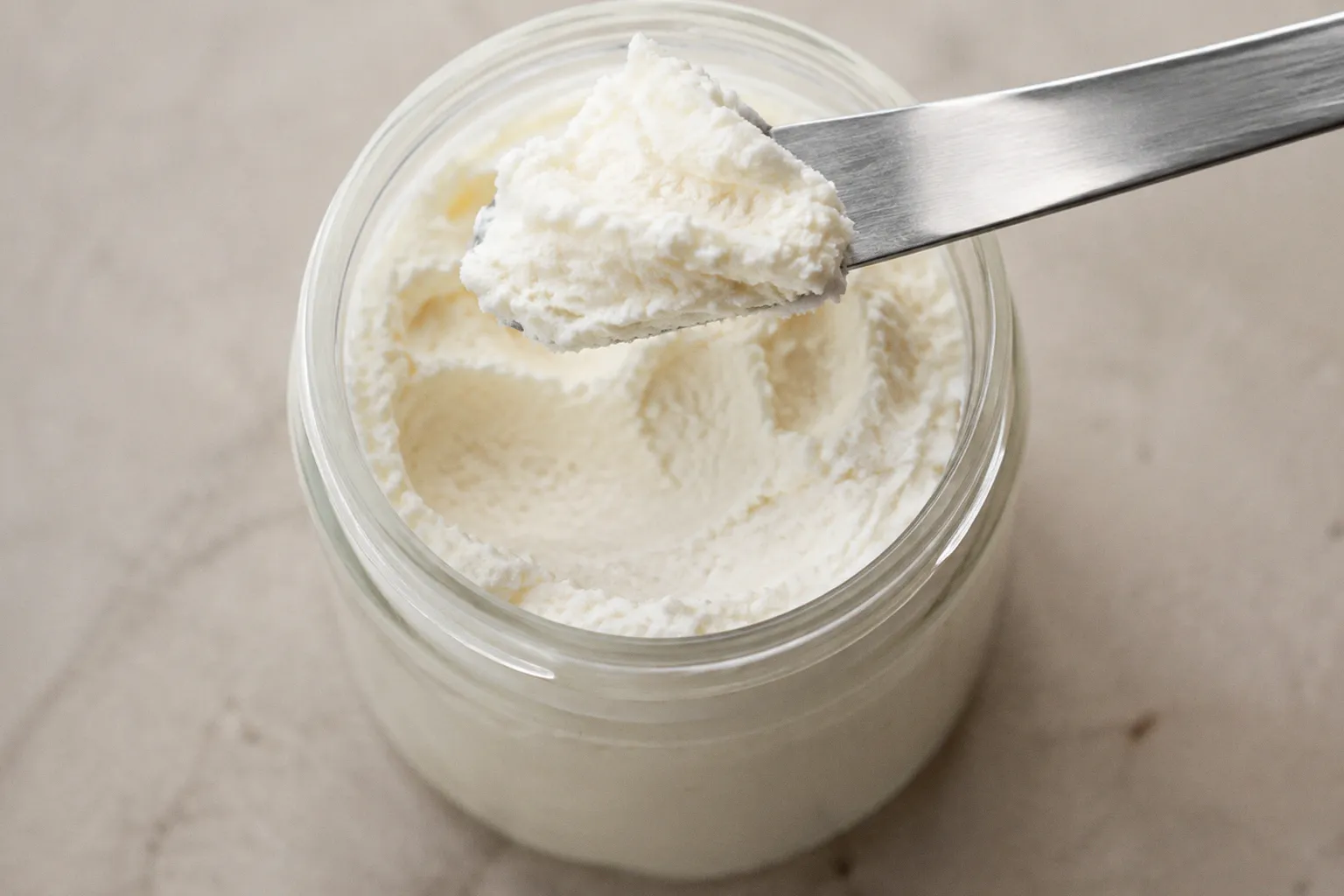
Whipped shea body butter is not automatically a high-quality product because it looks light, white, or aerated. Whipping changes the physical structure of a formula.
It does not improve an inferior fat, correct an unstable oil ratio, or compensate for poor thermal processing.
The useful question is more specific: does the formula contain a sound lipid system, remain stable during storage, and support the skin barrier without leaving an unnecessarily heavy film? In practice, that means examining the shea butter grade, the balance between solid and liquid oils, the presence of oxidation control, and the way the product behaves after application.
A good whipped body butter is an anhydrous emulsion-free system. It contains no water phase. Its performance depends mainly on the quality of its fats and on the control of crystallization during production. The visible texture is only one part of the assessment.
The case for Grade A unrefined shea butter
Shea butter is obtained from the nuts of Vitellaria paradoxa. It is a semi-solid botanical fat with a high proportion of stearic and oleic fatty acids, along with a smaller unsaponifiable fraction. That unsaponifiable fraction includes compounds such as triterpene esters and cinnamic acid esters.
These components matter because they contribute to the behavior of the butter on skin. They influence occlusivity, spread, structural consistency, and the ability of the formula to reduce transepidermal water loss. Shea butter does not add water to the skin. It slows water loss by forming a lipid-rich layer over the stratum corneum.
Unrefined Grade A shea butter generally retains more of its naturally occurring minor compounds than refined material. Refining commonly involves bleaching, deodorization, and other processing steps that reduce color, odor, and some naturally occurring constituents. The result may be more neutral in appearance and scent, but it is not chemically identical to the original fat.
When evaluating a whipped shea body butter, the ingredient list should therefore be read in terms of function rather than appearance. Look for:
- Shea butter appearing as one of the primary ingredients rather than as a minor addition to a mostly oil-based blend.
- A clear indication that the butter is unrefined when the product is marketed around its botanical profile.
- No dependence on mineral fillers or low-function powders to create the impression of volume.
- A formulation that acknowledges the natural color and odor variation of unrefined shea butter.
- Supporting oils selected for absorption and spread, not simply added to dilute the butter.
The term “Grade A” is generally used to describe the quality and condition of the raw shea butter supplied for formulation. It should not be treated as a universal medical certification or as proof that the final cosmetic is suitable for every skin type. A person who reacts to naturally occurring aromatic compounds may prefer a refined, deodorized, or fragrance-free version.
That distinction is important. Unrefined does not mean universally superior. It means less processed and chemically closer to the original botanical fat. Whether that is preferable depends on the intended use, sensory tolerance, and the rest of the formula.
Whipping can improve spreadability. It cannot upgrade the underlying fat.
What quality looks like in the butter itself
A well-made whipped formula based on shea butter usually has a uniform, fine structure. It should not contain hard waxy fragments, visible oil separation, or large crystalline grains. The color may range from ivory to pale yellow depending on the raw material and processing history.
Natural variation is expected. A perfectly white product may indicate refined shea butter, a blend with other white fats, or the use of color correction. None of these automatically makes the product ineffective. They simply provide information about how the formula was processed.
Odor is also a useful, although limited, indicator. Unrefined shea butter can have a mild nutty or earthy odor. A strong rancid odor suggests lipid oxidation or contaminated raw material. A strong added fragrance tells you very little about the quality of the shea butter itself.
Balancing shea butter with sebum-mimicking carrier oils
A formula made from shea butter alone can be protective but dense. Its high solid-fat content gives structure and persistence, yet the same property can produce drag during application. This is why a well-designed whipped body butter commonly combines a hard butter with lighter liquid oils.
Jojoba and sweet almond oil are typical examples. Jojoba is technically a liquid wax ester rather than a conventional triglyceride oil. Its chemical structure gives it a dry, stable slip that can reduce the heavy feel associated with solid butters. Sweet almond oil contributes oleic-rich emollience and improves spread across rough or dehydrated skin.
The objective is not to make the product disappear instantly. A barrier-supporting product should leave some lipid film behind. The objective is to control the film so that it is distributed evenly rather than remaining as a sticky layer.
A standard anhydrous structure may use approximately a 3:1 ratio of hard butter to liquid carrier oil. This is not a universal formula and should not be interpreted as a fixed rule. It is a useful reference point for understanding the balance:
| Formulation direction | Likely skin feel | Structural consequence | Main limitation |
|---|---|---|---|
| Higher shea butter content | Dense, protective, slower to absorb | Firmer and more resistant to collapse | Can feel greasy or drag during spreading |
| Approximately 3:1 butter-to-oil ratio | Balanced structure with improved glide | Usually stable when properly cooled and whipped | Still depends on the specific oils and temperature |
| Higher liquid-oil content | Softer, faster-spreading, more fluid | Greater risk of slumping or oil separation | May provide less persistent protection |
| Shea butter with jojoba or sweet almond oil | More controlled slip and less waxy drag | Maintains a semi-solid body while improving application | Oil quality and oxidation stability remain relevant |
Why the oil ratio changes performance
The skin does not respond to a list of ingredients in isolation. It responds to the final film formed by those ingredients. A heavy butter, a low-viscosity oil, and a powder each alter the friction, spread, and persistence of that film.
If the formula contains too little liquid oil, the product may be difficult to distribute over a large body surface. Users then apply more mechanical pressure, which is not ideal on irritated or fissured skin. If it contains too much liquid oil, the product may feel immediately slick and lose the coherent structure expected from a body butter.
The most useful test is simple:
1. Remove a small amount with a dry spatula or clean fingertip.
2. Warm it between the fingers for several seconds.
3. Spread it over a small area of dry skin.
4. Observe the residue after the initial slip has reduced.
5. Reassess the area after several minutes rather than judging the product immediately.
A quality formula should soften with body heat, spread without hard particles, and leave a coherent but not excessively tacky lipid film. “Non-greasy” should not mean “no residue.” The absence of all residue would undermine much of the barrier function.
Carrier oils are not interchangeable
Replacing jojoba with a cheaper liquid oil can alter stability and skin feel even when the percentage remains identical. The fatty acid profile, molecular structure, viscosity, and oxidation sensitivity all matter.
For example, an oil rich in polyunsaturated fatty acids may feel light but oxidize more readily than a more stable oil. Oxidized lipids can develop an unpleasant odor and may be less suitable for a leave-on product. This is why formulation quality cannot be judged only by the number of botanical ingredients listed on the label.
A long ingredient list is not evidence of a sophisticated formula. In an anhydrous body butter, a short list can be technically strong if each lipid has a clear function.
The role of natural starches in non-greasy absorption
Arrowroot powder and cornstarch are often used in whipped body butter at approximately 1% to 2%. At this concentration, they can reduce the perception of oiliness and create a drier, more velvety after-feel.
The powder does not make the butter absorb into the skin in the same way as water. It changes the sensory profile of the surface film. It can reduce slip, absorb a portion of the free oil at the skin surface, and make the product feel less wet or glossy.
This distinction prevents a common misunderstanding. A starch is not an absorption enhancer in the pharmacological sense. It does not force the lipid phase through the stratum corneum. It modifies the product’s interface with the skin.
How to assess starch in the formula
A reasonable amount of starch should be almost invisible in use. When the product is spread correctly, it should not leave an obvious white cast or form powdery rolls.
Signs of excessive starch include:
- A dry, chalky finish immediately after application.
- White streaks on darker skin tones.
- Powder collecting in body folds.
- A change from smooth slip to drag during massage.
- Visible clumps in the jar or on the skin.
These defects often indicate poor dispersion rather than a problem with arrowroot or cornstarch as ingredients. Powder must be incorporated evenly into the oil-and-butter phase. If it is added too quickly or without sufficient mixing, the final product may contain localized dry pockets.
Starch can also change the apparent density of a whipped product. A formula may feel lighter because the powder reduces surface oil, not because the butter itself has become less occlusive. The distinction matters for users with very dry skin. A dry after-feel and strong barrier support are not opposites, but they come from different parts of the formulation.
A practical comparison
When comparing two products, do not judge the formula only by whether it feels dry after application. Use the following sequence:
- Assess the initial spread.
- Check whether the product leaves particles or a white film.
- Note whether the skin remains comfortable after the surface oil settles.
- Observe whether roughness returns quickly.
- Compare the result on elbows, shins, hands, and feet rather than only on the forearm.
Body skin varies substantially by area. A butter that feels balanced on the arms may be more appropriate for feet or elbows than for the chest or upper back.
Thermal regulation and the science of preventing graininess
Graininess is one of the clearest signs that a shea butter formula has not been thermally controlled. The problem is not necessarily contamination or poor raw material. It is often a consequence of fat crystallization.
Shea butter contains several types of triglyceride structures that melt and recrystallize at different rates. If the melted butter cools unevenly, some components can form larger crystals while others remain in a softer liquid phase. Those crystals are perceived as grains when the product is applied.
Whipping can hide the problem temporarily by incorporating air and reducing the apparent density of the product. It does not remove the crystals. With time and temperature fluctuation, the graininess may become more noticeable.
A more reliable production sequence is:
1. Melt the butter phase completely and evenly.
2. Combine the selected liquid oils while the phase is uniform.
3. Begin cooling under controlled conditions.
4. Continue until the mixture becomes opaque and semi-solid.
5. Whip only when the structure is sufficiently cool to hold air.
6. Fill the container without introducing water or wet tools.
7. Allow the product to stabilize before evaluating the final texture.
The transition from clear liquid to opaque semi-solid is a useful practical marker. Whipping while the mixture is too warm can produce a loose product that later collapses. Whipping after the mixture has already crystallized heavily can produce a stiff, uneven texture.
Typical texture failures
| Observed defect | Probable formulation or process issue | What it suggests |
|---|---|---|
| Hard grains that melt slowly on contact | Uneven cooling or uncontrolled recrystallization | The butter phase was not stabilized properly |
| Oil pooling on the surface | Excess liquid oil, overheating, or poor incorporation | The lipid system lacks structural coherence |
| Product collapses after filling | Whipping occurred at too high a temperature or too much air was incorporated | The apparent volume was not supported by the solid phase |
| Dense, waxy mass | Insufficient whipping or an overly high solid-fat ratio | The formula may need more controlled liquid-oil content |
| White powdery streaks | Poorly dispersed starch or excessive starch | The sensory modifier is not uniformly incorporated |
| Strong stale or rancid odor | Oxidation of botanical fats | The product may have exceeded its useful storage life |
Temperature stability during storage also matters. Repeated warming and cooling can cause the crystalline network to reorganize. A product that was smooth on the day of manufacture may develop a different texture after transport or storage in a warm bathroom.
This is why “whipped” is a process description, not a quality guarantee.
A smooth jar at purchase is not proof of long-term stability. The crystal network must remain controlled after the product leaves the workshop.
Anhydrous stability: why waterless formulas last longer
A pure whipped body butter contains no water. This has a major preservation consequence. Microorganisms require available water to grow. In a genuinely anhydrous system, the absence of a water phase means that a conventional synthetic liquid preservative is generally not required.
That does not make the product immune to spoilage. The main stability concern shifts from microbial growth in the bulk formula to lipid oxidation and accidental water introduction.
Vitamin E, or tocopherol, is commonly used as a lipid antioxidant. It helps slow oxidation in botanical oils and butters. It does not function as a broad-spectrum preservative, and it does not make a contaminated product safe. These are separate mechanisms.
The distinction can be summarized clearly:
- An antioxidant helps protect oils from oxidation.
- A preservative controls microbial growth where water is available.
- A waterless formula reduces the conditions that support microbial growth.
- Wet hands, shower water, and damp bathroom storage can still introduce contamination.
- A product can smell rancid even when it has no visible mold.
A typical shelf-life expectation for an anhydrous whipped body butter containing Vitamin E may be around 12 months, but this depends on the raw materials, packaging, antioxidant system, storage temperature, and exposure to air. The date should not be treated as a guarantee independent of handling.
Packaging changes the risk profile
A wide-mouth jar is convenient for a thick whipped product, but it exposes the contents to repeated contact with fingers and ambient humidity. A pump or airless package can reduce direct contact, although very aerated products may not dispense easily through every pump system.
For a jar-based product:
1. Use a dry spatula where possible.
2. Do not scoop immediately after washing hands unless the hands are fully dry.
3. Keep the container away from direct heat and prolonged sun.
4. Close the lid promptly after use.
5. Discard the product if the odor becomes sharply stale, the texture changes substantially, or visible contamination appears.
The bathroom is not automatically a problem, but the combination of steam, wet hands, and temperature cycling is less favorable than a cool, dry storage location.
How to read a whipped body butter ingredient list
The ingredient list should be considered as a functional sequence. In most cosmetic labeling systems, ingredients are listed in descending order of concentration until a low-use threshold is reached. This allows a general assessment, although it does not reveal the exact percentages of every component.
For a barrier-focused whipped shea body butter, the following structure is technically coherent:
- Shea butter as the principal solid lipid.
- One or more liquid carrier oils for spread and slip.
- A small amount of natural starch if a drier finish is intended.
- Tocopherol or another suitable antioxidant for lipid protection.
- Fragrance or essential oil, if present, clearly separated in your assessment from the barrier function.
- No water if the product is described as anhydrous.
The presence of essential oils does not improve the basic barrier performance of the butter. It changes the fragrance profile and may increase the possibility of irritation or sensitization in susceptible users. A formula intended for compromised or reactive skin should be assessed more conservatively when fragranced botanicals are included.
The same applies to vitamin claims. Natural shea butter contains lipid-soluble compounds, but a body butter should not be treated as a substitute for a clinically evaluated treatment product merely because it contains naturally occurring vitamins.
Ingredient claims that need skepticism
Several common claims are imprecise:
- “Chemical-free” is meaningless. Shea butter, carrier oils, starches, and tocopherol are all chemicals in the scientific sense.
- “Preservative-free” does not establish safety. It may simply indicate that the product contains no water and uses an antioxidant rather than a preservative.
- “Non-greasy” describes a sensory target, not a measured clinical outcome.
- “Deeply moisturizing” usually means the product reduces water loss or improves surface feel. It does not mean that the butter injects water into deeper tissues.
- “Pure” may refer to the absence of added water or fillers, but the exact meaning depends on the formulation and labeling.
A rigorous assessment starts with the formula and its behavior, not the language printed on the front of the container.
Matching the formula to the skin barrier
The stratum corneum is often described as a brick-and-mortar structure. Corneocytes provide the structural units, while intercellular lipids help regulate water movement. A shea body butter mainly works at the surface by supplying an occlusive and emollient lipid film.
This makes it useful for dry, rough, or flaky body skin, particularly after bathing. It can reduce the rate of water loss when applied to skin that still contains some residual moisture. The product itself does not provide that water, so application timing affects the result.
For dry skin barrier support, use a small amount after showering and distribute it while the skin is slightly damp, not wet. Excess water should not be trapped under a thick product if the skin is irritated or prone to discomfort. The goal is a controlled film, not maximal occlusion at any cost.
Different body areas often need different quantities:
- Shins: Usually benefit from a moderate layer because the skin commonly becomes dry and tight.
- Elbows and knees: Can tolerate a richer application due to thicker, rougher surface skin.
- Hands: Need repeated application but are exposed to washing, so persistence matters more than initial softness.
- Feet: May benefit from a heavier layer at night, especially over thickened areas.
- Chest and upper back: Often require less product and may respond poorly to a heavy, fragranced formula.
A whipped body butter is not automatically the best choice for every condition. If the skin is actively inflamed, cracked, infected, or persistently itchy, the cause should not be reduced to a lack of oil. Cosmetic occlusion can support comfort, but it does not diagnose or treat an underlying dermatological disorder.
A controlled method for choosing between formulas
When two whipped shea body butters appear similar, use a structured comparison rather than relying on packaging or scent.
1. Identify the primary solid lipid
Determine whether shea butter is a major component of the formula. If it appears near the end of a long ingredient list, the product may be primarily a liquid-oil blend with a small amount of shea butter.
2. Examine the supporting oils
Jojoba and sweet almond oil can improve spreadability and reduce the dense feel of shea butter. Other oils may also be appropriate, but the formula should have a clear reason for including them. A large number of oils does not automatically improve performance.
3. Look for oxidation control
Tocopherol can help protect botanical fats from oxidation. Its presence is useful, but it does not replace good raw-material handling, protective packaging, or reasonable storage conditions.
4. Assess the texture at room temperature
The product should be uniform, with no obvious oil separation, hard particles, or dry powder pockets. A whipped texture should remain coherent rather than behaving like a loose foam.
5. Test the application film
Warm a small amount between the fingers and apply it to dry skin. Evaluate the residue after several minutes. A good formula should spread evenly and leave a controlled lipid film.
6. Check for water exposure
If the product is anhydrous, the package should be handled as an oil-based formula. Wet fingers and shower water introduce a different stability problem from ordinary lipid oxidation.
7. Consider fragrance separately
A pleasant scent is not evidence of efficacy. Fragrance, essential oils, and naturally aromatic shea compounds may be relevant to tolerance, but they do not determine whether the butter supports the skin barrier.
The difference between quality and personal preference
A thick, unrefined shea formula may be chemically well designed and still feel unsuitable to someone who dislikes natural odor or persistent residue. Conversely, a lighter refined formula may be preferable for daytime use, frequent hand application, or fragrance-sensitive skin.
Quality should therefore be evaluated against the intended function:
- For maximum barrier persistence, a higher proportion of solid butter may be appropriate.
- For easier body-wide application, a balanced liquid-oil phase is more practical.
- For a drier finish, 1% to 2% arrowroot powder or cornstarch may improve the sensory profile.
- For odor-sensitive users, refined or deodorized shea butter may be preferable.
- For compromised skin, a simpler, fragrance-free formula reduces unnecessary variables.
- For long storage, antioxidant protection and dry handling become more important.
There is no single ideal butter independent of use conditions. The correct formula is the one whose lipid structure, sensory profile, and stability match the skin area and application routine.
Final assessment
High-quality whipped shea body butter is defined by formulation control, not by air incorporation or decorative claims. The strongest formulas typically combine a substantial amount of unrefined Grade A shea butter with compatible carrier oils, a controlled butter-to-oil ratio, and an antioxidant such as Vitamin E. A small percentage of arrowroot powder or cornstarch can reduce surface greasiness without eliminating the protective lipid film.
Texture provides useful evidence. Graininess points to uncontrolled recrystallization. Oil pooling suggests instability or an imbalanced lipid phase. A chalky residue may indicate excessive or poorly dispersed starch. A stale odor indicates oxidation.
The final verdict is straightforward: choose the formula that demonstrates coherent lipid design, stable texture, controlled residue, and realistic claims. Whipped shea body butter can support the body skin barrier effectively, but its performance comes from the chemistry of the fats and the discipline of the manufacturing process—not from the word “whipped” on the label.