Unrefined shea butter: 5 steps to verify raw quality
Unrefined shea butter is not defined by a single visual cue. Color alone cannot confirm authenticity. A white block may indicate refining or bleaching, while a yellow block is not automatically superior.
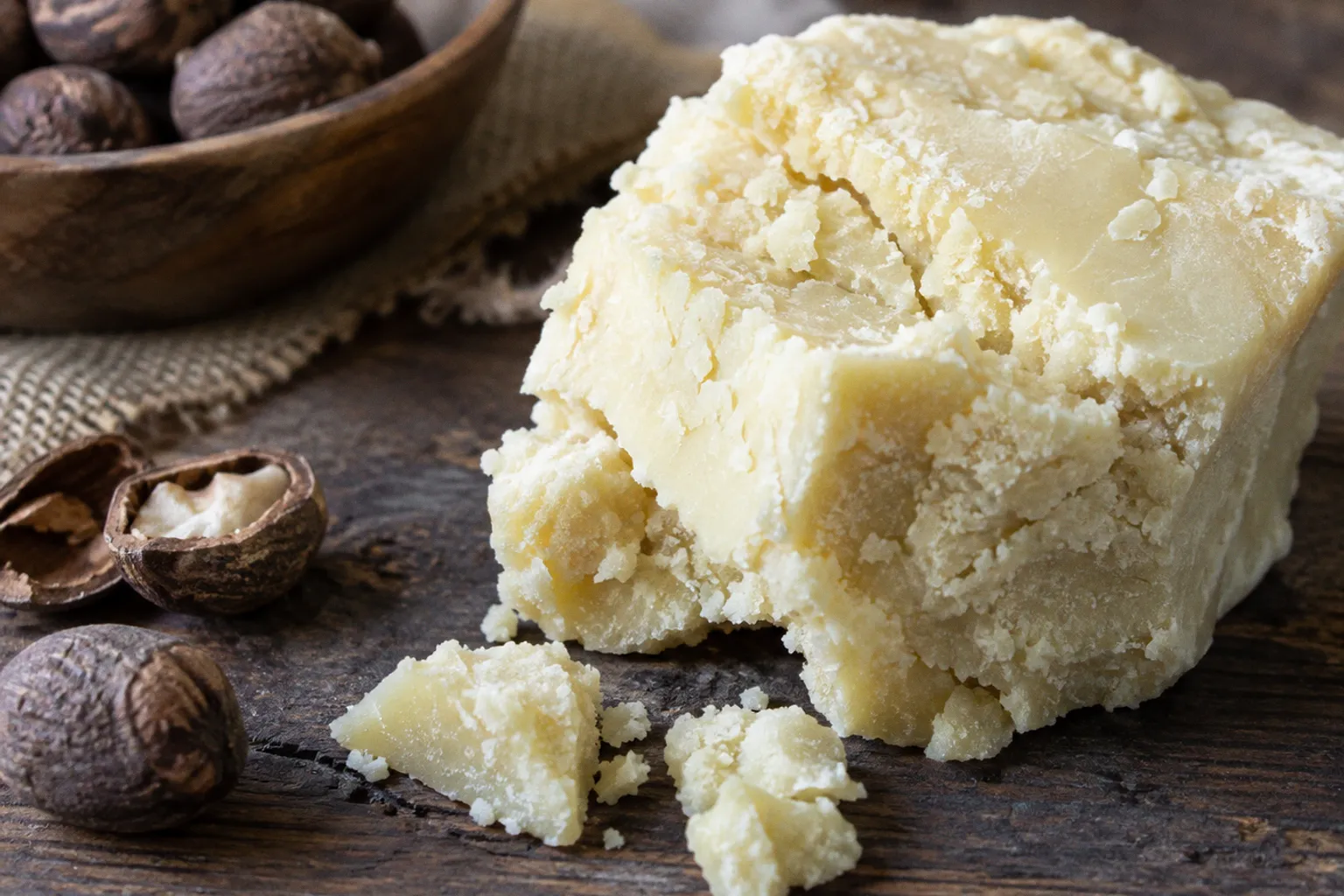
Reliable unrefined shea butter quality assessment requires several observations made together: color, scent, melting behavior, texture, processing grade, and sourcing information.
The material is produced from the kernel of Vitellaria paradoxa, also known by the botanical synonyms Butyrospermum paradoxum and Butyrospermum parkii. In traditional processing, the kernels are cracked, roasted, ground into a paste, kneaded with water, and boiled so the fat separates. Each stage affects the final appearance, odor, and physical behavior.
A home inspection can identify inconsistencies and obvious quality problems. It cannot establish complete chemical purity. Peroxide value, free fatty acid content, moisture, and insoluble impurities require laboratory analysis. The practical objective is therefore narrower: determine whether the product behaves like traditionally processed raw shea butter and whether the seller provides enough information to support that claim.
Step 1: Examine the natural color
Authentic raw shea butter does not have one fixed color. Natural variation is expected because the appearance depends on the kernel, the processing method, and the source material.
The normal range includes:
- Off-white and ivory.
- Beige and cream.
- Pale yellow or light yellow.
- Golden yellow in products naturally colored through botanical infusion, such as borututu root.
This range is more useful than a single color target. A buyer who expects all unrefined shea butter to be deep yellow may reject a legitimate batch. A buyer who assumes all white shea butter is raw may accept a processed product.
What stark white can indicate
A stark, uniform white appearance is a reason to investigate processing. Chemical refining and bleaching commonly remove or reduce the color associated with the original raw material. White shea butter is not automatically unusable, but it should not be presented as definitive evidence of an unrefined product.
Color also becomes less informative when the butter has been blended with other ingredients, deodorized, filtered, or exposed to processing that the label does not describe clearly. A finished balm may contain unrefined shea butter while showing a different color because of oils, waxes, pigments, or botanical extracts.
For a raw ingredient, inspect a clean sample under neutral light. Do not evaluate color through heavily tinted packaging. Compare the surface and the interior if the product is sold as a solid block. A naturally variable material may show slight variation across the batch. That is not the same as contamination or degradation.
Color is a screening parameter, not a certificate of authenticity. Uniform whiteness raises a processing question; natural yellow color does not answer every quality question.
What color cannot prove
Color does not establish:
- Exact botanical origin.
- Organic certification.
- Grade A status.
- Absence of oxidation.
- Absence of adulteration with another fat.
- Suitability for a particular formulation.
A pale product may still be correctly processed. A yellow product may have been colored, blended, or processed in a way that does not match the seller’s description. Use color as the first filter, then continue with the other four steps.
Step 2: Assess the characteristic scent
Raw shea butter usually has an earthy, mildly smoky, and nutty scent. The odor comes primarily from the traditional roasting of shea kernels over an open fire. This is one of the more useful differences between unrefined and heavily refined material.
The scent should be evaluated on a small amount of product at room temperature. Warm the sample between the fingertips only after first smelling it in its solid state. Heat changes volatility and can make the aroma more noticeable than it is in the finished ingredient.
A raw batch may have a recognizable roasted or nutty odor. The intensity can vary. A stronger scent does not automatically mean higher quality, and a weaker scent does not conclusively prove refining. Deodorization, filtration, storage, and batch variation all affect the olfactory profile.
How to interpret an odorless sample
Odorless shea butter should not be described as completely raw and unrefined without additional evidence. The absence of scent may result from refining or deodorization, although scent intensity alone cannot identify the exact process used.
The correct question is not whether the butter smells pleasant. Raw shea butter is not required to have a perfume-like aroma. The useful question is whether the odor is consistent with the claimed processing method.
Compare the label with the sensory result:
| Label or claim | Sensory result | Reasonable interpretation |
|---|---|---|
| Raw, unrefined, traditionally processed | Mild nutty or smoky scent | Consistent with the claim |
| Raw and unrefined | Completely odorless | Requires clarification about deodorization or refining |
| Refined | Very low odor and pale or white appearance | Consistent with a processed material |
| Unspecified processing | Any scent profile | Insufficient information; do not infer grade from odor alone |
When the scent becomes a concern
A raw butter can have a pronounced natural odor. That is different from an odor that is sharply abnormal for the product or changes substantially during storage. A sensory test can flag a batch for further investigation, but it cannot identify the specific cause of an off-odor.
Do not use fragrance as a correction for a raw ingredient when the product will be used in a formulation. Added fragrance can obscure the original profile and make later quality checks more difficult. In a laboratory or small production setting, record the initial odor when the container is opened. Batch notes are more useful than memory.
Step 3: Test melting behavior near skin temperature
Quality raw shea butter is solid at ordinary room temperature and melts into an oil when exposed to human skin heat. Its typical melting range is approximately 34°C to 38°C.
This is a practical physical test because it examines the material’s phase transition rather than its marketing description.
A simple tactile procedure
1. Take a small, clean sample from the center of the container.
2. Observe whether it is solid at room temperature.
3. Press it lightly between clean fingers.
4. Note whether it softens and begins to liquefy with skin contact.
5. Observe the resulting film rather than rubbing aggressively for several seconds.
A raw butter that softens around skin temperature is behaving consistently with its expected melting range. It should not remain rigid under normal finger pressure indefinitely. It also should not behave like a completely liquid oil at ordinary room temperature unless the ambient temperature is already close to the melting range or the product has been blended with another liquid ingredient.
The test is not a substitute for a controlled melting-point measurement. Room temperature, sample size, container material, and prior storage conditions all affect the result. A large cold block will take longer to soften than a thin shaving. This is a physical limitation of the test, not evidence of a different chemical identity.
Why melting behavior matters in formulation
The melting profile affects handling and finished-product structure. In a body butter, the butter contributes to firmness, spread, and the temperature at which the formula begins to soften. In a beard balm, it interacts with waxes and liquid carrier oils to determine whether the product remains stable in the container or becomes too soft during use.
A sample that melts near body temperature is not automatically superior to one that melts slightly differently. The relevant point is consistency with the declared ingredient and compatibility with the intended formulation.
Step 4: Separate texture defects from temperature history
Raw shea butter may develop a grainy texture. This is a physical phenomenon caused by uneven melting and cooling, often after shipping or exposure to temperature fluctuations. Graininess does not, by itself, indicate spoilage or loss of nutrient value.
The texture may range from smooth and dense to slightly granular. The surface can also become irregular when the butter partially melts and resolidifies inside the package.
A practical texture assessment
Evaluate three properties separately:
- Firmness: Does the butter remain solid at room temperature?
- Spread: Does it soften under skin heat?
- Uniformity: Does the sample feel smooth, slightly grainy, or contain hard foreign particles?
Fine graininess caused by thermal cycling is different from visible debris, packaging fragments, or insoluble material. Do not classify every non-smooth texture as contamination. Conversely, do not use the word natural to excuse material that contains visible foreign matter.
If the texture changes after a warm delivery or storage in a fluctuating environment, the first explanation should be thermal history. Allow the container to return to a stable room temperature before judging the final consistency. Repeated heating and cooling can alter the physical structure even when the butter has not spoiled.
Graininess and finished formulations
Graininess matters more in a leave-on product than in the raw ingredient container. Small crystals may remain perceptible in a body butter or balm if the formula is not cooled under controlled conditions. The issue is usually physical structure, not proof that the shea butter has lost its useful lipid fraction.
For small-batch formulation, the thermal process should be recorded. Note whether the butter was fully melted, how quickly it cooled, and whether the finished product was exposed to temperature changes. Without those records, it is easy to blame the raw material for a texture problem created during manufacturing.
Grainy shea butter is often a thermal-history problem. Treat it as a physical observation first, not as a verdict on freshness.
Step 5: Verify the grade and the supply chain
Sensory inspection can support a quality decision, but sourcing transparency provides the operational context. A credible supplier should identify the botanical material, processing status, and origin information with enough precision to distinguish raw, filtered, refined, or deodorized shea butter.
Two recognized reference systems are useful here:
- The Codex Alimentarius Regional Standard CXS 325R-2017 for unrefined shea butter.
- The American Shea Butter Institute grading system.
The ASBI grading system describes several categories:
| ASBI grade | General description |
|---|---|
| Grade A | Raw or unrefined |
| Grade B | Ivory or slightly filtered |
| Grade C | Yellow, naturally colored, or processed |
| Grade D | Gray |
| Grade F | The supplied research does not provide a complete description |
The grading language should not be treated as a replacement for the supplier’s full processing statement. Terms such as raw, unrefined, filtered, deodorized, and refined describe different levels of intervention. A product can be suitable for a formulation without being unrefined. The problem is inaccurate labeling, not processing itself.
Questions that distinguish a documented ingredient from a vague one
Before purchasing, look for information about:
- The botanical source: Vitellaria paradoxa or its accepted synonyms.
- Whether the kernels were traditionally hand-processed, mechanically processed, filtered, refined, or bleached.
- The country or region of origin.
- The production batch or lot.
- The storage conditions used before sale.
- Whether organic or field-sourcing claims are supported by documentation.
- Whether the supplier explains the expected color and scent variation.
Organic field sourcing has been associated with lower free fatty acid levels, lower peroxide values, lower moisture content, and lower insoluble impurities compared with butter derived from inorganic fields. These are chemical and operational quality parameters. They cannot be confirmed by looking at the product.
A supplier’s ethical sourcing information also has practical value. Traditional Grade A production in West Africa is commonly associated with manual processing stages such as cracking, open-fire roasting, grinding, kneading, and boiling. A transparent description of those stages gives the buyer a better basis for interpreting color and scent.
What a home test can and cannot establish
Testing shea butter purity at home is limited to sensory and physical screening. It can reveal contradictions between the product description and the material’s behavior. It cannot confirm the absence of adulteration or establish laboratory values.
A home assessment can reasonably evaluate:
1. Whether the color falls within a plausible natural range.
2. Whether the scent is consistent with traditionally roasted kernels.
3. Whether the butter is solid at room temperature.
4. Whether it melts with skin heat around the expected temperature range.
5. Whether graininess is present.
6. Whether the seller provides coherent processing and sourcing information.
It cannot reliably determine:
- Peroxide value.
- Free fatty acid level.
- Moisture content.
- Insoluble impurity content.
- Exact proportion of shea butter in a blend.
- Whether the material has been chemically altered without disclosure.
- Whether the product meets every legal or regional specification.
If the ingredient is intended for commercial production, laboratory documentation is the appropriate next step when the batch is critical. Sensory checks are useful for incoming inspection, but they should not be presented as chemical analysis.
Storage conditions and quality control
Raw shea butter should be protected from unnecessary heat and repeated temperature changes. Thermal cycling can produce graininess and alter the working texture. Keep the container closed between uses and store it in a stable environment rather than moving it repeatedly between hot and cold locations.
Record the condition of the material when it arrives:
- Date received.
- Batch or lot number.
- Color.
- Scent.
- Texture.
- Packaging condition.
- Storage location.
These records create a baseline. If the scent or texture changes later, the comparison is more reliable than an unrecorded impression. The approach is particularly useful for handmade skincare production, where the same raw ingredient may be used across multiple batches.
Signs associated with rancidity should not be reduced to one universal smell or color rule. Natural shea butter already has a nutty and mildly smoky odor, and color varies by source and processing. A meaningful evaluation compares the current batch with its original documented profile and, when necessary, uses laboratory measures such as peroxide value rather than relying on a generic online description.
A practical five-step decision sequence
For a small maker or ingredient buyer, the inspection can follow this order:
1. Read the processing claim. Confirm whether the product is described as raw, unrefined, filtered, refined, or deodorized.
2. Inspect the color. Accept natural variation from ivory and beige through pale or light yellow; investigate stark uniform whiteness.
3. Evaluate the scent. Look for the characteristic earthy, nutty, mildly smoky profile associated with roasted kernels.
4. Check melting and texture. The butter should be solid at room temperature, soften with skin heat, and may show graininess after thermal fluctuation.
5. Review sourcing evidence. Match the sensory profile with botanical identity, origin, processing description, grade terminology, and batch information.
No single step is decisive. A pale yellow color cannot compensate for unclear sourcing. A natural scent cannot prove purity. A smooth texture cannot establish Grade A status. Quality assessment is the convergence of several compatible observations.
Final verdict
Authentic unrefined shea butter is a variable natural fat, not a standardized white cosmetic base. Its color may range from ivory to yellow. Its scent may be nutty, earthy, or mildly smoky. It should remain solid at room temperature and melt near skin temperature, typically around 34°C to 38°C. Graininess may result from uneven cooling and does not automatically indicate spoilage.
The most defensible assessment combines sensory inspection with supplier documentation. Use the five steps to screen the material, but reserve claims about chemical purity for laboratory data. For formulation work, the correct standard is not the strongest marketing claim. It is a consistent raw material with transparent processing, traceable sourcing, and physical behavior that matches its description.