Turmeric Body Polish: Step-by-Step Exfoliation Routine
Most turmeric scrub sessions go wrong before the polish even reaches the skin. The common mistakes are predictable: too much pressure, no patch test, exfoliating immediately after shaving, or treating a body polish like an ordinary cleanser.
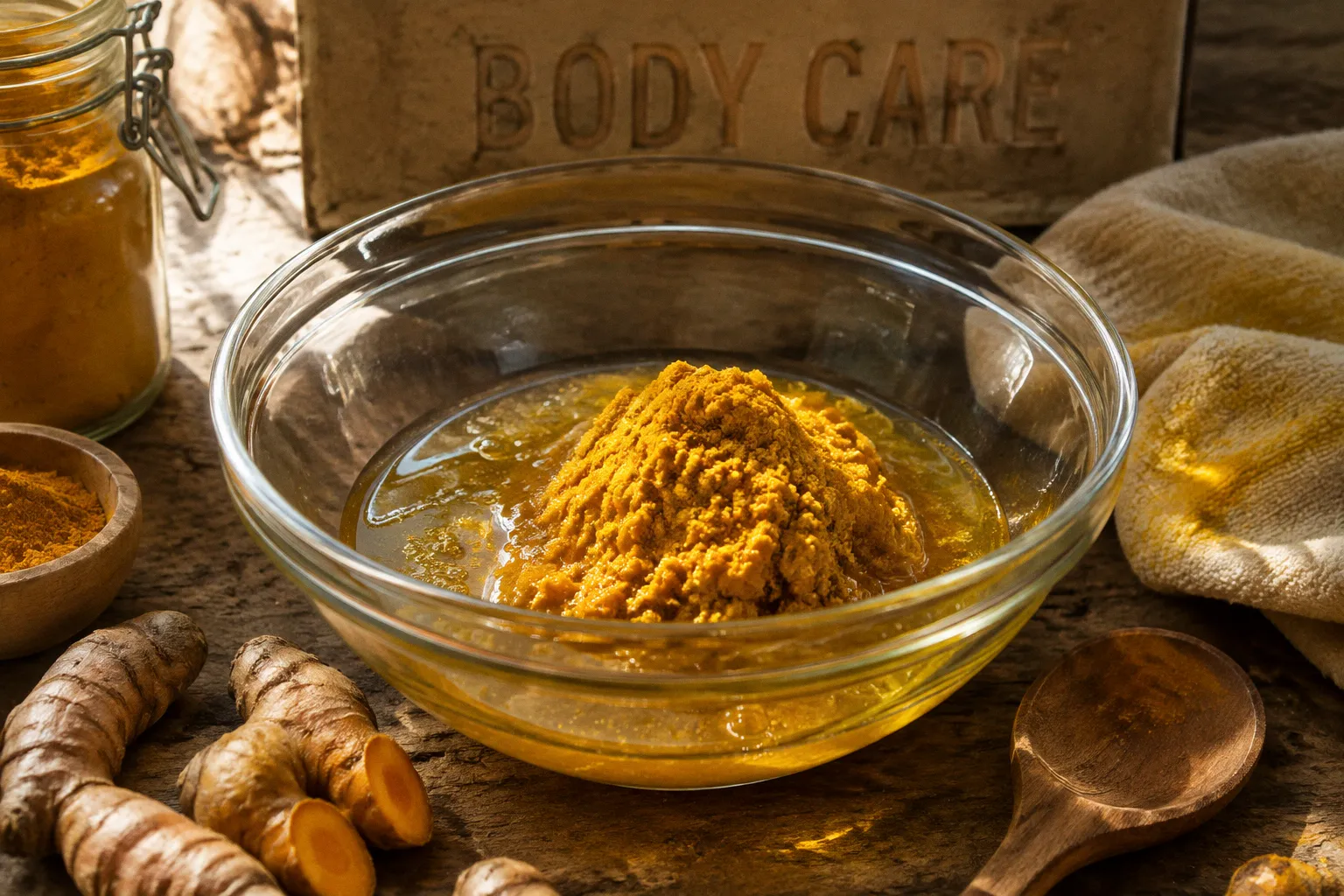
The result can be irritation, tightness, a yellow towel, or a breakout that gets blamed entirely on the turmeric.
The ingredient may be part of the problem, but technique matters just as much. A turmeric body polish can be a useful way to smooth dull, congested-looking skin on the arms, legs, chest, and back. The curcumin contributes the characteristic color and antioxidant properties; the sugar or salt base provides the physical exfoliation. Neither part needs aggressive handling.
Run the routine in the right order and the shower becomes simple: prepare the skin, cleanse, polish damp skin with controlled pressure, rinse thoroughly, then restore moisture. Skip those steps and you are more likely to end up with razor burn, a tight skin barrier, or a stained towel than a convincing glow.
Safety First: Patch Testing and Skin Readiness
Before a single grain of sugar touches your body, find out how your skin is likely to respond. Turmeric is tolerated well by many people, but a body polish is rarely made from turmeric alone. The formula may also contain essential oils, citrus extracts, honey, ginger, fragrance, or preservatives. Concentration and product quality matter too.
A patch test cannot predict every possible reaction, but it is a sensible first filter. Apply a small amount of the finished polish to the inner arm, just below the elbow, and leave the area alone. Watch for redness, itching, bumps, burning, or swelling over the next day. If the area reacts, rinse it off and do not move on to a full-body application.
The timing around shaving matters. Freshly shaved skin can be more reactive because shaving removes some surface cells and may leave tiny areas of irritation. Applying a gritty product immediately afterward adds friction to an already stressed surface. Wait until the skin feels calm again rather than following a rigid schedule. For many people, that means leaving roughly a day or two between shaving and exfoliating.
There are a few other situations in which the polish should stay in the jar:
- Active irritation or a rash: Do not use an exfoliant on skin that is already inflamed, itchy, or stinging.
- Sunburn: Scrubbing burned skin can worsen discomfort and delay recovery.
- Cuts, cracks, or broken skin: Salt, fragrance, and essential oils can sting, while the particles may create more mechanical irritation.
- Fresh waxing or other hair-removal treatments: Give the area time to settle before adding a scrub.
- Known sensitivity to the formula: If the product contains an ingredient you already avoid, turmeric does not make it safe.
If your skin is reactive and the formula is heavily fragranced or essential-oil based, do not try to rescue it by improvising with large amounts of body oil. A smaller test area and a gentler, fragrance-free product are safer approaches. Dilution can also change how the product spreads and how preservatives perform, particularly if you mix product inside the jar or store the altered mixture.
A patch test is not overcautious. It is a small interruption that can prevent a full-body reaction.
This preparation takes very little time, but it changes the entire risk profile of the routine. Exfoliation should begin with skin that is intact and reasonably calm, not skin that is already asking for less.
The Optimal Shower Sequence: Timing Your Exfoliation
The practical answer to the question of whether to use turmeric polish before or after soap is straightforward: cleanse first, then polish damp skin.
That sequence removes sweat, sunscreen, deodorant, and surface product before the abrasive step. It also avoids the rough dragging sensation that tends to happen when granules are worked over dry skin. Dry application is not automatically forbidden, but it is more intense and less forgiving, especially on thin or sensitive areas.
Use this order:
1. Warm the skin without overheating it. Stand under comfortably warm water for a couple of minutes. The goal is to soften surface buildup and make the polish easier to spread, not to leave the skin flushed or dehydrated.
2. Cleanse first. Use your usual body wash or soap to remove sweat, oil, sunscreen, and product residue. Rinse away the cleanser rather than layering the scrub over it.
3. Keep the skin damp. Step away from the direct stream or turn the water down. Pat off only excess water if needed; the skin should remain moist enough for the polish to glide.
4. Apply in sections. Start with one arm, leg, or another manageable area. This prevents the product from drying while you are still trying to distribute it.
5. Rinse completely. Do not leave the polish sitting on the skin as though it were a treatment mask unless the product instructions specifically say to do so.
The polish is an exfoliant, not a replacement for soap. Using it before cleansing can spread body oil and residue around rather than removing them. Using it after a short cleanse gives you better control over the amount of friction and makes the final rinse easier.
Some people prefer applying a scrub before entering the shower, particularly on very thick areas such as heels. That approach may feel more effective because the friction is stronger, but stronger is not the same as better. On dry skin, particles drag more, pressure tends to creep upward, and irritation becomes easier to create. If you try a pre-shower application, use a very small amount, keep the pressure light, and avoid treating the whole body that way.
| Application method | Where it can work | Main concern |
|---|---|---|
| Cleanse, then polish damp skin | Most arms, legs, chest, and back | The safest starting point for controlling friction |
| Polish dry skin before showering | Small areas of thick, rough skin | More drag and a greater chance of irritation or visible pigment |
| Polish after shaving | Generally not recommended immediately afterward | Freshly shaved skin may sting and react more easily |
| Use polish instead of soap | Not a substitute for cleansing | Exfoliation and washing perform different jobs |
The right method is the one that leaves the skin smooth without making it feel hot, tight, scraped, or unusually sensitive afterward.
Technique and Duration: Maximizing Curcumin Benefits
This is where most turmeric body polish routines are either made or ruined. People often scrub as if they are trying to remove paint from a wall. Body skin is more durable than facial skin, but it still has a protective barrier. A rough texture does not require rough treatment.
Use the flats of your palms rather than the tips of your fingers. Fingertips concentrate pressure in a small area and make it easy to dig into the skin. Palms distribute the product more evenly. Move in small circular motions, keeping the hand moving instead of pressing down in one spot.
The pressure should be firm enough for the granules to move across the surface, but gentle enough that the skin does not become visibly red from friction. If the polish contains salt, be particularly careful around shaving bumps, small cracks, and dry patches. Salt can sting compromised skin even when the formula itself is otherwise well tolerated.
Direction matters, but not in the way people often claim
Working in the direction of hair growth can make the routine more comfortable for people who are prone to irritation or shaving bumps. It may reduce unnecessary tugging around follicles. However, scrubbing against hair growth is not, by itself, a direct cause of ingrown hairs. Ingrown hairs are influenced by the way hair grows back, follicle shape, hair texture, shaving and waxing habits, and skin inflammation.
So use direction as a comfort adjustment, not as a hard rule or a promise. On the legs, many people find it comfortable to work from the ankle toward the knee. On the arms, wrist to shoulder is a reasonable starting direction. Around the bikini line, knees, and the backs of the upper arms, reduce pressure and use fewer passes. These areas can become irritated more easily, and vigorous scrubbing will not solve every form of bump or congestion.
The same principle applies to beard care: start with the grain when the goal is to reduce pulling and irritation, then decide whether any additional work is actually necessary. Skin does not need to be challenged to prove that the product is working.
How long should you polish each zone?
A short, controlled pass is enough. As a working guide, spend roughly half a minute to one minute on a larger body zone, adjusting for area size and sensitivity. That is not a timer you must obey to the second. It is a guardrail against turning exfoliation into a prolonged abrasion session.
| Body zone | Approximate working time | Pressure |
|---|---|---|
| Each arm | 30–45 seconds | Light to moderate |
| Each leg | 45–60 seconds | Light to moderate |
| Chest or stomach | 30–45 seconds | Light |
| Back | 45–60 seconds | Light to moderate |
| Feet and heels | Up to 60 seconds | Moderate, without scraping |
Stop earlier if the skin begins to sting, feel hot, or look increasingly red. Do not keep polishing a rough patch in the hope that more passes will make it disappear. Roughness can come from dehydration, follicular plugging, irritation, or an underlying skin condition. A scrub only addresses surface buildup and should not be used as a diagnosis.
Rinse with comfortably warm water until no gritty residue remains. Pay extra attention to elbows, knees, ankles, and heels, where product can collect in folds and dry patches. Leaving a turmeric polish to dry on the skin can make the temporary yellow cast more noticeable and may leave the surface feeling tight.
The goal is controlled contact, not maximum friction. If your skin looks and feels punished, the technique has already gone too far.
Managing Pigment: Preventing Staining on Skin and Fabrics
Curcumin is a strong natural pigment. That is why turmeric can temporarily tint skin and mark towels, clothing, bath mats, and other fabrics. It is not accurate to say that staining is purely a technique problem. Technique determines how much residue remains and where it ends up, but the pigment itself can stain.
The risk is usually more noticeable on pale fabrics and on dry, rough areas of skin such as the elbows, knees, ankles, and heels. A temporary yellow cast does not necessarily mean the skin has been damaged. It usually means some product remains on the surface or has collected in textured areas.
Control it at the rinse stage:
- Rinse until the water is clear. Pay attention to creases, knees, ankles, and the backs of the elbows rather than rinsing only the broad surfaces.
- Use an older or darker towel. Pat the skin dry instead of rubbing it aggressively. Rubbing can move leftover pigment deeper into the towel fibers and create more friction on freshly exfoliated skin.
- Keep a dedicated towel for colored products. This is particularly useful if you use turmeric polish regularly or make your own body-care products.
- Treat a stained towel promptly. Follow the care label and wash with regular detergent. Avoid assuming that more heat will help; heat can make some pigment stains harder to remove. A cold or cool initial rinse is often a sensible first step.
- Change into washable sleepwear. Pale robes and white bedding are not the best match for a product that contains a vivid botanical pigment.
- Do not scrub yellow skin harder. If a faint tint remains, give it time to fade or use a gentle cleanser or oil-based cleanser on the area. Repeated abrasive passes are more likely to irritate than to improve the color.
The cleanest routine is not necessarily the one with the least turmeric. It is the one in which you use enough product to cover the area, keep the application controlled, and take the final rinse seriously.
There is also a practical difference between a temporary surface tint and persistent discoloration. A yellow cast that gradually fades after washing is generally a residue issue. Dark marks that remain, spread, or change in texture are not something to treat by increasing scrub frequency. Those may reflect post-inflammatory pigmentation or another skin concern and deserve a different approach.
Post-Scrub Care: Hydration and UV Protection
After exfoliation, the skin often feels unusually smooth because some surface buildup has been removed. That smooth feeling is not a reason to leave the skin bare. The next step is to reduce moisture loss and avoid adding unnecessary irritation.
Moisturize while the skin is still slightly damp
Pat dry rather than rubbing. Within a few minutes, apply a body lotion, cream, butter, or oil that suits your skin. A cream or lotion containing humectants and emollients can help restore a comfortable feel; a body oil or balm can be layered over it when the skin is very dry.
Whipped shea butter, cocoa butter blends, jojoba oil, sweet almond oil, and marula oil are all common choices, but the best product is the one your skin already tolerates. There is no advantage in applying the richest formula available if it is fragranced, pore-clogging for you, or likely to cause heat and irritation.
Pay attention to how the skin feels over the next several hours:
- Tightness or flaking suggests the session was too intense, too frequent, or followed by insufficient moisturization.
- Persistent burning or redness is a reason to stop using the product until the skin settles.
- New bumps may indicate irritation or a reaction to another ingredient in the formula rather than a need for more exfoliation.
Keep the rest of the routine quiet
The same evening is not the time to stack multiple active products on the polished areas. Avoid applying retinoids, strong exfoliating acids, or heavily fragranced products immediately afterward if your skin is sensitive. Essential-oil blends can also sting freshly exfoliated skin, particularly when they contain citrus, cinnamon, peppermint, or other potentially irritating ingredients.
This is not because every active ingredient is automatically unsafe. It is because combining several sources of irritation makes it difficult to tell what your skin can tolerate. A simple moisturizer gives the skin a clearer recovery window.
Use sun protection on exposed areas
Exfoliated skin should be protected from unnecessary sun exposure. If your arms, chest, shoulders, legs, or another polished area will be outdoors, apply a broad-spectrum sunscreen with SPF 30 or higher according to the product directions and reapply when needed. Clothing and shade provide additional protection.
Do not treat SPF as a way to make aggressive exfoliation safe. Sunscreen cannot cancel out a damaged barrier or prevent all irritation. It is simply part of sensible aftercare when freshly exfoliated skin will see daylight.
Turmeric itself should not be described as a guaranteed photosensitizer. The more reliable concern is that exfoliation can leave skin more reactive, while sun exposure can worsen redness and contribute to unwanted pigmentation. Protect the area because the skin has been exfoliated, not because the ingredient creates a fixed rule for every user.
How Often to Actually Do This
Routine beats intensity. Most body skin does not need daily polishing, and daily use can turn a cosmetic step into a source of dryness and irritation.
A reasonable starting rhythm looks like this:
- Normal or oilier body skin: Begin with once or twice a week, leaving recovery days between sessions. Increase only if the skin remains comfortable and shows no persistent redness or tightness.
- Dry or mature skin: Once a week is often enough. A richer moisturizer may do more for the finished look than a second round of scrubbing.
- Sensitive or reactive skin: Start every seven to ten days. Keep the pressure light and use a simpler, fragrance-free formula where possible.
- Areas prone to bumps: Treat the area gently and judge the result by reduced irritation, not by how aggressively you can work the product in.
These are starting points, not performance targets. If your skin becomes tight, shiny in an unnatural way, flaky, itchy, or tender, reduce the frequency or stop until the barrier feels normal again.
More polish does not equal more brightening. Repeated friction can create irritation, and irritation may leave behind the uneven tone you were trying to improve. Consistency means using a tolerable amount at a tolerable interval, not forcing the skin to keep up with an arbitrary schedule.
Common Mistakes That Wreck the Routine
The same errors appear again and again:
- Scrubbing immediately after shaving or waxing: Give the area time to calm down.
- Using the polish as a daily cleanser: A scrub removes surface buildup; it is not a substitute for washing.
- Applying it to dry, irritated skin: Damp application gives you more control and usually reduces drag.
- Pressing harder when the skin still feels rough: Roughness is not proof that the product needs more force.
- Scrubbing against the hair direction with excessive pressure: Direction may affect comfort, but aggressive friction is the real problem to avoid.
- Leaving the polish on as a mask: Unless the product is specifically formulated and labeled for leave-on use, rinse it away.
- Skipping the final rinse: Residue can increase temporary yellow tint and leave the skin feeling gritty.
- Following with several active products: Keep post-scrub care simple, especially during the first uses.
- Skipping sun protection on exposed areas: Freshly exfoliated skin does not need additional avoidable stress from direct sunlight.
- Keeping a sugar-based scrub in a wet shower: Water introduced into the jar can affect texture and product stability. Keep the lid closed and store the container away from the direct spray.
- Sharing a jar or dipping wet hands into it: Use clean, dry hands or a clean scoop to limit contamination.
Routine beats intensity. A couple of well-spaced sessions will usually serve your skin better than daily scrubbing with increasingly heavy pressure.
The Hard-and-Fast Rule
If you take one thing from this, use the sequence rather than chasing a stronger sensation: patch test first, cleanse before polishing, apply to damp skin, use your palms and moderate pressure, work in short sections, rinse until no residue remains, moisturize while the skin is slightly damp, and protect exposed areas with SPF 30 or higher.
Turmeric body polish is not complicated, but it is not a free pass to scrub harder either. Curcumin can temporarily stain skin and fabrics, so careful rinsing and sensible towels are part of the routine. Hair-growth direction can affect comfort, but it is not a simple cause of ingrown hairs. And no precise technique can compensate for using an exfoliant on sunburned, freshly shaved, or already irritated skin.
Handled with restraint, the polish can leave the body feeling smoother and looking more even. The result comes from a clean sequence and repeatable care, not from turning a shower into a sanding session.