After-Shower Body Oil: Key Formula Details to Check
Transepidermal water loss, or TEWL, is one of the most useful concepts for separating a functional body oil from an expensive scented lubricant. The distinction is simple: an oil does not hydrate skin by supplying water.
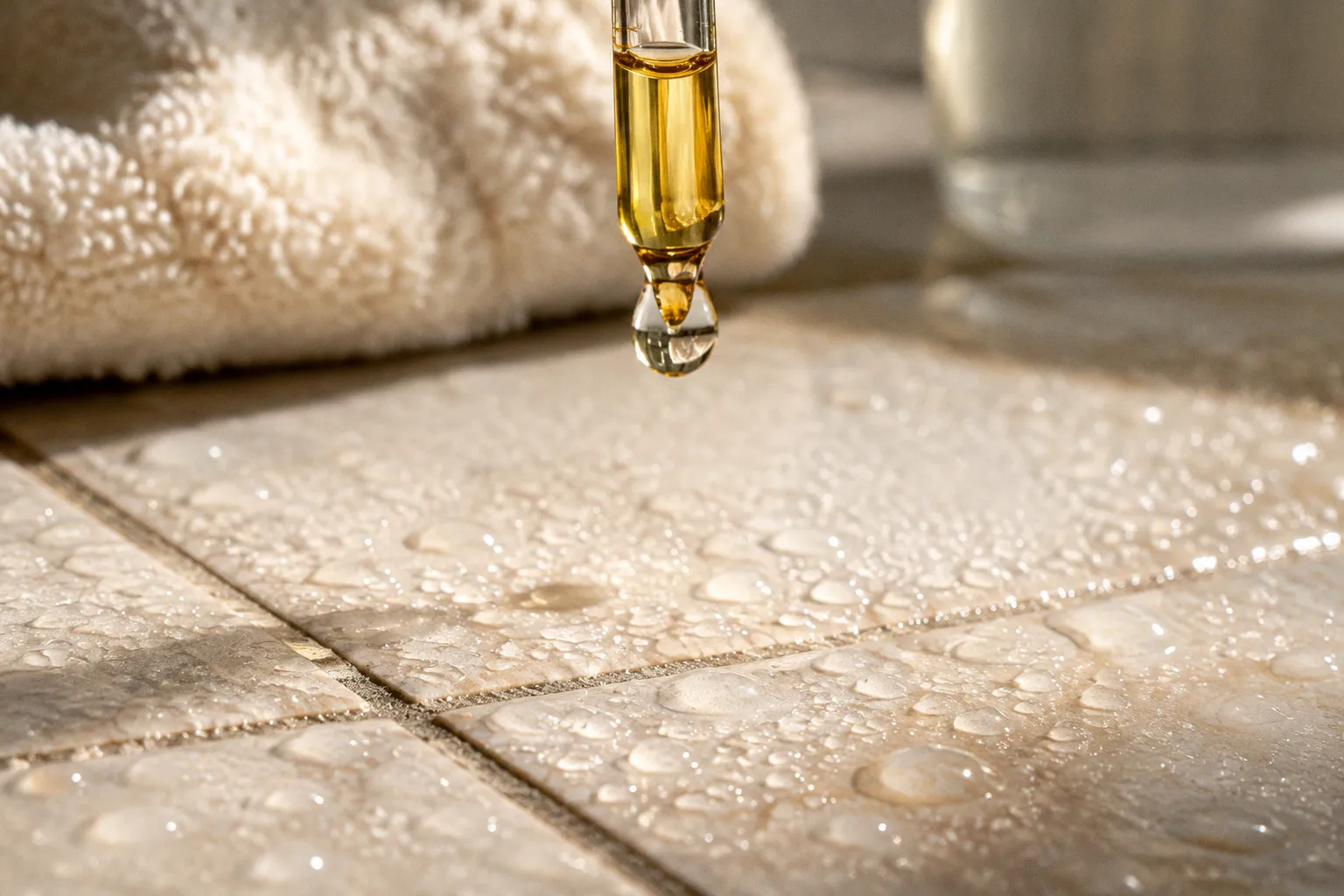
It helps slow the loss of water that is already present in the upper layers of the skin.
Immediately after a shower, the surface of the stratum corneum is hydrated. Applying an oil while the skin is still damp allows the oil to form a hydrophobic film over that water. The film does not create moisture and does not rebuild a damaged barrier overnight. It reduces evaporation and gives the outer skin layers more time to remain flexible.
That operational principle — occlusion over hydrated skin — defines the entire category of after-shower body oils. If a formulation fails at this basic task, every botanical extract and marketing claim layered on top becomes secondary. The more useful question is not whether a bottle contains a long list of luxurious oils. It is whether the formula can remain stable, spread evenly, limit water loss, and avoid irritating already-dry skin.
The Occlusive Mechanism: Why Damp Skin Matters for Oil Absorption
The stratum corneum, the outermost layer of human skin, is often described as a brick-and-mortar barrier. Corneocytes form the bricks; intercellular lipids, including ceramides, cholesterol, and free fatty acids, form the mortar. This structure is not inert. Its flexibility and barrier performance change with hydration, temperature, cleansing, and exposure to the surrounding environment.
After a shower, the outer layer has absorbed water and is temporarily more hydrated. That is the point at which an oil can do its most useful work. Spread across damp skin, it creates a continuous hydrophobic layer that slows the movement of water from the surface into the air. The oil is not expected to travel deep into the epidermis and replace the skin’s entire lipid matrix. Its immediate role is more modest and more mechanical: reduce the rate of water loss.
The result is familiar even when the chemistry is not. Skin feels less tight, looks less ashy, and remains smoother for longer. Dryness is not erased; it is managed by keeping the outer layer in a better-hydrated state.
There is no universal four- or six-minute deadline that applies to every body, shower, climate, or product. The practical window depends on how warm the water was, how thoroughly the skin was towel-dried, the humidity of the room, and how much exposed skin is involved. The useful rule is simply to apply the oil soon after showering, while the skin still feels slightly damp rather than waiting until it has become completely dry.
An oil applied to bone-dry skin later in the day can still soften the surface and reduce friction. It can make rough elbows, shins, and hands feel more comfortable. What it cannot do is recover water that has already evaporated. On dry skin, the product behaves primarily as an emollient and surface conditioner. On damp skin, it also functions as an occlusive layer.
The point is not to catch a precise number of minutes. It is to apply the oil while the shower’s water is still on the skin, not after the skin has already tightened and dried.
What the ingredient list confirms
A functional after-shower body oil usually combines ingredients with different spreading and staying powers. A very light ester may disappear quickly and feel elegant but offer limited persistence. A heavier oil or wax ester may remain on the surface longer but feel greasy if used without a lighter partner.
Common base materials include:
- Jojoba oil — technically a liquid wax ester rather than a conventional triglyceride oil. It has a dry, relatively elegant skin feel and contributes to a persistent surface film.
- Squalane — a saturated hydrocarbon commonly sourced from olive or sugarcane feedstocks. It is lightweight, highly oxidation-resistant, and useful when the formula needs slip without a heavy finish.
- Caprylic/Capric Triglyceride — a lightweight carrier often derived from coconut oil. It spreads quickly and helps dilute heavier materials, although it is not usually the strongest occlusive ingredient when used alone.
- Sunflower, safflower, hemp, rosehip, or other botanical oils — these contribute a particular fatty-acid profile and sensory character. Their stability depends heavily on the degree of unsaturation, refining, packaging, and antioxidant support.
- Esters used for dry touch — cosmetic esters can make an oil blend feel faster-absorbing and less sticky. They improve application, but a dry finish should not be confused with superior barrier performance.
A well-balanced dry skin body oil often pairs a persistent material such as jojoba with a faster-spreading carrier such as squalane or Caprylic/Capric Triglyceride. The objective is not maximum heaviness. It is enough surface residence to slow water loss without leaving the body coated in a film that makes clothing uncomfortable.
The amount applied matters as well. A small quantity spread over damp skin can feel richer than the same quantity applied to dry skin, because the water helps the product distribute across the surface. Pouring on more oil does not necessarily improve the result. It usually creates a stronger sensory impression of greasiness without proportionally increasing the benefit.
Decoding Lipid-Mimicking Ingredients: The Role of Jojoba and Barrier Additives
Jojoba oil is one of the most useful and most misrepresented ingredients in the body oil category. Marketing language often calls it the oil most similar to human skin. The idea points in the right direction, but the chemistry is more specific.
Jojoba is composed predominantly of wax esters: long-chain fatty acids joined to long-chain fatty alcohols. Sebum also contains wax esters, alongside squalene, triglycerides, free fatty acids, and other components. Jojoba therefore resembles one important fraction of the skin’s surface lipids; it does not reproduce the whole sebum profile and should not be treated as a complete substitute for the skin barrier.
That distinction does not make jojoba less useful. Its wax-ester structure contributes to a smooth, relatively non-sticky film, and its resistance to oxidation makes it a practical base for a product that may be opened repeatedly in a warm bathroom. It also tends to give a body oil more staying power than a very light ester alone.
The phrase “lipid-mimicking” needs similar care. A material can resemble a component of skin lipids without rebuilding the entire barrier. In a finished body oil, jojoba is primarily an emollient and occlusive-support ingredient. It improves feel and helps reduce surface water loss. That is valuable, but it is not the same as biological repair.
Barrier lipid additives: Ceramides, Cholesterol, and Phytosphingosine
Some more ambitious body oil formulas include Ceramide NP, Cholesterol, or Phytosphingosine. These materials belong to the same broad lipid system associated with the intercellular matrix of the stratum corneum. Their presence suggests that the formulator is attempting to offer more than a surface-softening effect.
The formulation challenge is substantial. Ceramides and phytosphingosine are not as easy to dissolve as liquid botanical oils. They are solid or waxy materials with limited solubility in a cool oil phase. A manufacturer must select a suitable solvent system, manage temperature, mix thoroughly, and ensure that the ingredients remain evenly distributed during storage.
This is where the difference between an ingredient list and a finished formula becomes important. Seeing Ceramide NP on the label does not automatically prove that the product delivers a meaningful barrier-support effect. The ingredient must be compatible with the rest of the formula, present in an appropriate amount, and dispersed consistently. A decorative addition at a very low level can sound more impressive than it performs.
| Additive | Why it is used | What the formula must solve |
|---|---|---|
| Ceramide NP | Supports a lipid profile associated with the skin barrier | Limited solubility and the risk of uneven distribution in a simple oil phase |
| Cholesterol | Complements ceramide- and fatty-acid-based barrier systems | Compatibility with the carrier oils, texture, and stability during storage |
| Phytosphingosine | Used in some barrier-oriented formulas as a skin-compatible lipid component | Slow dissolution and the need for consistent dispersion |
| Jojoba | Provides a persistent wax-ester film and a smooth skin feel | Balancing staying power with spreadability |
| Squalane | Adds slip, lightness, and oxidation resistance | Preventing the formula from becoming too thin or too quickly absorbed |
The label will not reveal the exact mixing temperature or the manufacturing protocol. It can, however, offer indirect clues. An oil that contains solid lipid additives should feel uniform rather than gritty, waxy, or visibly separated. Changes in texture over time, particles at the bottom of the bottle, or a formula that becomes lumpy in ordinary storage suggest that the system deserves caution.
A smooth appearance is not proof of efficacy, but instability is a clear problem. If a barrier additive settles out or crystallizes, the product may not deliver the same composition from the first application to the last.
Antioxidant Stability: Understanding Tocopherol Concentrations in Anhydrous Blends
Every oil-based product has an oxidation profile. The speed of oxidation depends on the fatty-acid composition of the carriers, the degree of refining, exposure to heat and light, oxygen in the headspace, and the presence of antioxidant support.
Oxidation gradually changes an oil’s smell, colour, and skin feel. In advanced stages, degradation products may also make a formula less comfortable on reactive skin. A body oil can remain visually acceptable while its aroma has already shifted from fresh and botanical to stale, waxy, or paint-like. Scent is not a perfect laboratory test, but an obvious change is a reason to stop using the product.
Tocopherol, commonly referred to as vitamin E, is widely used as an antioxidant in cosmetic oil blends. It helps interrupt the chain reactions involved in lipid oxidation. It is not a preservative, and it is not a guarantee that an unstable formula will remain fresh indefinitely.
The amount required depends on the formula. A blend dominated by stable saturated or monounsaturated materials has different needs from one built around fragile, polyunsaturated botanical oils. The type of tocopherol matters too: mixed tocopherols, natural tocopherol, and synthetic forms can have different compositions and technical roles. Tocopheryl Acetate is often used for a different purpose and should not be treated as interchangeable with free tocopherol when assessing antioxidant protection.
There is no single universal concentration that proves that an oil is adequately protected. A small amount may be technically useful, while a larger amount cannot compensate for poor packaging, excessive heat exposure, or a carrier blend that is inherently prone to oxidation. Claims based on a neat threshold should therefore be treated cautiously.
What the EU framework says
The EU Cosmetics Regulation, Regulation (EC) No. 1223/2009, provides the legal framework for cosmetic products placed on the EU market. It does not amount to a blanket declaration that any use of tocopherol is unrestricted or automatically safe in every formula.
Tocopherol use remains subject to the product’s cosmetic safety assessment, the intended conditions of use, the finished formula, and the manufacturer’s responsibility to ensure that the product is safe as marketed. The regulatory status of an ingredient should not be confused with a universal permission to use it at any concentration or in any application without assessment.
Tocopherol is generally used in oil formulas as an antioxidant rather than as a conventional preservative. That distinction is more important in practice than the marketing language around vitamin E.
Tocopherol helps keep oils from going rancid. It does not make a product immune to microbial contamination, poor packaging, or careless use.
Antioxidant and antimicrobial functions are separate. A product can be protected against lipid oxidation and still become contaminated if water enters the bottle, the dispenser is handled with wet hands, or the formula contains an unprotected water phase. Conversely, a product may be microbiologically low-risk but still develop an unpleasant oxidized odour.
How to read the label without overreading it
Cosmetic ingredient lists are presented in descending order of concentration, subject to the labelling rules that apply in the relevant market and to conventions for ingredients used at low levels. In a short oil blend, the position of Tocopherol can provide context, but it cannot reveal the exact amount or prove that the antioxidant system is adequate.
A formula with several stable carriers may need less antioxidant support than a formula built mainly on fragile unrefined oils. Botanical extracts can also complicate the picture. Some arrive in oil, some in glycerin or water, and some contribute their own stabilizers. The INCI list tells you what is present, not the complete manufacturing rationale.
Pay particular attention to the primary carriers:
- Jojoba and squalane are comparatively stable choices for a body oil intended to spend time in a bathroom.
- Rosehip, hemp, flax, and other polyunsaturated-rich oils can offer a desirable fatty-acid profile but are more vulnerable to oxidation.
- Refined oils may have a milder smell and longer practical stability, while unrefined oils retain more of their characteristic colour and aroma but require more careful handling.
- Essential oils and fragrance can mask early changes in the base, making smell a less reliable indicator of freshness.
Storage is part of the formula’s performance. Keep the bottle closed, away from direct sunlight and excessive heat. A pump or treatment-style dispenser can reduce repeated contact with air and wet hands. Clear packaging is not automatically unacceptable, but light-sensitive blends benefit from opaque, tinted, or otherwise protective containers.
The Science of Anhydrous Formulations: Why Preservatives Aren’t Required
An anhydrous body oil is a product with no intentionally added water phase. That characteristic has major consequences for microbial growth. Bacteria, yeasts, and moulds require available water to multiply. Pure oils do not provide the same environment as a water-based cream, lotion, or mist.
The relevant concept is water activity, written as aw. It describes how much water is available for microbial use, rather than simply how much total water a product contains. A genuinely water-free oil has very low water activity, so conventional broad-spectrum preservatives are generally not required to control microbial growth in the oil phase.
That does not make the product invulnerable. Contamination can still occur at the opening, on the dropper, around the cap, or through repeated contact with wet skin. The contamination may not multiply readily inside a truly anhydrous formula, but good manufacturing practice and sensible packaging still matter.
The distinction is straightforward:
- Preservatives control microbial growth.
- Antioxidants slow oxidation of oils.
- Packaging limits exposure to air, light, and accidental water.
These functions overlap in the consumer’s mind because all three affect shelf life, but they are not interchangeable. A bottle containing tocopherol is not necessarily preserved in the conventional antimicrobial sense. A bottle described as preservative-free is not necessarily making an impressive technical claim if it contains only oils and has no water phase to preserve.
Traditional petrolatum-based products illustrate the same principle. Their low available-water environment is one reason they do not require the same preservative strategy as a water-rich lotion. The absence of a preservative is a consequence of the formula, not proof that the product is purer or more advanced.
When the claim breaks down
The no-preservative logic applies only when the product is genuinely anhydrous and remains so in use. The ingredient list should be checked for water-phase materials such as Aqua, Aloe Barbadensis Leaf Juice, floral waters, hydrosols, or water-based botanical extracts.
A small amount of water can change the preservation problem even if the product still looks and feels like an oil. A formula containing water dispersed through an oil phase is not simply a pure oil blend; it may be an emulsion or another multiphase system that requires appropriate microbial protection and stability testing. The correct preservative strategy depends on the whole formula, not merely on whether the word lotion appears on the front label.
This is also why adding water at home is a bad idea. Mixing a body oil with wet hands, pouring it into a damp bath container, or combining it with aloe gel creates conditions the original manufacturer did not formulate or test. The resulting mixture may separate, spoil, or irritate the skin.
Evaluating Skin Barrier Recovery: Beyond Surface-Level Hydration
After-shower body oils are often sold under the language of dry-skin repair. That phrase can mean several different things: temporary relief from tightness, smoother-looking flakes, improved comfort, or actual restoration of barrier function. These outcomes should not be treated as identical.
A well-formulated oil reduces water loss from the stratum corneum. With repeated use, that can improve the appearance and feel of dry skin. Roughness may become less noticeable, scaling may soften, and clothing may cause less friction. These are real benefits, but they are primarily the result of improved hydration and lubrication at the surface.
The effect is also maintenance-dependent. If the product is stopped while the underlying cause of dryness remains — frequent hot showers, harsh surfactants, low humidity, friction, or a skin condition — the original symptoms may return. That does not mean the oil has failed. It means occlusion is a management strategy rather than a permanent biological repair.
True barrier recovery involves the skin producing and organizing its intercellular lipids, including ceramides, cholesterol, and fatty acids. It also depends on the removal of irritants and the reduction of repeated damage. A body oil can create more favourable hydration conditions and reduce friction while that process takes place, but it does not instruct the skin to rebuild itself simply because the bottle contains a prestigious botanical ingredient.
Occlusive body oils manage moisture loss at the surface. They support comfort and flexibility, but they should not be sold as a substitute for time, gentle cleansing, or treatment of an underlying skin disorder.
What distinguishes a repair-supportive formula
A body oil that aims to support barrier recovery rather than merely mask dryness may include several of the following characteristics:
1. Barrier-associated lipids — Ceramide NP, Cholesterol, or Phytosphingosine can indicate an attempt to support the skin’s lipid environment. Their presence is meaningful only if the formula keeps them stable and evenly dispersed.
2. A considered fatty-acid profile — The balance of saturated, monounsaturated, and polyunsaturated materials affects both skin feel and oxidation stability. No single ratio works for every body or every skin condition, so sweeping claims deserve caution.
3. Stable carrier oils — A formula using oxidation-resistant carriers, appropriate packaging, and antioxidant support is less likely to add stale-smelling degradation products to already-irritated skin.
4. Controlled fragrance exposure — Fragrance and essential-oil constituents such as linalool, limonene, and eugenol can be problematic for sensitized individuals, especially when the barrier is compromised.
5. A texture that encourages regular use — A theoretically sophisticated formula is not useful if it is so sticky that the user avoids applying it. Consistent application often matters more than a long ingredient list.
The absence of ceramides does not make a body oil useless. Most oils are designed primarily for occlusion and emollience, and they can perform that role well. The point is to match the claim to the formula. A product with jojoba and squalane may be an excellent after-shower oil without being a complete barrier-repair treatment.
The pH consideration
The skin’s surface is mildly acidic, but pure oil-phase products do not have a conventional aqueous pH. They contain no water phase in which hydrogen-ion activity can be measured in the same way as in a lotion, cleanser, or toner.
That means an anhydrous body oil generally does not shift skin pH in the same direct way a water-based product can. This can be useful for people who react to strongly fragranced or poorly tolerated aqueous products, although it does not make every oil suitable for sensitive skin. Fragrance, essential oils, oxidation products, and occlusion itself can still cause problems for some users.
The absence of a pH issue should not be mistaken for the absence of all irritation risk. It is one favourable property of anhydrous oils, not a universal safety certificate.
Selecting an After-Shower Body Oil: A Practical Evaluation Framework
Once the chemistry is clear, choosing an after shower body oil for dry skin becomes less dependent on luxury language. The useful questions concern the whole formula: what forms the base, how stable is it, what is added for function, and what might irritate compromised skin?
Confirm the product is genuinely anhydrous
Look for the absence of water-phase ingredients. Aqua, aloe juice, hydrosols, and some water-soluble extracts indicate that the formula may require a preservation system. If a product contains water but presents itself as a simple preservative-free oil, the claim deserves closer scrutiny.
Identify the primary carrier
The first ingredients usually reveal the product’s basic character. Jojoba and squalane suggest a stable, relatively elegant base. Caprylic/Capric Triglyceride suggests quick spreading and a lighter finish. A formula led by fragile, unrefined oils may offer a richer botanical profile but needs stronger attention to antioxidants, packaging, and storage.
Read tocopherol in context
Tocopherol can be useful, but its position alone is not a quality score. Consider which oils appear before it, whether the product uses a mixture of fragile carriers, and whether the packaging protects the blend from light and air. Tocopheryl Acetate should not automatically be counted as the same antioxidant support as free tocopherol.
Look for a coherent barrier strategy
Ceramide NP, Cholesterol, and Phytosphingosine may indicate a formula designed with barrier support in mind. Their absence is not disqualifying. A simple oil can still be effective for reducing surface dryness, especially when applied consistently to damp skin.
Screen fragrance according to the skin’s condition
For ordinary dry skin, fragrance may be a personal preference. For irritated, cracked, eczema-prone, or freshly exfoliated skin, it becomes a more consequential choice. “Botanical” does not mean non-irritating; essential oils contain volatile compounds that can be sensitizing, and natural fragrance materials can oxidize over time.
Assess packaging and use conditions
Opaque or tinted packaging is helpful for light-sensitive oils. A pump can be more hygienic and less exposed to wet hands than an open-neck bottle. The best packaging is also the one that allows the product to be used without repeatedly introducing water into the container.
Judge the finish on damp skin, not just on a paper description
“Fast absorbing” is not a complete performance claim. A product may disappear quickly because it contains volatile or highly spreading materials, while a more persistent oil may provide better protection against water loss. The useful test is whether the body feels comfortable after application, whether clothing can be put on without excessive residue, and whether the skin stays supple through the day.
A practical selection sequence looks like this:
1. Check whether the formula is truly water-free.
2. Identify the main carriers and their likely stability.
3. Look for antioxidant support without treating tocopherol as a preservative.
4. Decide whether barrier additives are relevant to the skin’s condition.
5. Screen fragrance and essential oils if the barrier is irritated.
6. Consider packaging, storage, and the amount of product needed per use.
7. Apply the oil to damp skin and judge the result by comfort and persistence rather than by the length of the ingredient list.
The Verdict
After-shower body oils are simple products with a specific mechanism: they help reduce transepidermal water loss when spread over recently washed, still-damp skin. Their value does not depend on dramatic claims about deep penetration. It depends on whether the formula creates a comfortable, stable, sufficiently persistent film without bringing unnecessary irritation or oxidation instability into the routine.
The best after shower body oil for dry skin is not automatically the one with the most botanical ingredients. A shorter formula built around stable carriers, sensible antioxidant support, protective packaging, and a tolerable finish may outperform a crowded blend assembled primarily for marketing appeal. Jojoba can provide wax-ester-based staying power; squalane can improve slip and stability; barrier-associated lipids can add formulation ambition. None of these ingredients, alone, turns a surface oil into a complete repair treatment.
Apply the product while the skin is still damp, store it away from heat and light, and read the label as a formula rather than a collection of promises. The shower supplies the water. The oil’s job is to help keep it there.