Handmade Balm Sweating: Causes and Simple Fixes
You've poured a batch of salve that looked flawless at the bench: smooth surface, glossy sheen, nice snap on the stick. Three days later, you crack a tin open and find a thin film of oil pooling on top.
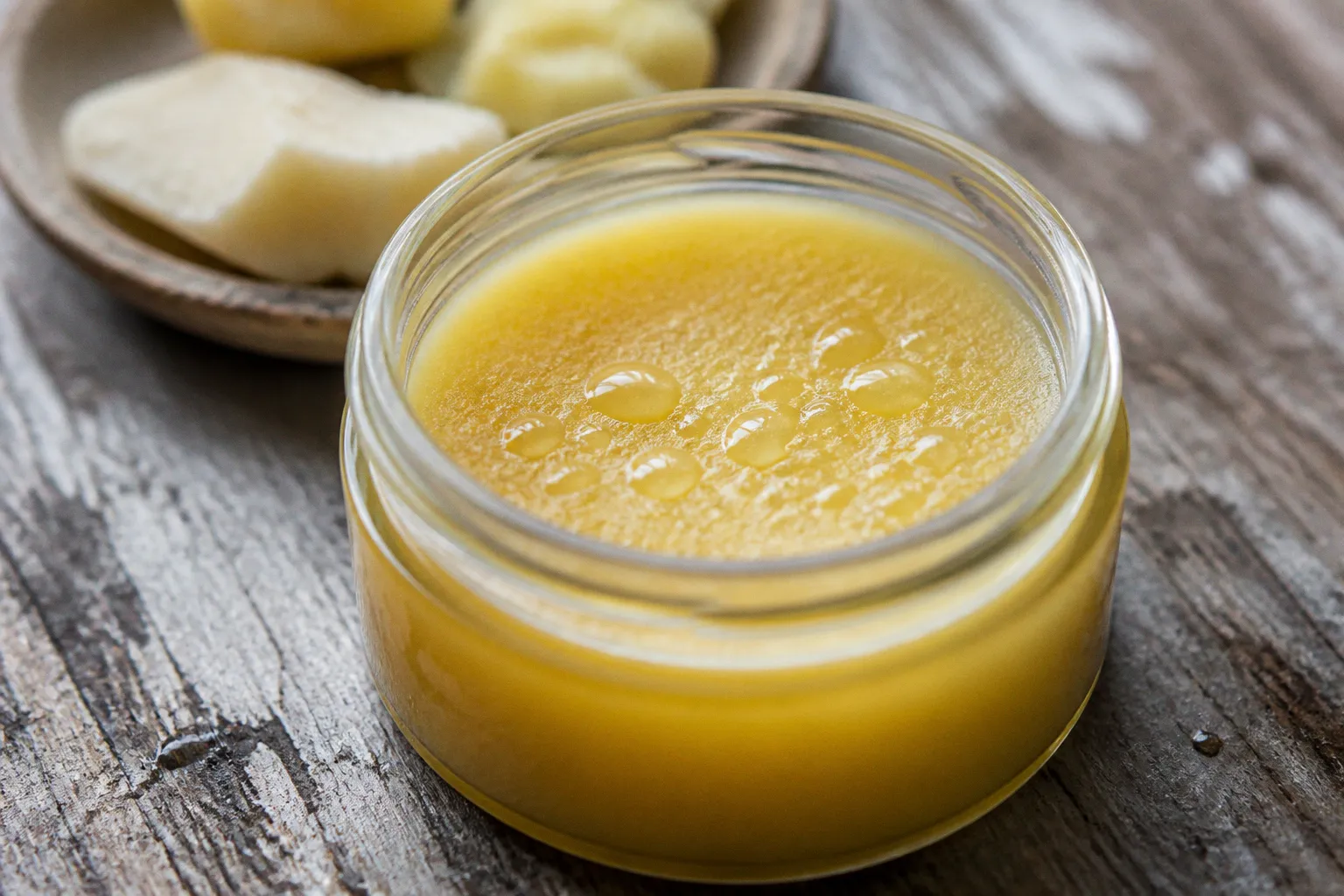
Maybe a week after that, the surface turns cloudy, then greasy, then outright weepy. That's not necessarily spoilage. That's your wax matrix giving up the liquid fraction it couldn't hold.
Formulators call this sweating, oil weeping, syneresis, or blooming. Whatever word you use, the symptom is the same: liquid oils migrate out of a solidified wax network and bead up on the surface. It's one of the most common defects in handmade balm, salve, and stick work, and it almost always traces back to three variables — oil load, wax selection, and thermal history.
The Science of Syneresis: Why Balms Weep
A finished balm isn't really a solid. It's a crystalline gel — a web of interlocking wax crystals that physically traps liquid oil inside its lattice. Think of the wax as a sponge at the molecular level: as the blend cools from roughly 75–80 °C down to room temperature, the higher-melting waxes crystallize first and build the structural skeleton, while the lower-melting and liquid oils get caught in whatever pockets remain. When that lattice is dense and well-matched, the oil stays put for the life of the product. When it isn't, the oil migrates.
Syneresis happens the moment internal oil pressure exceeds what the crystal network can retain. Day/night temperature swings are the usual trigger. As ambient temperature climbs toward 30 °C or higher — common in a sunlit windowsill, a hot shipping container, or a retail shelf without climate control — the wax crystals expand and loosen slightly. As the temperature drops at night, they contract again. That repeated breathing squeezes mobile oil phase toward the surface, where it beads up. The droplets you see are liquid oil that the matrix literally couldn't keep inside anymore.
If your balm sweats at room temperature, the wax lattice was already over-saturated when it set. Heat didn't cause the problem — it just exposed it.
Two things make this worse in handmade work. First, total lipid content in stick and tin formulas routinely runs 60–80% — oils, waxes, and plant butters combined. Second, small-batch makers usually rely on waxes alone for structure, without the rheology modifiers industrial cosmetics lean on. That leaves very little margin for error when the wax type, oil load, and ambient conditions don't line up.
The Role of Lipid Ratios and Structural Integrity
The single most common cause of balm sweating is too much liquid oil for the amount of solidifying wax in the formula. Stick and tin balms typically hold 60–70% total emollient. Push that load toward 45% pure liquid oils — fractionated coconut, sweet almond, jojoba, rosehip, meadowfoam — against a modest 15–20% wax content, and you've built a sponge with the holes bigger than the walls. The oil has nowhere to go but out.
Wax percentage matters, but wax type matters more. Beeswax gives a firm, somewhat brittle network that holds oil reasonably well at moderate temperatures. Candelilla wax builds a denser, harder matrix that grips liquid oil tighter, which is why vegan balms often tolerate higher oil loads before sweating starts. Carnauba is harder still, and a small percentage of it can firm up a soft blend noticeably — but use too much and you lose skin glide. Soft plant waxes like soy or sunflower set into weaker networks and tend to let oil escape faster under thermal cycling, especially in warm climates.
The other lever is pasty emollients — butters like shea, mango, cocoa, and kokum. These sit between true waxes and true liquid oils: solid at room temperature, soft enough to blend smoothly into the warm phase, but with enough crystalline structure to absorb and immobilize liquid oil in the matrix. Pulling roughly 30% of your lipid phase from pasty butters gives the wax network a second tier of oil-holding capacity. That's why swapping a portion of your liquid oil for shea or mango butter is usually the first fix a formulator reaches for when a batch starts weeping. The texture stays rich, the skin feel stays cushioned, and the lattice gets denser without going brittle.
Managing Polymorphic Butters and Thermal Stability
Shea butter and cocoa butter aren't just soft fats — they're polymorphic, meaning their crystals can exist in several different physical forms, and they shift between these forms over time and with temperature. The melting range for these butters sits roughly between 25 °C and 50 °C, which puts them right at the edge of normal ambient conditions in a warm kitchen, a sunlit shelf, or a shipping container in July. Polymorphism is also what causes the grainy texture you sometimes feel in a balm that started smooth — the butter has partially re-crystallized into a coarser form after the fact.
When a polymorphic butter cools too slowly, or goes through repeated heating and cooling cycles, its crystals settle into less stable arrangements. These metastable forms have looser packing, hold less oil, and tend to release that oil as visible droplets — what most people call fat bloom. You see it as a white, waxy haze on chocolate that hasn't been tempered properly; in balms, the same phenomenon shows up as greasy patches, surface cloudiness, or full-on weeping.
The fix is thermal discipline on the bench. Heat your entire oil and wax phase to a true 75–80 °C so every crystalline form melts completely, hold the melt briefly to even out temperature gradients, then cool under controlled conditions rather than letting it set wherever it sits. Rapid, even cooling produces smaller, more uniform crystals — a tighter lattice that holds oil better and resists blooming. If you suspect a batch is at risk, tempering the melted blend by holding it around 50 °C for 15–20 minutes before pouring can encourage the most stable crystal form to dominate and reduce later phase shifts.
Formulation Strategies to Lock in Liquid Emollients
Once you understand the cause, the fixes are practical and repeatable. Five levers, in roughly this order of impact:
- Raise the wax or pasty-butter content. Move 5–10% of your formula out of liquid oil and into beeswax, candelilla, or a soft butter. Watch the texture — you don't want a balm that snaps like a crayon — but a small bump in structural lipids usually stops sweating within a batch or two.
- Use a gelling thickener. If you can't afford to lose the silky skin feel of your current liquid oil load, add a structuring agent that holds oil without adding hardness. Glyceryl behenate, dextrin palmitate, and fumed silica are common picks in indie formulation. Even 1–2% can noticeably reduce weeping and improve the balm's resistance to thermal cycling.
- Swap the wax type. A blend of beeswax and candelilla (or a touch of carnauba) often outperforms pure beeswax, especially in vegan formulas or in warm climates. Different waxes crystallize into different lattice geometries, and a mixed network holds oil better than a single-wax network.
- Tighten your melt and cool protocol. Bring every component to a full 75–80 °C melt, hold briefly, and cool deliberately — an ice bath, chilled marble slab, or at minimum a room with steady 20 °C air. Avoid pouring into containers that haven't been pre-warmed; a cold tin wall can shock the surface layer into a different crystal form than the bulk.
- Adjust your storage and shipping. If your customers live somewhere warmer than where you formulate, build the formula for the climate they'll actually use it in, not the one on your bench. A balm that's stable at 18 °C can sweat at 32 °C even if everything else is dialed in.
The fastest single fix for a sweating balm is dropping 5% of your liquid oil and replacing it with shea or mango butter. Done.
Troubleshooting Your Batch: When to Adjust the Matrix
When a batch weeps, work through the diagnosis in this order before you scrap the formula. Stack one change at a time so you can actually learn what moved the needle.
| Symptom | Most likely cause | First adjustment |
|---|---|---|
| Surface oil in the first 24–48 hours | Liquid oil load too high for wax content | Reduce liquid oil 5%, add pasty butter |
| Weeping only after warm days or shipping | Thermal cycling, weak crystal lattice | Add gelling thickener, raise wax 2–3% |
| Greasy haze plus grainy texture | Polymorphic butter phase change | Improve melt/cool protocol, temper at 50 °C |
| Sweating at the rim only | Container cold-shock at pour | Pre-warm tins and jars to ~30 °C |
| Persistent oil after every fix above | Wax type mismatched to climate | Swap beeswax for candelilla blend |
If a single adjustment doesn't resolve the issue within the next batch, move to the next lever rather than stacking bigger changes on top of each other. Sweating rarely has more than one root cause in a given formula, and tracking which variable you moved lets you build a reliable formula library instead of guessing every time.
One more thing sweating is not: it is not, on its own, evidence of microbial spoilage, rancidity, or a batch gone bad. Because balms are anhydrous — containing no water phase — the conditions that support bacterial or mold growth are largely absent, which is why sweating by itself is generally a formulation issue rather than a contamination event. That said, the presence or absence of off-odors, unusual texture, or color change is not a reliable way to confirm a product is safe. If a batch has been handled in less-than-clean conditions, exposed to water or wet tools, or stored for an extended period, sweating could coincide with other degradation that you can't detect by smell or feel. When in doubt, set the batch aside from retail inventory. You can re-melt and correct the formula for personal use, adjust and repour into smaller sample tins, or rework it into a whipped body butter where the surface texture matters less than the slip — but don't assume structural weeping automatically means the product is fine to sell just because it looks and smells normal.
The Bottom Line
Handmade balm sweating is a structural problem, not a contamination problem. Your wax network is holding more liquid oil than it can physically retain, and heat, slow crystallization, or polymorphic phase shifts exposed the weakness. The fix is almost always one of three moves: tighten the wax-to-oil ratio, swap in a denser or mixed wax system, or add a gelling thickener to reinforce the lattice. Nail those three levers — and keep your melt and cool protocol honest — and you stop chasing oil beads across the lid of every batch.