Handmade Skincare Stability Testing: 4 Essential Steps
A cosmetic formula can remain visually acceptable while its preservative system, emulsion structure, fragrance profile, or packaging compatibility is already failing.
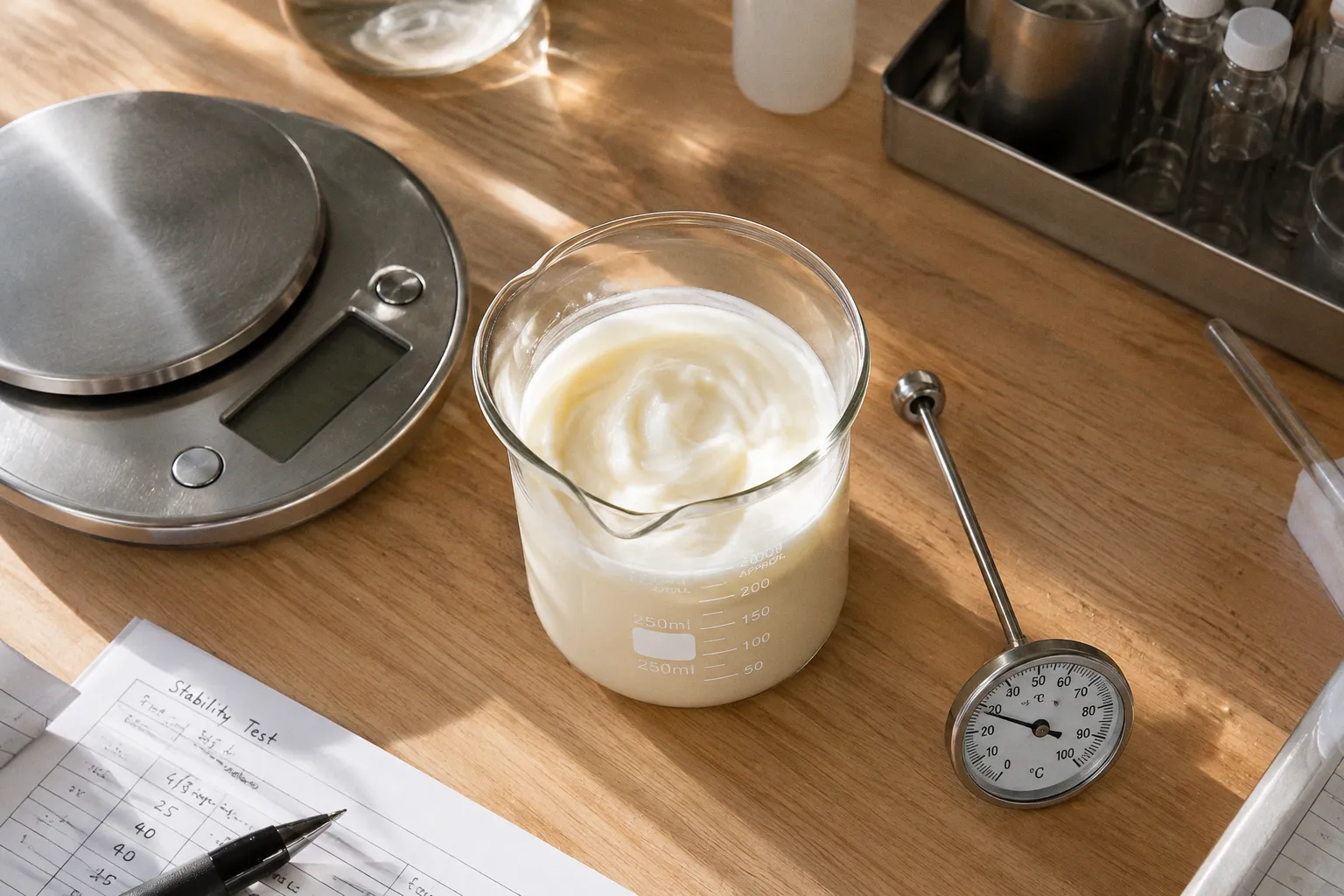
This is why a product that looks unchanged after two weeks on a workbench has not yet demonstrated a reliable shelf life.
Small batch skincare stability testing steps should therefore evaluate more than color and scent. A useful protocol examines physical structure, chemical drift, microbiological risk, temperature stress, and interaction between the formula and its container. These variables are related, but they do not produce the same failure pattern.
A water-based cream may separate during heat exposure. A balm may oxidize without changing viscosity. A botanical extract may alter color over time. A pump may absorb volatile fragrance compounds or leak after repeated temperature cycling. Each failure requires a different observation method.
Stability testing does not prove that a formula is safe indefinitely. It establishes how the formula behaves under defined conditions and where its limitations begin.
For small-batch formulators, the objective is not to reproduce every procedure used by a large manufacturer. The objective is to generate meaningful evidence before assigning a shelf life, selecting packaging, or releasing a product for sale.
Step 1: Define the Formula and the Test Conditions
Stability testing begins before the samples enter an incubator. The formula must be classified by its risk profile, and the test conditions must reflect the way the product will be stored and used.
An anhydrous lip balm, a preserved facial lotion, and a botanical hydrosol do not require identical testing. Their dominant failure mechanisms are different:
- Anhydrous products such as balms, body butters, oil serums, and beard oils are primarily vulnerable to oxidation, rancidity, fragrance loss, melting behavior, and container interaction.
- Emulsions such as creams and lotions can experience phase separation, viscosity change, pH drift, color variation, and preservative-system failure.
- Water-rich products such as toners, gels, mists, and hydrosols have a higher microbiological burden because water supports microbial growth.
- Products with suspended particles may develop sedimentation, clumping, or uneven distribution of pigments, powders, exfoliants, or botanical material.
- Bar soaps are comparatively low-risk from a microbiological perspective after adequate curing, but they still require assessment of moisture loss, cracking, sweating, scent retention, and packaging behavior.
A basic test design uses several sample groups rather than one sample kept at a single temperature. The exact design can be adapted to the formula. There is no universal protocol that applies equally to every small-batch product.
Establish a reference sample
Keep at least one sample under controlled ambient conditions. Around 25°C is commonly used as a room-temperature reference. This sample provides a baseline for comparison with heat-stressed and temperature-cycled samples.
Record the following before testing:
- Formula name and batch number.
- Production date.
- Complete ingredient list and percentages.
- Manufacturing process, including heating and cooling stages.
- Initial pH, where applicable.
- Initial viscosity or a defined flow observation.
- Fill weight or volume.
- Container type and closure.
- Preservative system, if the product contains water.
- Fragrance or essential-oil concentration.
- Appearance, color, odor, and texture at day zero.
A reference record prevents a common formulation error: interpreting a normal batch-to-batch variation as stability failure, or overlooking a gradual change because there is no documented starting point.
Use multiple samples from the same batch
One container can be defective. One filling event can introduce an air pocket. One jar can receive more headspace than the others. Replicate samples reduce the chance that a single container will determine the conclusion.
For each condition, use samples that represent the intended final packaging. Testing bulk formula in a glass beaker does not adequately predict how the product will behave in a plastic jar, aluminum tube, airless pump, or dropper bottle.
The product must be tested in the format the customer will actually receive.
Step 2: Run Accelerated Temperature and Freeze-Thaw Testing
Temperature stress reveals weaknesses faster than ordinary room-temperature storage. It does not provide a direct conversion from four weeks of heat exposure to a guaranteed expiration date. It is a screening method that helps identify likely instability mechanisms.
A commonly used accelerated condition is 40°C ± 2°C. Some protocols also use 45°C as a more aggressive stress condition. Samples may be evaluated over periods ranging from approximately four weeks to twelve weeks, while longer programs may extend across three to six months depending on the purpose of the study.
The test should compare stressed samples with the ambient reference rather than treating the high-temperature sample in isolation.
What heat can reveal
Elevated temperature may accelerate:
- Emulsion phase separation.
- Loss of viscosity.
- Increased viscosity or wax crystallization.
- Fragrance evaporation.
- Oxidation of unsaturated oils.
- Color changes in botanical extracts.
- pH movement.
- Container deformation.
- Leakage through closures or seals.
- Migration or absorption of ingredients into the package.
For an oil-based beard serum, odor is a major indicator. A rancid or stale odor can signal oxidation even when the liquid remains clear and fluid. For a cream, the more informative indicators may be viscosity, pH, separation, and changes in dispensing behavior.
The correct assessment depends on the formula. A single pass/fail observation is not sufficient.
Use a defined observation schedule
Examine the samples at regular intervals. The schedule can be weekly during the early phase, followed by less frequent observations if the formula remains stable. Each inspection should be recorded rather than described from memory.
A practical observation sheet includes:
- Color: unchanged, slightly shifted, or visibly altered.
- Odor: unchanged, weaker, sharper, rancid, or otherwise abnormal.
- Viscosity: measured if equipment is available; otherwise recorded using a repeatable flow method.
- pH: measured for water-containing products.
- Phase behavior: no separation, partial separation, oiling-out, sedimentation, or complete breakdown.
- Surface condition: sweating, crusting, bubbling, mold-like growth, or excessive drying.
- Dispensing: normal pump stroke, restricted opening, leakage, or inconsistent dose.
- Container condition: swelling, distortion, brittleness, corrosion, staining, or loss of closure integrity.
Terms such as “looks fine” are not useful laboratory records. They do not define the parameter, the degree of change, or the comparison point.
Add freeze-thaw cycling for emulsions
A handmade skincare freeze thaw test places the formula through repeated transitions between low and elevated temperatures. 5°C can be used as a low-temperature evaluation condition, followed by return to room temperature or a warmer condition. The objective is to expose emulsion systems to stress that may not appear during constant-temperature storage.
Freeze-thaw cycling can reveal:
- Irreversible phase separation.
- Large changes in viscosity.
- Graininess caused by wax or butter crystallization.
- Droplet coalescence.
- Water release.
- Cracking or collapse of gels.
- Changes in product flow after temperature recovery.
A product that thickens while cold and returns to its original consistency at room temperature has not necessarily failed. Reversible change is expected for some systems. Failure occurs when the structure does not recover, or when the product becomes visibly separated, gritty, watery, or otherwise inconsistent after the cycle.
For emulsions, evaluate the product after it returns to the reference temperature. Inspecting only the cold sample can confuse normal temperature-dependent viscosity change with permanent instability.
Heat exposes accelerated degradation. Freeze-thaw cycling exposes structural weakness. Neither test replaces the other.
Step 3: Measure Physical, Chemical, and Organoleptic Integrity
Temperature conditions create the stress. Measurements determine whether the formula has actually changed.
The most useful stability parameters are those that describe the product’s function and structure. A handmade cream may retain its color while losing its intended viscosity. A toner may remain clear while its pH shifts outside the range supported by its preservative system. A beard oil may dispense normally while oxidation has altered its odor.
pH
pH is relevant to water-based products, emulsions, gels, and other formulas containing an aqueous phase. It should be measured with a calibrated meter or a method appropriate to the formula. Test strips may provide a rough indication but are less precise for professional stability work.
Track the direction of change rather than focusing only on a single reading. A gradual pH drift can indicate chemical reactions, ingredient degradation, contamination, or interaction with the packaging.
The meaning of a pH value is formula-specific. There is no universal cosmetic pH that makes every product stable or suitable for skin. The target range must be connected to the ingredients, preservative system, emulsifier, active materials, and intended use.
Viscosity and flow
Viscosity affects application, suspension, dosing, and consumer perception. It is also a useful indicator of emulsion and gel structure.
If a rotational viscometer is available, record the instrument settings with the result. Spindle type, speed, temperature, and sample preparation affect the reading. A viscosity number without those conditions is difficult to compare.
For small-batch work without laboratory equipment, a defined flow test is more useful than a subjective description. For example, document the time required for a fixed amount of product to pass through a specified opening at a controlled temperature. The method is less sophisticated, but it can still identify a substantial change when performed consistently.
Color and odor
Color changes may result from oxidation, botanical instability, Maillard-type reactions, light exposure, or interaction with the container. Photographing samples under the same lighting and against the same background creates a stronger record than memory.
Odor evaluation is especially relevant to formulas rich in plant oils, essential oils, fragrance materials, or unsaturated lipids. Oxidation can produce an off-odor before any visible physical change occurs.
Do not mask a changed odor with additional fragrance during development. That alters the formula without resolving the underlying instability.
Phase separation and sedimentation
Inspect emulsions for:
- Oil droplets on the surface.
- Water release.
- A clear layer beneath the cream.
- Graininess.
- Collapse of the emulsion.
- Localized discoloration.
- Changes after shaking or gentle mixing.
A product that can be temporarily re-dispersed is not automatically stable. Record whether the change is reversible, how much mechanical force is required, and whether the product returns to a uniform state after standing.
For suspensions, examine the rate and character of sediment formation. A small amount of settling may be expected, but hard-packing at the bottom can make the product impossible to redisperse with ordinary use.
Build a comparison table
A compact record helps distinguish a cosmetic defect from a safety concern.
| Parameter | Stable result | Investigate further |
|---|---|---|
| Color | No meaningful change from the reference sample | Darkening, bleaching, uneven spots, or strong pigment migration |
| Odor | Characteristic odor remains consistent | Rancid, sour, sharp, metallic, or markedly weakened odor |
| pH | Remains within the formula’s defined target range | Progressive drift or sudden change |
| Viscosity | Similar flow and dispensing behavior | Watery separation, hardening, thinning, or inconsistent dosing |
| Emulsion structure | Uniform appearance after storage and recovery | Oiling-out, water release, curdling, or permanent separation |
| Container | No swelling, leakage, corrosion, or deformation | Seal failure, stress cracking, staining, or blocked dispenser |
| Microbiology | Meets the applicable safety requirements | Detection of specified pathogens or unacceptable microbial growth |
The table does not replace laboratory analysis. It organizes the evidence and indicates when a product should be removed from further development rather than released.
Step 4: Test Packaging Compatibility and Microbiological Safety
The formula and its container function as one system. A stable bulk formula can become unstable in the final package. This is common in small-batch production because packaging is often selected for appearance, cost, or availability before compatibility has been evaluated.
Packaging stability testing examines several forms of interaction:
- Ingredient absorption into the container.
- Chemical reaction between the formula and package material.
- Fragrance loss through the container or closure.
- Leakage around caps, pumps, liners, or seals.
- Corrosion of metal components.
- Container swelling, brittleness, or deformation.
- Discoloration or staining of the package.
- Changes in dispensing behavior.
- Increased air exposure during use.
Test the final container
Fill samples using the intended production method. Include the actual label, closure, liner, pump, dropper, or nozzle where these components affect the seal or dose.
A cream packaged in a wide-mouth jar experiences repeated exposure to air and contact with fingers. The same cream in an airless pump has a different oxygen and contamination profile. A beard oil in a dropper bottle has different contact points than the same oil in a metal tin.
Observe the package during temperature testing, not only after it ends. Leakage may occur at high temperature and disappear after cooling. A closure that seals at room temperature may lose integrity under expansion and contraction.
Microbiological screening
Microbiological risk is highest in products that contain water, botanical infusions, hydrosols, proteins, sugars, or other materials that can support microbial growth. Preservatives reduce that risk, but their performance depends on concentration, pH, formula composition, packaging, and manufacturing hygiene.
Screening commonly includes organisms such as:
- Pseudomonas aeruginosa.
- Staphylococcus aureus.
- Candida albicans.
For these specified pathogens, the relevant benchmark is that they must not be detectable in 0.1 g or 0.1 ml of product. Routine microbial testing may also evaluate total viable counts and yeast or mold levels, depending on the product and the laboratory protocol.
Visual inspection cannot confirm microbiological safety. A clear lotion can contain unacceptable microorganisms. A product with no visible mold can still fail laboratory analysis.
Home observation is therefore only a preliminary control. It does not replace professional microbiological testing, and it does not replace Preservative Efficacy Testing, also called challenge testing, for water-based formulas where such testing is required to validate the preservative system.
Do not confuse stability testing with challenge testing
These tests answer different questions:
- Stability testing: Does the product retain its physical, chemical, and packaging integrity over time and under stress?
- Microbiological screening: Are microorganisms present in the tested sample, and at what level?
- Preservative Efficacy Testing: Can the preservative system control deliberate microbial challenge under a defined laboratory method?
A formula can pass a visual stability review and still require additional preservative validation. Conversely, a product can have a robust preservative system but fail because its emulsion separates or its pump becomes incompatible with the formula.
Interpreting Results Without Overstating Shelf Life
Accelerated aging can shorten development time, but it cannot create a guaranteed mathematical expiration date on its own. A sample held at 40°C for four weeks has experienced a defined stress condition. It has not automatically demonstrated two years of room-temperature stability.
Real-time stability testing holds samples around 25°C for the intended shelf life. A 12-month real-time program provides substantially stronger evidence for a one-year claim than a short accelerated test alone. Packaging data and microbiological evidence remain necessary parts of the conclusion.
When reviewing results, classify each change by severity:
1. No meaningful change: The sample remains within the defined physical, chemical, and packaging limits.
2. Reversible change: The product changes under stress but returns to its original condition after recovery.
3. Progressive change: The formula continues to drift across test intervals.
4. Irreversible failure: Separation, rancidity, pH movement, leakage, contamination, or structural collapse remains after the sample returns to the reference condition.
A minor change in color may be acceptable for a botanical formula if it does not affect function, odor, safety, or consumer expectations. A small pH shift may be unacceptable if it reduces preservative performance or destabilizes an active ingredient. The interpretation must be linked to the formula’s design.
Typical formulation responses
If the formula fails, change one variable at a time where possible. Otherwise, the next test will not reveal which modification solved the problem.
Potential responses include:
- Revising the emulsifier or co-emulsifier system.
- Adjusting the oil phase and internal-to-external phase ratio.
- Replacing an oxidation-sensitive oil.
- Adding an appropriate antioxidant where technically justified.
- Revising the preservative system or its pH environment.
- Reducing water activity through formula design.
- Changing the container material or closure.
- Moving from a jar to a pump or airless package.
- Increasing process control during heating, homogenization, and cooling.
- Improving sanitation and batch handling procedures.
- Reducing exposure to light, oxygen, or repeated consumer contact.
Do not solve a packaging problem by reformulating the entire product before testing a compatible container. Likewise, do not increase preservative concentration as a first response to an emulsion that is physically separating. The failure mechanism should determine the intervention.
Equipment for a Small-Batch Stability Program
A home or micro-batch laboratory does not need every instrument used in industrial development, but it does need controlled conditions and repeatable records.
Useful equipment may include:
- Calibrated pH meter.
- Accurate scale for batch and sample preparation.
- Thermometer or temperature logger.
- Controlled refrigerator capable of approximately 5°C.
- Temperature-controlled incubator or oven for accelerated storage.
- Clean sample containers matching the final packaging.
- Labels resistant to heat and moisture.
- Camera or standardized photographic setup.
- Viscosity measurement equipment, if the product requires quantitative control.
- Access to a qualified microbiology laboratory.
Small benchtop incubator ovens for stability work may begin at approximately US $150, although the full cost of a reliable program is higher once temperature monitoring, calibration, sample containers, laboratory testing, and documentation are included.
An oven without a verified temperature profile is not a controlled stability chamber. Hot spots can create misleading results, especially in small containers. Place a temperature logger or independent thermometer in the chamber and document the actual conditions.
Common Errors in Handmade Skincare Stability Testing
Testing only the bulk formula
Bulk testing in a beaker ignores the package, headspace, closure, and dispensing mechanism. The final container must be part of the program.
Using a single temperature
Room-temperature storage alone may take months to reveal a problem. High-temperature storage alone may exaggerate a change that does not occur under normal use. A reference sample and stress conditions provide a more informative comparison.
Treating appearance as proof of safety
A product may look unchanged while microbial contamination or oxidation is developing. Visual inspection is necessary but insufficient.
Assigning a two-year shelf life after a short heat test
Accelerated data can support development decisions. It does not automatically justify a long expiration period. Real-time evidence, packaging compatibility, and microbiological validation are separate requirements.
Failing to record baseline data
Without initial pH, viscosity, color, odor, and appearance records, later observations remain subjective. The first sample evaluation is part of the test, not an optional note.
Testing a different formula from the one being sold
Changes in fragrance, botanical extract, preservative, oil, emulsifier, water phase, or process can alter stability. A stability conclusion applies only to the tested formula and manufacturing process.
A Practical Sequence for New Small-Batch Products
For a new handmade skincare formula, the most efficient order is usually:
1. Produce a controlled pilot batch with complete batch records.
2. Fill samples into the intended final packaging.
3. Document baseline appearance, odor, pH, viscosity, and fill weight.
4. Store reference samples around 25°C.
5. Expose additional samples to accelerated conditions around 40°C ± 2°C and, where appropriate, a stress condition around 45°C.
6. Run freeze-thaw cycles for emulsions, gels, and products vulnerable to low-temperature structural change.
7. Inspect samples at defined intervals and record changes using the same method each time.
8. Submit water-based products for appropriate microbiological analysis.
9. Evaluate package leakage, deformation, corrosion, dispensing, and fragrance retention.
10. Continue real-time storage for the intended shelf-life period.
11. Reformulate or repackage if the failure mechanism is identified.
12. Assign a shelf life only after the available evidence supports that decision.
This sequence is more defensible than relying on supplier claims, traditional use, or an informal smell test. It also makes the development process more efficient because each result points toward a specific formulation or packaging decision.
Final Verdict
Small batch skincare stability testing is not a single experiment. It is a controlled set of observations covering temperature stress, freeze-thaw resilience, physical and chemical integrity, packaging behavior, and microbiological safety.
The four essential steps are straightforward:
- Establish a reference sample and define the formula’s risk profile.
- Use accelerated temperature storage and freeze-thaw cycling where appropriate.
- Measure changes in pH, viscosity, color, odor, flow, and phase structure.
- Test the final packaging and obtain microbiological evidence for water-containing products.
The central limitation is equally straightforward: a short accelerated test can identify instability, but it cannot independently guarantee a long shelf life. For handmade and small-batch cosmetics, credible product dating comes from converging evidence rather than one attractive result. A formula is ready for release when its structure, chemistry, microbiology, packaging, and intended use all remain within defined limits—not merely when it still looks acceptable on the bench.