Soap Superfatting: What It Is and How It Works
When a cold process soap bar feels unexpectedly soft, leaves a film on the skin, or loses its lather long before it should, the cause may not be the fragrance, the cure time, or the choice of botanical additives.
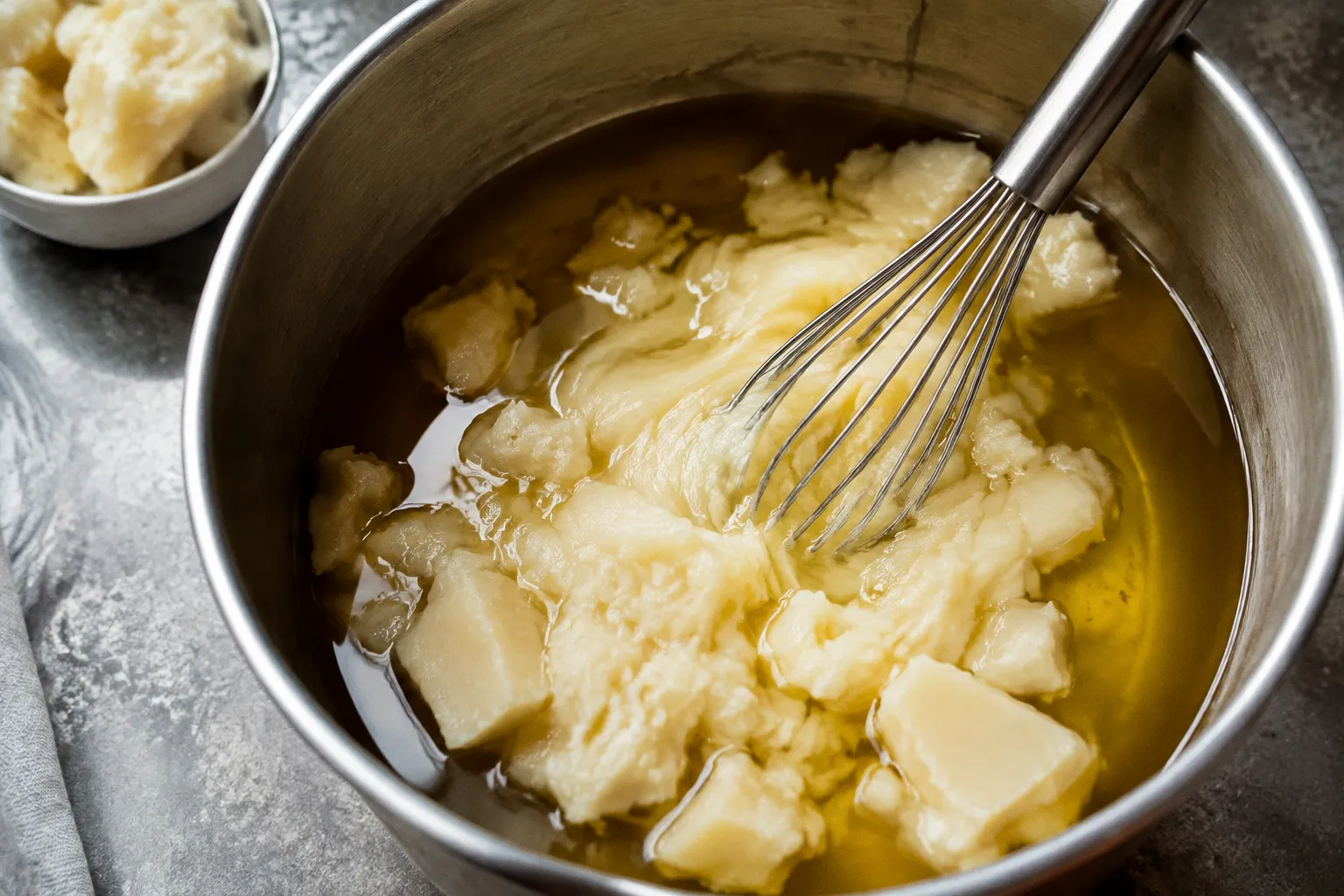
Often, the balance begins with the amount of oil deliberately left behind after the lye has done its work.
That balance is called superfatting in cold process soap. It is one of the quiet decisions that shapes the entire bathing experience: whether a bar feels creamy or squeaky, whether the skin feels comfortably clean or tight afterward, and whether the soap remains stable on the shelf.
I think of superfatting as the softness built into a recipe—not softness in the sense of a bar melting in the dish, but a measured generosity in the oil-to-lye ratio. Used thoughtfully, it can make a cleansing bar feel more enveloping and restorative. Used too freely, it can weaken the bar, mute its lather, and invite rancidity.
The chemistry of lye discounting and superfatting
Cold process soap begins with a simple but powerful reaction. Oils or butters are combined with sodium hydroxide, commonly called lye, and water. The lye reacts with the fatty acids in the oils through a process called saponification, creating soap and glycerin.
A recipe calculated for complete saponification would contain enough lye to react with the available oils according to their individual fatty acid profiles. In practice, most soapmakers do not formulate standard bars at that exact point. Instead, they reduce the amount of lye slightly, leaving a small portion of the oils unsaponified.
That reduction is known as a lye discount. The resulting percentage of unreacted oils is the superfat. Functionally, these terms describe the same adjustment:
- A lye discount refers to using less sodium hydroxide than full saponification would require.
- Superfatting refers to the excess oil remaining in the finished soap.
- Both describe the same oil-to-lye relationship in a cold process recipe.
So, what does superfat soap mean in practical terms? It means the bar has been formulated with more oil than the lye is intended to convert into soap. The finished bar is not simply a block of cleanser with added oil poured over it afterward. The excess is created by the recipe’s proportions from the beginning.
This is why accurate weighing matters so much. A digital scale and a reliable lye calculator are not decorative tools on a soapmaker’s workbench. They are part of the safety structure of the recipe. Sodium hydroxide is highly caustic before saponification, and the lye amount must be calculated for the exact oils and quantities being used.
Once the oils, water, and lye solution are combined, the reaction continues gradually over hours and then progresses during the cure. The oils are not neatly assigned individual roles in the pot. The lye interacts with the available fatty acid chains throughout the mixture.
Superfatting is not an oil added for luxury at the last moment; it is a measured change to the whole architecture of the recipe.
What happens to the oils during saponification
Each oil brings a different composition of fatty acids. Olive oil, coconut oil, cocoa butter, shea butter, castor oil, and other fats all behave differently in a bar because they contribute different qualities to the soap:
- Some support hardness and longevity.
- Some increase cleansing power.
- Some create a dense, creamy lather.
- Some help produce larger bubbles.
- Some contribute conditioning qualities before and after saponification.
The lye reacts with the mixture rather than politely selecting one oil and leaving another untouched. This matters because soapmaking advice sometimes suggests that adding a particular luxury oil at trace will guarantee that oil becomes the superfat. In cold process soap, that is not a dependable claim. Saponification happens slowly, and the lye remains active throughout the pot.
Adding rosehip, avocado, jojoba, or another expensive oil at trace may still influence the recipe in other ways, depending on its quantity and the formulation. But it does not ensure that the oil will remain intact as a distinct, untouched layer of skincare in the finished bar.
The more grounded approach is to formulate the entire oil blend with intention, then choose a superfat level that suits the cleansing profile and the way the bar will be used.
Why 5% is the usual starting point
For a typical cold process soap recipe made with a balanced blend of hard and soft oils, the most common superfat range is approximately 3% to 8%. A 5% superfat is widely used as the default setting in lye calculators because it offers a practical middle ground.
It does not attempt to make the bar exceptionally oily. It simply builds in a modest buffer so the recipe is not calculated at the sharp edge of complete lye consumption.
That buffer has two functions. First, it can reduce the likelihood of an overly harsh, lye-heavy bar if the recipe has been accurately calculated but the oils vary slightly in their fatty acid values. Second, it contributes to a more comfortable skin feel than a zero-superfat formula would generally provide.
A 5% superfat is not a guarantee that every bar will feel gentle on every body. Skin response depends on the entire formula, including the oil blend, water content, cure, fragrance or essential oils, washing frequency, water hardness, and how the bar is stored. A superfat percentage cannot compensate for an aggressively cleansing recipe or a bar that has been left sitting in water.
For a standard oil blend, the relationship looks like this:
| Superfat level | General effect in a balanced cold process bar | Main consideration |
|---|---|---|
| 0–2% | Leaner, more cleansing feel | Leaves little margin for formulation error and may feel harsh |
| 3–5% | Firm, balanced, and commonly used | Often a practical range for everyday bars |
| 6–8% | More cushion and a richer skin feel | May soften the bar and reduce some lather |
| Above 8–10% | Noticeably more excess oil | Greater risk of softness, dull lather, and rancidity |
These are formulation tendencies, not promises. Two bars with the same superfat percentage can feel entirely different if one is built around coconut oil and the other around olive oil and shea butter.
In weight terms, a 5% superfat is not a handful of oil floating freely in the finished bar. For a pound of soap, the difference may be roughly equivalent to 0.8 ounces of additional oil compared with a fully saponified calculation, depending on the recipe and how the calculation is expressed. The important point is proportionality: the superfat is part of the total formulation, not a separate moisturizing treatment sitting on top of the soap.
Why higher is not automatically better
The language of skincare can make “more moisturizing” sound like an uncomplicated improvement. Soap is less cooperative than that.
A bar with a higher superfat may feel creamier, but the extra oils also change its physical behavior. The bar may be softer, wear away faster, or produce less lively lather. In a warm, humid bathroom, these differences become especially noticeable if the soap is stored on a flat surface where water cannot drain.
Higher superfatting can also increase the risk of rancidity. The unreacted oils remain vulnerable to oxidation, and over time a poorly balanced or overly rich recipe may develop unpleasant orange discoloration and stale odors, often referred to by soapmakers as “dreaded orange spots,” or DOS.
This is one reason I prefer to think about superfat as a precise adjustment rather than a virtue to maximize. The aim is not to leave as much oil as possible in the bar. The aim is to leave an appropriate amount for the recipe’s cleansing strength, intended use, and storage conditions.
Adjusting the ratio for coconut oil
Coconut oil deserves separate attention because it is exceptionally cleansing in soap. A bar made with 100% coconut oil can feel very stripping at ordinary superfat levels, even when it has been properly made and fully cured.
For this reason, 100% coconut oil bars are commonly formulated with a much higher superfat, often around 15% to 20%. The additional unsaponified oil helps temper the powerful cleansing character of the recipe.
This does not mean that a high superfat is always required whenever coconut oil appears in a formula. A bar containing a moderate proportion of coconut oil alongside olive oil, tallow, palm, shea butter, cocoa butter, or other fats behaves differently from a bar made entirely from coconut oil.
The question is not simply, “How much superfat should soap have?” The better question is, “How cleansing is this particular oil blend, and what role will the bar play in the bathing ritual?”
A highly cleansing hand bar may need a different balance from a body bar. A soap intended for occasional use after gardening may be formulated differently from one used several times a day. A shaving bar, facial bar, and shower bar each ask something different from the lather and skin feel.
A practical way to think through a coconut-rich formula
When working with a coconut-heavy recipe, consider the following sequence:
1. Look at the total oil blend rather than one ingredient in isolation.
Coconut oil may provide firmness and abundant lather, but the other fats determine whether the final bar feels balanced or starkly cleansing.
2. Consider the area of use.
Hands, body, face, and beard have different tolerances. A formula that feels satisfying on hardworking hands may be too cleansing for facial skin.
3. Choose a superfat that supports the formula’s purpose.
The higher range used for a 100% coconut oil bar exists because the underlying cleansing profile is unusually strong. It should not be copied automatically into every recipe containing coconut oil.
4. Allow the bar to cure fully.
A fresh bar contains more water and has not yet developed its final hardness and lather. Judging the recipe too early can lead to unnecessary changes.
5. Store the bar where it can dry between uses.
Even a well-formulated bar will soften when repeatedly exposed to standing water.
Coconut oil illustrates a larger principle: superfatting does not work independently of the oils. It modifies the experience created by the whole formula.
The myth of adding luxury oils at trace
The idea of adding a precious oil at trace is appealing. It suggests that the oil will remain untouched, resting on the skin as a botanical gift after the more ordinary fats have become soap.
In cold process soap, the chemistry is less selective. Trace means the mixture has thickened enough to show that emulsification and saponification are progressing, but it does not mean the lye has finished reacting. The reaction continues for hours, and the lye interacts with oils across the mixture.
A luxury oil added at trace may influence the bar because it changes the overall oil balance. It may also carry a sensory or marketing role, especially when used in a carefully formulated recipe. But it cannot be reliably reserved as the designated superfat.
This distinction is useful when reading product descriptions. A handmade bar may contain argan oil, calendula-infused olive oil, oat oil, or another botanical ingredient, and those ingredients may be meaningful parts of the formulation. Still, the presence of a named oil does not prove that it remains in a fully intact, skin-conditioning state after saponification.
For the soapmaker, the lesson is straightforward: formulate the oils together, calculate the lye accurately, and treat superfatting as a percentage of the complete recipe.
Trace is not a magic boundary
Trace is often described as though the mixture crosses an invisible line and suddenly locks every ingredient into place. In reality, it is a visual stage in a moving reaction.
At light trace, the emulsion may still be fluid and pourable. At a thicker trace, it may hold the mark of a spatula or whisk. Neither stage creates a chemical guarantee that a particular oil will avoid saponification.
This is especially important with expensive oils. Adding more of them does not necessarily make a bar more restorative. Some delicate oils can shorten shelf life, soften the bar, or increase the potential for oxidation when used in large amounts.
A carefully chosen oil at a modest percentage, supported by a stable recipe and proper storage, is generally more sensible than adding a generous amount simply to create a luxurious ingredient list.
Managing the trade-offs: lather, stability, and shelf life
A good cold process bar is a set of relationships. Hardness, cleansing, conditioning, bubbly lather, creamy lather, longevity, and superfat all pull against one another to some degree.
Superfatting affects several of these qualities at once. As the percentage rises, the bar may feel more cushioned and less aggressively cleansing, but the additional oils can also reduce the clarity of the lather and make the bar softer.
The most common trade-offs include:
- Skin feel: More superfat can create a smoother, less squeaky after-feel, particularly in a strongly cleansing recipe.
- Bar hardness: Excess oil may leave the bar softer, especially when combined with a high proportion of liquid oils.
- Lather: Too much unreacted oil can suppress the brightness and volume of the lather.
- Longevity: A softer bar dissolves more quickly, particularly when it is not allowed to dry between uses.
- Stability: Higher superfat levels leave more oils available to oxidize over time.
- Storage demands: Richer bars benefit from a draining soap dish and a dry, well-ventilated place between baths.
This is why the benefits of superfatted soap for skin should be described with care. A superfatted bar may feel more comfortable, but it is not automatically better for every person or every use. A person with very dry-feeling skin may appreciate a balanced, creamy bar, while another may prefer a leaner formula that rinses cleanly and leaves less residue.
The sensory impression also depends on the water. Hard water can affect lather and leave mineral deposits, making a soap seem less effective or more coating than the recipe alone would suggest. Fragrance and essential oils may affect comfort as well, even when the superfat is appropriate.
The most restorative bar is not the richest one; it is the one whose cleansing strength, superfat, cure, and storage are quietly in agreement.
How to recognize an over-superfatted bar
No single symptom proves that the superfat is too high, but a combination of signs can point in that direction:
1. The bar stays unusually soft after a proper cure.
A high proportion of liquid oils, excess water, or poor storage can also contribute, so the superfat should be considered alongside the complete recipe.
2. The lather feels muted or collapses quickly.
Excess oils can weigh down the lather, especially in formulas that already have limited bubbly qualities.
3. The soap leaves an oily film rather than a comfortable finish.
Some skin types enjoy a cushiony feel, but a persistent greasy residue suggests the formula may be too rich for its purpose.
4. Orange spots or stale odors develop over time.
These may indicate oxidation. High superfat is one possible contributor, along with vulnerable oils, heat, light, moisture, or poor storage.
5. The bar disappears quickly in the shower.
Softness caused by excess unreacted oils can combine with standing water to shorten the life of the soap.
When a bar behaves this way, increasing the superfat further is unlikely to solve the problem. The better response is to review the oil blend, water amount, cure, fragrance choices, antioxidants if appropriate, and storage conditions.
Superfatting as part of a restorative bathing ritual
The technical side of soapmaking matters because it determines what happens in the hand and on the skin. A well-balanced bar should not require the bather to rush through the experience or compensate for the formula with a heavy layer of products afterward.
I like to begin with warm water rather than very hot water, letting the skin soften before lathering. The bar can be worked between wet hands or passed gently over a washcloth, depending on the formula and personal preference. A creamy lather is then spread across the body with slow, deliberate movements, giving areas of tension—shoulders, hands, the back of the neck—a little more time rather than more pressure.
An exfoliating bath glove or natural loofah can be useful occasionally, but it should not be used to force a “squeaky clean” result. Repeated vigorous scrubbing can leave the skin feeling tight regardless of the soap’s superfat level. The bar should do the cleansing; the hands should provide the ritual.
After rinsing, the soap needs a place to breathe. A slatted or draining dish is more than a decorative accessory. It protects the bar from becoming waterlogged, preserves its texture, and reduces waste. This is particularly valuable with higher-superfat recipes, which may be more susceptible to softness.
The same principle applies to other bath products. A mineral soak, botanical bath salt, or shower steamer can create a grounding atmosphere, but each has its own role. Superfatting belongs to the soap’s formulation; it is not interchangeable with adding bath oil, fragrance, or an after-bath moisturizer.
Choosing a sensible superfat percentage
For most balanced cold process soap recipes, beginning around 5% is a reasonable and widely used approach. From there, the recipe can be adjusted according to its oil blend and purpose.
A lower range may suit a bar that needs a firmer, cleaner-rinsing profile. A moderate range often works well for everyday body and hand soaps. A higher range can be appropriate for an unusually cleansing formula, such as one made entirely from coconut oil, where 15% to 20% is commonly used to soften the result.
The percentage should never be separated from the rest of the formulation. Before changing it, look at:
- The proportion of coconut oil and other highly cleansing fats.
- The balance between hard oils and liquid oils.
- Whether the bar is intended for hands, body, face, shaving, or occasional use.
- The expected cure time and storage conditions.
- The desired balance between bubbly and creamy lather.
- The freshness and stability of the oils being used.
A simple recipe change can alter several sensory qualities at once. Increasing the superfat may improve the initial skin feel while reducing hardness and shortening shelf life. Decreasing it may produce a longer-lasting bar while making the cleansing experience feel more pronounced.
There is no universal ideal—only a proportion that makes sense for the particular soap.
The final balance
Superfatting in cold process soap is the practice of reducing the lye amount so that a measured portion of oil remains unsaponified. In standard recipes, the most common working range is approximately 3% to 8%, with 5% serving as a practical default. Coconut-only bars are an important exception, often requiring a much higher superfat to temper their intense cleansing action.
The central point is balance. Superfatting and lye discounting are not separate techniques with different chemical results, and adding a luxury oil at trace does not reserve that oil as a guaranteed skincare ingredient. A higher percentage does not automatically create a superior bar, either.
The finest soap feels considered from the first touch: firm enough to hold its shape, creamy enough to make washing pleasant, cleansing without leaving the skin distressed, and stable enough to remain beautiful through its useful life. When the formula, cure, and storage are given equal attention, superfatting becomes what it should be—a quiet, restorative adjustment that supports the ritual rather than trying to carry the entire experience alone.