Mineral Bath Salts: Ingredients to Look For Before Buying
A genuine mineral bath salt has a simple formulation: a mineral compound should appear first in the ingredient list, before oils, surfactants, fragrance blends, or decorative additives.
If sodium laureth sulfate or a carrier oil leads the formula, the product is better classified as a bath soak or foaming bath product, not a straightforward mineral salt preparation.
This distinction matters because packaging language is often broader than the chemistry. Terms such as “natural,” “botanical,” and “detoxifying” describe positioning, not a verified formulation standard. The useful information is in the INCI list: the standardized ingredient declaration that shows what the product actually contains.
For most buyers, mineral bath salts quality ingredients come down to three questions:
- Which mineral base is present?
- Is the formula transparent and proportionate?
- Could the added fragrance, dye, or preservative irritate the skin?
The answers are more reliable than the front label.
The mineral foundation: Epsom, Dead Sea, and Himalayan salts
The word “salt” does not identify one chemical substance. In bath products, it can refer to magnesium sulfate, sodium chloride, or a mixture of mineral-rich salts. These materials differ in composition, solubility, texture, and likely skin feel.
Epsom salt: magnesium sulfate, not table salt
Epsom salt is magnesium sulfate. It is not sodium chloride, the compound commonly used as table salt. In a bath formula, it is usually listed as Magnesium Sulfate.
Its main advantage is compositional clarity. A product made primarily with Epsom salt can be easy to evaluate because the mineral base is chemically defined. The ingredient list should not need a long explanation to establish what the material is.
However, magnesium sulfate in bath water should not automatically be treated as a reliable systemic magnesium treatment. The exact percentage of magnesium absorbed through the skin during an individual bath session is not established for every person or bathing condition. Water temperature, duration, skin condition, concentration, and the quality of the evidence all matter.
That does not make Epsom salt irrelevant. It remains a practical bath ingredient with a predictable mineral identity. It simply means that claims about correcting magnesium deficiency or producing a measurable internal effect exceed what the label can prove.
Dead Sea salt: a mineral mixture
Dead Sea salt is not a single pure compound. It is a naturally occurring mineral mixture associated with salts from the Dead Sea and is known for containing minerals such as magnesium and potassium.
In an INCI list, the exact naming may vary according to the ingredient supplier and regional labeling conventions. A transparent product should identify the mineral base clearly rather than relying only on a geographic name on the front of the package.
Dead Sea salt can be useful in a botanical bath soak selection guide because it often forms the mineral component around which other ingredients are built. But the presence of a geographic name does not, by itself, establish purity. A formula can contain Dead Sea salt and still include synthetic perfume, artificial dyes, or unnecessary solvents.
The mineral source is one variable. The finished formula is another.
Pink Himalayan salt: broad mineral content, limited interpretation
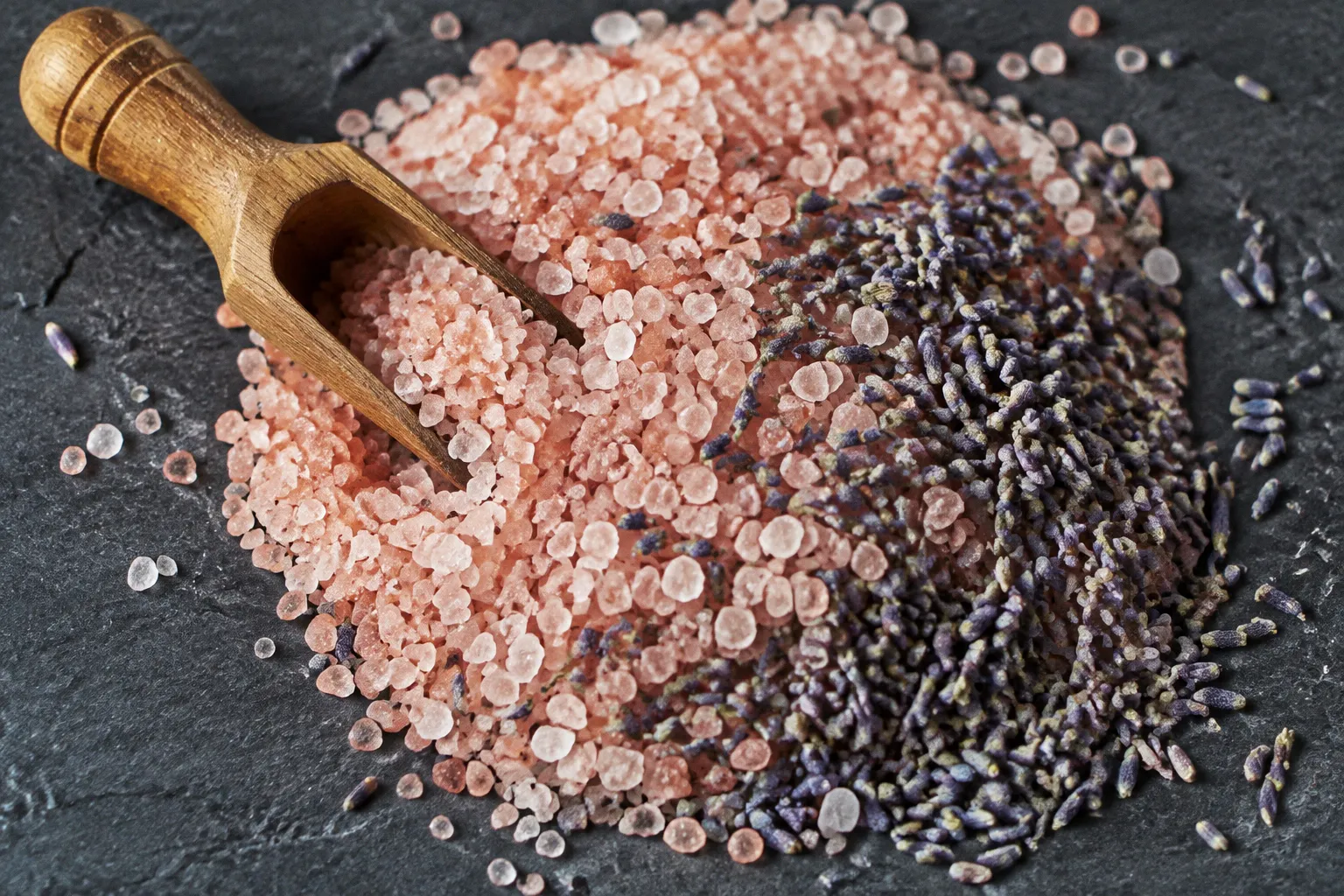
Pink Himalayan salt is sourced from ancient sea beds and is commonly described as containing more than 80 trace minerals, including calcium, magnesium, and potassium. This is a compositional description, not proof that each trace mineral produces a clinically meaningful effect during a bath.
In practical formulation terms, Pink Himalayan salt is often selected for its mineral profile, color, and crystal structure. The natural pink color may vary. Very bright, uniform coloring should prompt a review of the ingredient list because the color may come from added dyes rather than the salt itself.
A mineral bath product can contain several salt types. That is not inherently a problem. The relevant question is whether the mineral blend is dominant and disclosed, or whether the salts are present mainly as a marketing detail while fragrance, oil, or surfactants define the actual product.
| Mineral base | Primary chemical or source identity | What the label should make clear | Main limitation |
|---|---|---|---|
| Epsom salt | Magnesium sulfate | Magnesium Sulfate should be identifiable as the main ingredient | Do not assume a bath reliably corrects internal magnesium deficiency |
| Dead Sea salt | Naturally occurring mineral mixture | The mineral source and any additional ingredients should be disclosed | Geographic naming does not prove that the finished formula is free from irritants |
| Pink Himalayan salt | Salt from ancient sea beds with reported trace minerals | The salt should be listed before fragrance, oils, and dyes | Trace mineral presence does not establish transdermal clinical efficacy |
| Mixed mineral salts | Combination of mineral materials | Each major mineral component should be reasonably transparent | A long blend can conceal a low proportion of the advertised base |
The first ingredient tells you what the product is built from. The front label tells you what the brand wants you to notice.
Decoding the INCI list
INCI stands for International Nomenclature of Cosmetic Ingredients. Cosmetic ingredients are generally listed in descending order of predominance, although ingredients present at low concentrations may be listed with more flexibility near the end of the declaration.
For a true mineral bath salt, the first listed ingredient should be a mineral salt. Typical examples include:
- Magnesium Sulfate for Epsom salt.
- A clearly identified Dead Sea mineral salt.
- Sodium chloride-based mineral salts, where the source and blend are declared.
- A combination of mineral salts when the product is designed as a multi-salt formulation.
If the first ingredient is an oil, the product is primarily an oil-based bath preparation. If the first ingredient is sodium laureth sulfate, the product is primarily a surfactant-containing bath product. Neither category is automatically defective, but neither should be confused with a mineral salt whose primary material is the salt itself.
A practical label-reading sequence
Use the following order when evaluating a product.
1. Read the first ingredient before reading the claims.
This establishes the dominant material. If a mineral salt is not first, determine whether you are looking at a bath soak, bath oil, foaming product, or emulsified treatment rather than a conventional mineral salt.
2. Identify the mineral base by its chemical or standardized name.
“Mineral blend” is less informative than a declared ingredient such as Magnesium Sulfate. Geographic and descriptive language should not replace ingredient identification.
3. Separate functional additives from decorative additives.
Essential oils, botanical extracts, and carrier oils can have a legitimate formulation role. Glitter, intense dyes, and heavily perfumed blends usually contribute more to presentation than to barrier support.
4. Look for fragrance terminology.
“Parfum” or “Fragrance” can represent a complex mixture. The term does not tell you whether the aroma comes from essential oils, synthetic aroma chemicals, or a combination.
5. Check whether the product makes medical-sounding claims.
Statements about detoxification, disease treatment, or guaranteed mineral absorption should be treated as claims requiring evidence, not as consequences of the salt’s presence.
6. Assess transparency across the entire package.
A clearly printed INCI list, batch information, usage directions, and manufacturer details indicate better product accountability than vague claims about purity.
A short ingredient list is not automatically superior. A formula containing only mineral salt may be appropriate for a simple soak, while a product with an oil phase may be designed to reduce the dry feel that some salts can produce. The task is not to reward minimalism. It is to match the composition to the intended use.
Botanical ingredients: useful additions, not proof of efficacy
Botanical bath products often combine mineral salts with dried plant material, essential oils, or botanical extracts. These additions may support the sensory and functional design of the formula, but “botanical” is not a synonym for gentle.
An essential oil is a concentrated mixture of volatile compounds. Its natural origin does not remove the possibility of irritation or sensitization. The same applies to plant extracts. Their effect depends on the plant species, extraction method, concentration, stability, and the condition of the user’s skin.
A well-designed botanical bath soak should make the botanical component identifiable. Look for the plant name rather than only a broad phrase such as “herbal complex.” If essential oils are included, the formula should provide enough information for a sensitive-skin user to make a reasonable decision.
This is especially relevant for fragrance-free bath salts for sensitive skin. A product can be marketed as botanical and still contain a significant fragrance load. It can also be described as naturally scented while including aromatic materials that are poorly tolerated by an individual user.
For a low-complexity formula, the useful distinctions are:
- Mineral salt: the primary bath medium.
- Botanical extract: a plant-derived material added for a specific formulation or sensory purpose.
- Essential oil: a concentrated volatile aromatic material.
- Carrier oil: a lipid ingredient such as a plant oil, added for emollience or dispersion.
- Fragrance or parfum: a declared aromatic composition that may contain multiple materials.
None of these categories establishes safety for every person. Skin tolerance is individual, and damaged or recently exfoliated skin can react differently from intact skin.
Red flags in bath soaks for sensitive skin
Sensitive skin does not require the elimination of every additive. It does require a lower tolerance for unnecessary complexity. The more aromatic, colored, and heavily decorated the formulation, the more variables there are to investigate when irritation occurs.
The following ingredients deserve closer scrutiny:
Synthetic fragrance blends
“Parfum” and “Fragrance” are broad labeling terms. They can be legitimate cosmetic ingredients, but the declaration does not necessarily identify every aromatic substance in a way that helps a highly reactive user predict tolerance.
If the goal is a fragrance-free bath product, do not rely on the phrase “unscented” alone. Examine the INCI list. An unscented product may still contain masking fragrance, while a product described as lightly scented may contain essential oils that are not suitable for every user.
Artificial dyes
Bath salts do not require vivid color to function as a mineral soak. Artificial dyes may be used for visual differentiation, but they add no mineral value. They can also make it more difficult to identify whether redness after bathing comes from heat, the salt concentration, or the coloring system.
A pale natural color is not evidence of purity, and a bright color is not evidence of poor quality. The ingredient list is decisive.
Propylene glycol
Propylene glycol is used in cosmetics as a solvent, humectant, and carrier. It is not automatically unacceptable, but it may be undesirable for users who are deliberately seeking a simple mineral-only formulation or who know they react to particular ingredients.
Its presence tells you that the product is not merely dry mineral salt. That may be appropriate in a complex bath treatment. It is less consistent with a minimal formula intended for users who want only a salt base.
Parabens and other preservatives
Preservatives are not inherently evidence of poor formulation. Water-containing products generally require microbial control, and preservation can be a safety requirement. Dry mineral salts have a different risk profile because microorganisms require available water to grow.
A dry salt product containing several preservatives, solvents, and water-soluble additives may be a more complex system than expected. The correct response is not to treat every preservative as dangerous. It is to ask why the preservative system is present and what type of product is actually being sold.
High oil content
Plant oils can reduce the squeaky or dry feel associated with some bathing products. They can also make a tub slippery and may alter how the salt disperses in water. If oil is listed first, the formula is not primarily a mineral salt.
This distinction is important in the dead sea vs epsom bath salts purity question. Comparing the mineral bases is meaningful only when the products being compared are actually mineral-led formulas. Comparing a salt-heavy powder with an oil-rich bath treatment is a comparison of product categories, not simply of mineral sources.
The myth of natural labeling
The term “natural” is not a legally protected guarantee that every ingredient in a bath salt is naturally sourced. A product using this word may still contain synthetic perfume blends, artificial dyes, or other conventional cosmetic materials.
This is not necessarily a regulatory failure. It is a labeling limitation. Marketing language communicates a broad positioning, while the INCI list communicates the composition.
The same issue applies to words such as:
- Pure
- Clean
- Botanical
- Detox
- Therapeutic
- Non-toxic
- Chemical-free
“Chemical-free” is particularly uninformative because every ingredient is composed of chemicals, including magnesium sulfate, plant extracts, and water. The useful question is not whether a product contains chemicals. It is which chemicals are present, at what role in the formula, and whether the claim being made is supported.
A mineral salt product can reasonably be described as simple when its formulation is dominated by a disclosed mineral base and contains few additional ingredients. That is a compositional judgment. It is not the same as accepting the word “natural” as proof.
What transparency looks like
A transparent label usually provides:
- A complete INCI declaration.
- The primary mineral base in a recognizable standardized name.
- Clear usage directions.
- Warnings about essential oils, fragrance, or slippery surfaces where relevant.
- Batch or manufacturer information.
- No reliance on “natural” as the only explanation of the formula.
Transparency also means avoiding inflated promises. Mineral salts may contribute to a structured bathing ritual, but evidence for exact transdermal magnesium absorption and universal detoxification effects remains incomplete. A responsible product description should not present uncertain mechanisms as established medical outcomes.
A mineral bath can be restorative as a bathing practice without being a proven detoxification treatment.
How to choose clean bath soak minerals
The phrase “clean bath soak” has no universal technical definition. Convert it into measurable formulation preferences instead.
If you want a simple mineral bath, prioritize a product where:
- The first ingredient is a clearly identified mineral salt.
- There is no unnecessary synthetic fragrance.
- Dyes are absent or clearly disclosed.
- Essential oils are either absent or individually identified.
- The formula does not make unsupported medical claims.
- Directions specify a reasonable quantity and soaking time.
- The packaging does not hide a complex formula behind a broad botanical label.
For users with reactive or compromised skin, reducing the number of variables is usually more useful than pursuing a fashionable ingredient list. A plain Epsom salt formula may be easier to evaluate than a blend containing several salts, flowers, essential oils, fragrance, colorants, and extracts.
That does not make the plain product universally better. It makes the cause-and-effect relationship clearer. If irritation occurs, there are fewer possible contributors.
Dry skin and the lipid barrier
Mineral salts are not moisturizers. They do not replace lipids in the stratum corneum, and they should not be treated as a substitute for a barrier-supportive body product.
Long, hot baths can increase dryness by affecting the skin surface and removing some lipids. A salt product may intensify the dry or tight sensation for some users, particularly when the skin barrier is already impaired.
A barrier-first bathing routine is therefore straightforward:
1. Use warm rather than excessively hot water.
2. Keep the soak within the product’s recommended duration.
3. Rinse if the formula contains a high fragrance load or visible botanical residue.
4. Pat the skin dry instead of rubbing aggressively.
5. Apply a body moisturizer while the skin remains slightly damp.
6. Stop using the product if burning, persistent itching, or a spreading rash develops.
This is not a rejection of mineral bathing. It is a recognition that the bath water and the post-bath routine affect different parts of skin physiology.
Dosage and duration: what the numbers can and cannot tell you
A standard bath soak commonly uses approximately 1 to 2 cups, or roughly 300 to 600 grams, of salt. Some products recommend higher quantities, including 2 to 4 cups, or approximately 500 grams to 1 kilogram, one to three times per week.
These figures are usage conventions, not universal pharmacological doses. They do not establish how much magnesium or another mineral enters the body. The concentration of the bath depends on the volume of water, and a household bathtub does not have a standardized capacity.
A practical starting point is to follow the product directions rather than automatically using the largest stated amount. Increase neither the concentration nor the frequency to pursue a stronger “detox” effect. There is no universal clinical basis for assuming that more salt produces proportionally greater internal benefit.
A soak of 15 to 30 minutes is a common recommendation. Longer exposure is not automatically more effective. It may increase skin dryness, overheating, or irritation, especially in a hot bath.
A controlled approach to first use
For a new product, use a conservative process:
- Read the full ingredient list before opening the package.
- Avoid introducing several new bath products at once.
- Use the lower end of the stated quantity.
- Keep the first soak within the shorter part of the recommended duration.
- Observe the skin during the following hours, not only while in the bath.
- Discontinue the product if irritation persists.
This approach is particularly useful when the formula contains essential oils or a broad fragrance declaration. The objective is not to prove that a product is “clean.” It is to determine whether the formula is compatible with the skin.
Common buying errors
Most mistakes occur before the product reaches the bathtub. They come from treating a marketing category as if it were a chemical specification.
Mistaking color for mineral quality
Pink, blue, green, or purple salts may look distinctive, but color does not indicate mineral concentration. The color may originate from the mineral itself, a plant material, or an added dye.
Treating “natural” as a complete ingredient disclosure
Natural labeling is not a substitute for INCI review. The product may contain a natural mineral base and synthetic perfume at the same time.
Assuming essential oils are automatically mild
Essential oils are concentrated aromatic materials. Their plant origin does not guarantee suitability for sensitive skin. A bath also creates prolonged contact with a relatively large surface area.
Confusing an oil-based soak with mineral salts
If oil is the first ingredient, the product has a different structure and use profile. It may be valuable as a bath oil, but it should not be evaluated as if it were a pure mineral salt.
Using absorption claims as the main quality test
The exact systemic absorption percentage from a single bath is not established universally. A product cannot demonstrate mineral delivery merely by naming magnesium, potassium, or trace elements on the label.
Ignoring the post-bath barrier routine
A mineral soak may be comfortable while the skin is wet and leave it dry afterward. The final evaluation should include how the skin feels after drying and moisturizing, not only the immediate bathing experience.
A more precise way to compare mineral bath salts
When comparing two products, keep the comparison within the same category. Evaluate the dominant mineral base first, then the additives, then the directions.
For example, when comparing Epsom salt with Dead Sea salt, ask:
- Is Magnesium Sulfate the dominant ingredient in the Epsom product?
- Is the Dead Sea product primarily mineral salt rather than oil or surfactant?
- Are fragrance and dyes present?
- Does either product contain essential oils that may be unsuitable for sensitive skin?
- Are the claims limited to bathing benefits, or do they promise medical outcomes?
- Can the product be used at a moderate concentration without unnecessary extras?
This method separates chemistry from presentation. Epsom salt and Dead Sea salt are not interchangeable materials, but neither becomes superior merely because its packaging uses stronger language.
For a simple bath ritual, the best formula is often the one whose composition is easiest to understand and whose directions are proportionate. Product complexity should have a purpose. If an ingredient does not contribute a clear sensory, functional, or stability role, its presence deserves scrutiny.
Final assessment
High-quality mineral bath salts are identified by formulation structure, not by adjectives. The mineral base should lead the INCI list. Epsom salt should be recognized as magnesium sulfate. Dead Sea salt should be presented as a mineral mixture rather than a vague promise. Pink Himalayan salt may contain a broad range of trace minerals, but that fact does not establish a medical effect through bathing.
For sensitive skin, avoid unnecessary fragrance, artificial dyes, propylene glycol, and complex formulas that provide no clear benefit for the intended use. Do not interpret “natural” as a legally protected purity standard. Do not treat uncertain transdermal absorption or detoxification claims as established physiology.
The definitive test is simple: identify the dominant ingredient, classify the product correctly, assess the additives, and use the bath at a moderate concentration and duration. Mineral salts can support a disciplined bathing ritual. Their efficacy should not be expanded beyond what their chemistry and the available evidence can justify.