Botanical Bath Tea Prep: 5 Steps for Herbal Soaks
Dried botanicals do not dissolve in bathwater. Their soluble compounds disperse gradually through warm water, while insoluble leaves, petals, and stems remain as solid material.
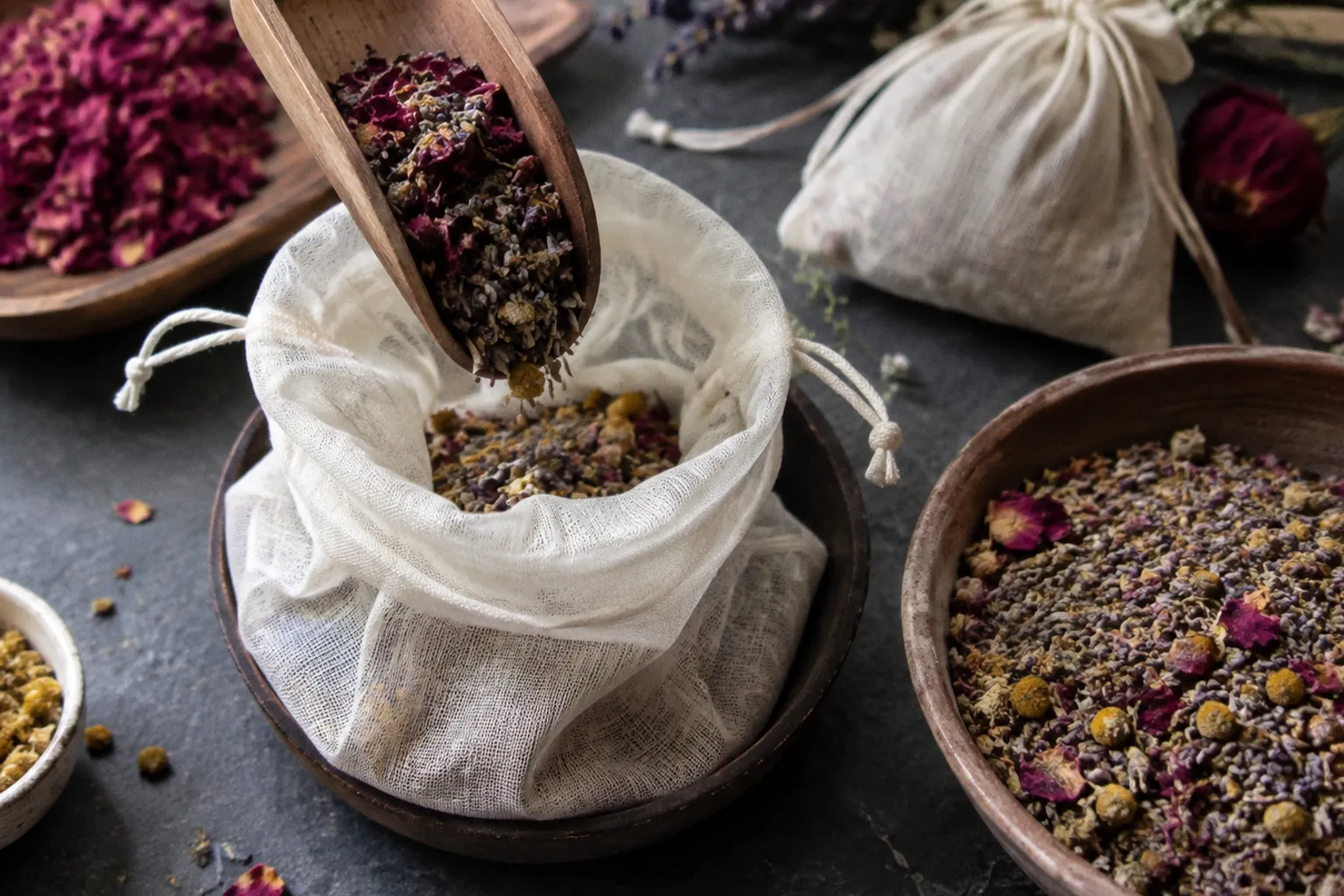
That distinction determines the correct botanical bath tea preparation steps: the herbs need containment, sufficient contact time, and controlled water temperature.
A bath tea bag is therefore not decorative packaging. It is a filtration and infusion device. Used correctly, it releases the water-soluble portion of the blend while keeping plant debris away from the drain, tub surface, and skin. The method is straightforward, but several common shortcuts reduce efficacy and create avoidable cleanup or irritation problems.
Step 1: Select and measure the botanical blend
Begin with a dried herbal mixture intended for external use. The blend may contain plant material such as dried leaves, flowers, or small pieces of stems, along with mineral salts when the formula is designed for them. Avoid using fresh plant material in a sealed pouch. Its higher water content changes storage behavior and can encourage spoilage between uses.
For one bath, use approximately 1/4 to 1/2 cup of dried herbal blend. The lower amount is suitable for a lighter infusion or a smaller bath. The upper amount creates a more concentrated botanical load without requiring the pouch to be packed tightly.
The composition of the blend affects the character of the infusion:
- Leaf material generally has a relatively large surface area and releases soluble compounds readily once wet.
- Petals and flowers are lightweight, but they can escape through coarse fabric and collect on the tub surface.
- Small stems or bark-like pieces require more water circulation and may release their constituents more slowly.
- Mineral salts dissolve in water, but they do not replace the need to contain the insoluble plant matter.
- Essential oils are not water-soluble and should not be treated as ordinary dried botanicals.
The formula should remain loose inside the bag. A pouch filled to capacity has poor internal circulation. Water reaches the outer material first, while the compressed center remains only partially hydrated. That produces an uneven infusion and makes the bag less effective as a steeping medium.
A practical loading ratio
Use the following sequence:
1. Measure 1/4 to 1/2 cup of the dried blend.
2. Transfer it into a breathable cotton or muslin bag.
3. Leave free space above and around the material.
4. Secure the opening so leaves and petals cannot escape.
5. Check that the fabric allows water to pass through without releasing fine debris.
Muslin works because it combines permeability with mechanical containment. The exact weave matters. If the fabric is too open, small particles can pass into the bath. If it is too dense, water flow slows and the pouch behaves more like a sealed packet than a steeping bag.
A botanical bath tea bag works through controlled contact, not compression. The blend needs room to hydrate and circulate.
Step 2: Use a contained pouch instead of loose herbs
Loose herbs in a bathtub create a predictable maintenance problem. Petals and leaves settle around the drain, adhere to wet enamel or acrylic, and remain in corners that are difficult to rinse. Fine plant particles can also enter the drain trap. The issue is not only cosmetic. Organic debris held in a damp plumbing environment can become a source of odor and residue.
The bath tea bag solves this by separating infusion from cleanup. Water moves through the fabric, extracts soluble components, and carries them into the bath. Larger plant particles remain inside the pouch.
The bag can be positioned in two ways:
- Hang it beneath the running water while the tub fills.
- Place it directly in the bathwater once the tub has reached the desired level.
Hanging the pouch under the faucet exposes it to moving water and begins the infusion before the bath is ready. Placing it in the tub gives the material a longer period of contact during the soak. Both methods are functional if the bag remains fully wet and the opening stays secured.
Do not knot the pouch so tightly that water cannot enter the upper portion. The objective is containment with circulation. A compressed or tightly sealed bundle will release less material into the water than a loosely filled pouch of the same size.
Why enclosure is preferable to a loose herb bath
| Method | Infusion behavior | Cleanup | Drain exposure | Practical limitation |
|---|---|---|---|---|
| Loose herbs in the tub | Uneven; material settles in different areas | High; petals and leaves remain behind | Direct | Plant debris can collect around the drain |
| Cotton or muslin steeping bag | More controlled; water passes through the blend | Low; debris stays contained | Minimal | The pouch must not be overfilled |
| Pre-brewed infusion | Consistent liquid distribution | Low if filtered before use | Minimal | Requires a separate bowl or pot |
| Coarse mesh bag | Good water movement | Moderate | Reduced | Fine particles may escape through the mesh |
A paper tea bag can also be used when its construction is suitable for warm-water immersion. It should be large enough to hold the blend without restricting expansion. Small single-cup tea filters are often too compact for a full bath formula. They may allow water through, but they do not provide enough surface area for the herbs to hydrate efficiently.
Step 3: Control the temperature and steep for at least five minutes
The recommended bath temperature for a botanical soak is approximately 98–102°F (37–39°C). This range is warm enough to support infusion and comfortable bathing without turning the preparation into a high-temperature exposure.
The five-minute rule refers to the minimum steeping period before entering the bath. Place or hang the bag under the running water and allow it to infuse for at least 5 minutes. During this time, the dry plant material absorbs water, expands, and releases soluble compounds into the surrounding liquid.
You can gently squeeze the pouch while the tub is filling. This increases contact between the water and the interior blend, but it should not be treated as a substitute for steeping. Repeated compression may force fine particles through the fabric, particularly when the bag contains powdered herbs or fragmented petals.
A simple bath tea bag brewing method looks like this:
1. Fill the tub with warm water within the 98–102°F range.
2. Hang the secured bag beneath the running water or place it in the partially filled tub.
3. Allow the bag to steep for at least 5 minutes.
4. Squeeze it gently once or twice if the fabric and contents permit.
5. Remove the bag only after the water has taken on the intended botanical infusion, or leave it in the bath during the soak.
The appearance of the water is not a reliable measure of chemical extraction. Some botanical compounds are highly soluble but nearly invisible at typical bath concentrations. Others may tint the water without contributing significantly to the functional profile of the soak. Color, therefore, is a weak indicator of efficacy.
The same principle applies to fragrance. Volatile aromatic compounds may become noticeable quickly, but scent intensity does not prove that the nonvolatile components of the plant material have been extracted to the same degree. A strong odor can coexist with poor distribution, particularly when essential oils have been added incorrectly.
The alternative: pre-brew the bath tea
A pre-brewed infusion is useful when the pouch is small, the blend contains dense plant material, or the tub faucet does not provide enough water movement.
To use this method:
1. Place the measured blend in a large cotton, muslin, or suitable heat-resistant infusion bag.
2. Cover it with hot water in a separate bowl or pot.
3. Allow the herbs to infuse before transferring the liquid to the bath.
4. Pour the infusion through a filter if loose particles have escaped.
5. Add the filtered liquid to the warm tub.
Pre-brewing separates infusion from bathing. It also makes it easier to inspect the liquid and remove plant debris before it reaches the tub. The used bag should still be kept out of the drain. Pouring an infusion directly into the bath does not eliminate the need to contain the original herbs.
Step 4: Add essential oils only with a suitable base
Essential oils are concentrated volatile substances. They do not dissolve in water. When added directly to a bath, they remain as undiluted droplets or surface films. Those droplets can contact the skin at a concentration much higher than intended by the bath formula.
This is a formulation problem, not a matter of preference. Stirring essential oil into the water does not create a stable dilution. The oil may disperse temporarily, but it will not become water-soluble. Contact with the skin can therefore be uneven.
If the blend includes essential oils, pre-mix them with a carrier oil or a salt base designed to distribute the oil through the bath. The base should be fully combined before it enters the water. Adding individual drops directly to the tub bypasses this step.
A carrier base serves two functions:
- It reduces the concentration of the essential oil at the point of skin contact.
- It improves distribution through the bathwater compared with free oil droplets.
However, a carrier does not make every aromatic ingredient appropriate for every user. Essential oils can be irritating or sensitizing, especially for people with reactive skin or a history of fragrance sensitivity. Keep the formula conservative, avoid contact with the eyes, and stop use if burning, itching, or persistent redness develops.
The same caution applies when botanical bath tea is combined with a handmade cold-process soap, bath bomb, or shower steamer. Each product can contribute fragrance materials. The total aromatic load is cumulative. A bath containing an essential-oil blend, followed by a strongly fragranced cleanser, exposes the skin to more fragrance than either product would provide alone.
For a barrier-first routine, simplify the sequence:
- Use the botanical infusion as the primary aromatic element.
- Choose an unscented or lightly scented cleanser if the skin is reactive.
- Avoid adding free essential oils to the water.
- Rinse the tub after the bath if the formula contains oils or fine botanicals.
- Apply a bland emollient afterward if the skin feels tight.
The purpose of the bath is not to maximize the number of ingredients. It is to control exposure and maintain tolerability.
Step 5: Soak for 15–20 minutes, then process the pouch correctly
Once the bag has steeped for at least five minutes, remain in the bath for approximately 15–20 minutes. This duration allows sustained contact with the infused water without turning the routine into an unnecessarily long exposure to warm water.
Longer soaking is not automatically more effective. Water itself can disrupt the organization of the stratum corneum when exposure is prolonged, especially if the water is hot or the skin barrier is already compromised. A moderate soak followed by gentle drying is generally more rational than extending the bath until the water cools completely.
During the soak, the pouch may remain in the tub. Keep it away from the drain and avoid rubbing the bag directly over the skin. The fabric is not a scrubber, and the contents may contain small abrasive fragments. Botanical infusion and mechanical exfoliation are separate procedures.
After bathing:
1. Remove the pouch before draining the tub.
2. Allow excess water to drain from the bag.
3. Empty or rinse the pouch according to its formula.
4. Hang a pure herbal pouch in a dry, ventilated location.
5. Clean the tub if petals, oil residue, or mineral sediment remain.
A pouch containing only dried herbs can usually be dried completely and reused two to three times before its potency declines. Drying is not optional. A wet fabric bag containing plant material is a damp organic environment. Leaving it sealed between baths can produce odor and spoilage.
Do not reuse a pouch indefinitely. The botanical material loses extractable content over repeated infusions, and the fabric may retain moisture or residue. Replace it when the blend becomes exhausted, develops an unusual odor, or fails to dry properly.
Pouches containing dairy powders, salt mixtures, carrier oils, or other moisture-retaining additives should be treated differently. These ingredients can remain in the fabric and change the storage conditions. They are not equivalent to a 100% herbal muslin bag. Dispose of them after use unless the product instructions explicitly define another process.
Common errors in a loose herb bath soak routine
Most failures come from incorrect handling rather than from the botanical formula itself.
Overfilling the bag
A densely packed pouch restricts water movement. The outer layer becomes wet while the center remains dry or only partially hydrated. Use less material or choose a larger bag. The blend should be able to expand.
Entering the bath immediately
A dry pouch placed into the tub and removed minutes later has not completed a meaningful infusion. Allow at least five minutes of contact before entering. This is particularly relevant when the blend contains larger leaves, petals, or dense plant fragments.
Using water that is too hot
High heat can increase discomfort, worsen dryness, and make the bath less suitable for reactive skin. The recommended range is approximately 98–102°F (37–39°C). A warm bath is sufficient for the intended infusion process.
Adding essential oils directly to water
This creates undiluted oil droplets. It does not create a stable bath formulation. Use a carrier oil or salt base, and combine the essential oil with that base before adding it to the bath.
Treating fragrance as proof of performance
A pronounced aroma indicates that volatile molecules are present in the air or water interface. It does not establish that a particular botanical compound has crossed the skin barrier or produced a measurable physiological effect. The transdermal absorption rates of specific plant flavonoids during a standard 20-minute soak are not established by scent or water color.
Leaving the wet pouch in a closed bathroom
A damp pouch needs airflow. Hang it open or spread it so the fabric dries fully. Do not place it in a sealed container while wet.
Pouring loose plant debris into the drain
The bath tea bag exists partly to prevent this. Remove the herbs before draining. If a pre-brewed infusion was used, filter it before it reaches the tub.
A controlled botanical bath ritual
The complete botanical bath ritual steps can be reduced to five operational decisions:
1. Measure: use 1/4 to 1/2 cup of dried blend per bath.
2. Contain: place the blend in a breathable cotton or muslin bag with room for expansion.
3. Infuse: use warm water at approximately 98–102°F (37–39°C) and steep for at least five minutes.
4. Soak: remain in the bath for about 15–20 minutes.
5. Dry: remove the pouch, dry it completely, and reuse a pure herbal bag no more than two to three times.
This sequence separates three functions that are often confused: extraction, aromatic dispersion, and physical exfoliation. The bag supports extraction and cleanup. A properly prepared carrier base supports essential-oil dispersion. Neither replaces a cleanser, moisturizer, or treatment product.
For users who prefer a stronger infusion without increasing the amount of plant material, pre-brewing is the better adjustment. For users concerned about cleanup, an enclosed bag is the more consequential change. Increasing fragrance is not a substitute for either one.
Final assessment
A botanical bath tea is a simple preparation, but the preparation is only as reliable as the bag, the temperature, and the handling around it. The pouch is not packaging; it is the infusion medium. Treat it that way, and the method becomes predictable.
The five steps in this sequence are a starting framework, not a rigid recipe. They cover the variables that most often go wrong: overpacking, understeeping, overheated water, undiluted essential oils, and neglected post-bath drying. Each variable can be adjusted once the basic protocol is in place. The protocol itself should remain stable.
Used consistently, this approach produces a defined infusion, a manageable cleanup, and a reusable pouch when the blend permits. It also keeps the skin's exposure controlled rather than incidental. That is the real purpose of how to steep herbal bath tea: a measured contact between water-soluble plant compounds and the body, without the residue or the guesswork that a loose herb bath soak routine usually leaves behind.