Beard Oil and Balm Layering: 5 Steps to Soft Facial Hair
Beard oil and balm do not perform the same function, and their application order is determined by formulation density. Beard oil is usually a low-viscosity blend of liquid emollients.
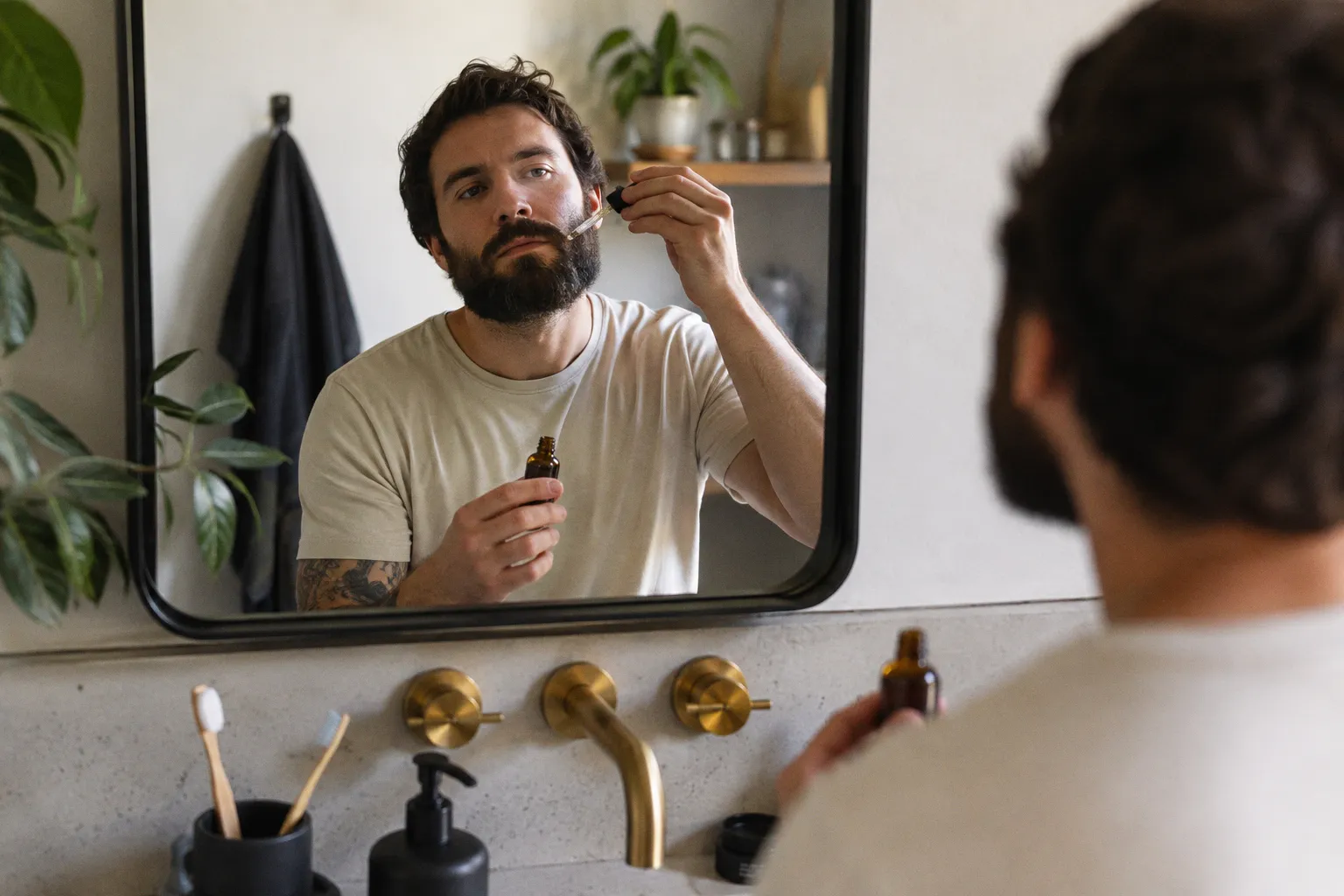
Beard balm contains heavier materials such as waxes, butters, and higher-viscosity oils. The lighter phase spreads and penetrates more readily. The heavier phase forms a more persistent film on the hair and skin.
That is why the correct beard oil and balm layering routine is oil first, balm second. Applying balm before oil can leave waxes and butters on the surface, reducing the oil’s access to the skin and the base of the beard. The result is often a coated beard rather than a conditioned one.
Beard oil conditions and lubricates. Beard balm seals, controls, and shapes. Density determines the sequence.
A practical routine requires five variables: cleansing frequency, moisture level, dosage, absorption time, and distribution technique. Ignore any one of them and the same products can feel greasy, ineffective, or uneven.
1. Understand the Science of Density: Why Oil Must Precede Balm
The question of beard oil before or after balm is not a matter of personal preference. It follows the physical behavior of the products.
Most beard oils are anhydrous formulas. This means they contain no meaningful water phase. Their base may include plant oils, ester-based emollients, or a combination of both. Common formulation goals include:
- Reducing friction between beard hairs.
- Improving combability.
- Limiting the rough sensation caused by dry, lifted cuticles.
- Supporting the skin’s lipid barrier by reducing water loss.
- Distributing fragrance through the beard.
A balm is typically more structured. Its consistency comes from waxes, butters, and solid or semi-solid lipids. Depending on the formula, it may provide:
- A more substantial coating on the hair shaft.
- Reduced moisture loss from the skin and beard.
- Directional control for the beard.
- Moderate styling hold.
- Protection against friction from collars, masks, and repeated touching.
The difference is best understood as a sequence of film formation. A thin liquid emollient can spread across the skin and hair more efficiently before a thicker material is introduced. Once balm has been applied, its wax and butter components can create a partially occlusive layer. That layer is useful after oil application. It is less useful as a first step.
What the products can and cannot do
Beard oil is often described as a hydrator. Technically, an oil does not add water to the skin in the same way a water-based product does. It mainly reduces transepidermal water loss and improves the feel of existing moisture. This distinction matters.
Applying oil to a completely dry beard may improve lubrication, but it does not compensate for the absence of water in the hair and skin. Applying it to a dripping-wet beard creates a different problem: excess water dilutes the product on the surface and encourages uneven runoff.
A slightly damp, towel-dried beard provides a more useful starting point. The water supplies temporary hydration. The oil then helps reduce moisture loss and improves the feel of the hair. Balm follows as a heavier sealing and styling phase.
The formulation differences can be summarized as follows:
| Parameter | Beard oil | Beard balm |
|---|---|---|
| Typical physical state | Liquid | Semi-solid |
| Primary function | Lubrication, emollience, reduced water loss | Sealing, conditioning film, styling control |
| Spreadability | High | Lower until warmed |
| Styling hold | Minimal to none | Low to moderate, depending on wax content |
| Best application point | After washing, on slightly damp hair | After oil has had time to spread and absorb |
| Main dosing risk | Excess shine and greasiness | Heavy coating, residue, loss of movement |
The exact formula changes the behavior. A balm with a high wax concentration may feel firmer and provide more hold. A butter-rich balm may feel softer but less sculpting. An oil based on lightweight esters may absorb faster than a formula dominated by dense, slow-spreading botanical oils. The label does not always reveal the complete sensory profile, so dosage should be adjusted by beard length, density, and product behavior rather than by a fixed rule.
2. Prepare the Canvas: Washing and Damp-Hair Application
Layering begins before the oil is opened. Sebum, sweat, food residue, dead skin cells, and styling product can accumulate around the beard base. Oil applied over that material does not improve the underlying condition. It simply adds another film.
A specialized beard wash is generally used two to four times per week rather than daily with a harsh head shampoo. The skin beneath the beard has its own sebum balance, and aggressive cleansing can remove too much of that lipid material. The resulting dryness may appear as itch, tightness, or flaking. Adding more oil afterward can mask the sensation without correcting the cleansing pattern.
A workable washing sequence is simple:
1. Wet the beard thoroughly with lukewarm water. Very hot water can increase the sensation of dryness and may make the skin more reactive.
2. Use a small amount of beard wash and work it through the hair down to the skin.
3. Rinse until no slippery residue remains at the roots and under the jaw.
4. Press the beard with a towel instead of rubbing it aggressively.
5. Apply oil while the beard remains slightly damp.
Daily washing may be reasonable for some people with heavy perspiration, occupational exposure, or frequent training. In that case, the cleanser should be mild and the skin response should determine the schedule. The general objective is not to preserve dirt in the name of natural grooming. It is to remove residue without repeatedly stripping the skin’s protective lipid film.
Why damp hair is preferable
Water temporarily swells the hair fiber and changes how the cuticle lies against the shaft. A damp beard is usually easier to detangle and distribute product through than a completely dry one. The oil also has a better chance of reducing water loss from the hair and skin when applied after towel drying.
The target condition is not wetness. If water is dripping from the beard, the product may be displaced before it can spread. If the beard is fully dry and rough, the oil may remain concentrated in a few areas, particularly around the chin and mustache.
A towel-dried beard should feel cool and slightly moist, not saturated. This is a small distinction, but it improves consistency across the rest of the routine.
3. Dose Precisely: Find the Beard’s Working Range
The correct amount of oil is not determined by the number of pumps printed on a bottle. Pump mechanisms vary. Dropper openings vary. Oil viscosity varies. Beard density varies more than most product instructions acknowledge.
A practical starting range is:
- Short beard or heavy stubble: 3 to 5 drops.
- Medium beard: approximately 5 to 8 drops.
- Long or very full beard: often 5 to 8 drops, with some product guidelines extending the range to 4 to 12 drops.
These are starting points, not universal measurements. A sparse medium-length beard may need less oil than a short but extremely dense beard. A coarse beard with a dry skin base may require more than a fine beard of the same length.
Use dosage as an iterative process:
1. Begin at the lower end of the range.
2. Rub the oil between the palms and fingers to create a thin, even film.
3. Press and rake it through the beard, starting at the skin and moving toward the ends.
4. Wait briefly and assess the result.
5. Add one or two drops only if the lower lengths still feel rough or unconditioned.
This approach prevents the most common dosing error: applying a large amount immediately because the beard feels dry. Dryness and insufficient product are not identical problems. The cause may be harsh cleansing, friction, low humidity, or poor distribution. More oil is not always the correct response.
Signs of under-application
The beard may need a small additional amount when:
- The ends remain stiff after combing.
- The skin beneath the beard still feels tight.
- Product is present near the chin but absent around the cheeks and jaw.
- The hair tangles quickly despite a clean, damp starting point.
Signs of over-application
The dose is probably excessive when:
- The beard looks wet or reflective long after application.
- Hair clumps together instead of separating naturally.
- The skin feels coated rather than comfortable.
- The balm added later cannot spread without dragging.
- The product transfers readily to collars, bedding, or hands.
Oil should not be judged only by immediate shine. Some formulas use slow-spreading oils that feel rich initially but settle over time. Others use lightweight esters that disappear quickly from the surface. A low-shine finish does not prove that a product is more effective, and a glossy finish does not prove that it is more conditioning.
4. Allow Absorption Before Sealing
The pause between oil and balm is a functional part of the routine. Allow approximately two to three minutes after applying beard oil before introducing balm.
This interval gives the oil time to spread across the skin and beard and begin interacting with the hair surface. It also reduces the risk of mixing two products into a single heavy layer in the palms. The goal is not complete disappearance. Many oils remain perceptible after two minutes, especially when they contain dense botanical lipids.
During the pause, avoid immediately brushing the beard into its final shape. Let the oil distribute first. A comb can then be used to move the product farther through the beard before balm is applied.
Balm should be used in a small quantity, beginning with roughly a pea-sized amount. A larger, dime-sized portion may be appropriate for a longer or fuller beard, but starting with a large amount creates unnecessary residue. The product can be increased more easily than removed.
Warm the balm between the palms until it becomes transparent or nearly transparent as a thin film. If solid pieces remain, they are likely to deposit unevenly. The result can be waxy patches around the mustache, jawline, or beard ends.
Balm application sequence
After warming the balm:
1. Spread it across both palms and between the fingers.
2. Press the hands against the sides of the beard.
3. Work from the lower neck and jaw toward the cheeks.
4. Use the fingertips to reach the skin beneath dense areas.
5. Pull the remaining product through the middle lengths and ends.
6. Apply the smallest residue to the mustache unless stronger control is required.
This sequence places most of the product where density and friction are highest. It also reduces the risk of leaving the visible outer surface overloaded while the inner beard remains untreated.
The two-to-three-minute pause is not a cosmetic ritual. It separates the spreading phase from the sealing and styling phase.
5. Distribute Evenly and Set the Shape
The beard is a three-dimensional fiber mass. Product applied only to the exterior will leave the roots and inner layers untreated. Product applied aggressively to the skin may produce unnecessary occlusion and shine. Distribution requires controlled contact.
The most efficient method combines fingers, a comb, and, when appropriate, a brush.
Fingers for the base layer
Fingers provide the best control during oil application. They can reach the skin and identify dry areas that a brush would glide over. Use the fingertips to massage product into the beard base without scratching the skin.
The oil should move in several directions:
- Against the natural lay to reach the roots.
- With the natural lay to smooth the surface.
- Downward through the ends to reduce friction and tangling.
A beard does not need forceful manipulation. Excessive rubbing creates friction before the conditioning film has spread.
Comb for separation
A wide-tooth comb is useful for distributing oil through medium and long beards. It separates compressed sections and carries product from the root area toward the ends. A narrow comb can provide more control around the mustache but may pull at knots if used before detangling.
Comb after the oil has been spread, not before. Running a comb through a dry, tangled beard can increase mechanical stress on the hair fibers. Once balm has been added, the comb can refine the shape and remove small clumps.
Brush for surface alignment
A beard brush helps align the outer layer and distribute remaining balm residue. It is not a substitute for reaching the skin. A brush with stiff bristles used aggressively on a short beard can create unnecessary abrasion, particularly if the skin is already irritated.
For styling control, brush or comb in the direction the beard naturally grows. Balm can redirect the hair to some extent, but it cannot permanently change the underlying growth pattern. A formula with modest wax content may control flyaways. It will not provide the same hold as a dedicated mustache wax or high-hold styling product.
Product placement by beard area
Different zones often need different amounts:
- Cheeks: Usually require a light film because the hair is less dense and more visible from the surface.
- Jawline: Often needs additional distribution because the hair can be coarse and compressed.
- Chin: Commonly retains excess product because it is dense and centrally located. Start with less.
- Mustache: Requires minimal oil and balm unless the hair is coarse or prone to dryness. Too much product can transfer to the lips.
- Neck: May benefit from balm for control, but product should not be used to conceal poor trimming or persistent irritation.
The beard oil and balm layering routine is complete when the beard feels flexible, separated, and controlled. It should not feel wet, sticky, or rigid unless the product was selected specifically for high hold.
Common Errors That Reduce the Result
The sequence itself is straightforward. Most failures come from changing the surrounding conditions.
Applying balm before oil
This reverses the density hierarchy. The wax-rich layer can limit the spread of the oil and leave the beard feeling coated. If balm has already been applied, adding more oil on top is unlikely to correct the distribution. Wash or gently cleanse the beard at the next suitable opportunity and restart with a lower dose.
Using head shampoo every day
Head shampoos are often designed for a different combination of hair density, scalp sebum, and cleansing frequency. Daily use on facial hair and the skin beneath it may remove more lipid material than necessary. The resulting dryness often leads to compensatory over-application of oil.
Applying oil to a dripping-wet beard
Excess water reduces control. The oil can slide toward the neck or collect in isolated areas. Press the beard with a towel until it is damp rather than saturated.
Measuring by eye after the first application
A large initial dose makes it difficult to identify what the beard actually needs. Start low, distribute, and increase gradually. This is particularly relevant for dense formulas based on heavier oils.
Skipping the skin
Facial hair conditioning is not only a surface treatment. Itch often originates at the skin beneath the beard. If oil and balm remain on the outer hair while the roots are dry, the routine is incomplete. Use the fingertips to reach the skin without over-massaging.
Treating every day as a styling day
A balm is not automatically required at every application. Short beards may need oil alone. Longer beards may benefit from the additional sealing and control of balm. Using both products daily can be appropriate if the quantities are small and the skin remains comfortable, but more product does not create proportionally better conditioning.
How to Adjust the Routine by Beard Type
A simple sequence can be adapted without changing its logic.
For short facial hair, use a few drops of oil on damp skin and hair. Balm may be unnecessary unless the beard is coarse, the skin is dry, or a small amount of control is needed.
For a medium beard, oil should reach the skin and the full length of the hair. After the two-to-three-minute pause, a pea-sized amount of balm can reduce friction and control stray hairs.
For a long or full beard, work in sections. Apply oil to the underside, sides, and chin rather than placing the entire dose on the front surface. Once the oil has spread, use balm sparingly through the middle lengths and ends. The interior of a dense beard may need more attention than the visible exterior.
For a coarse beard, distribution is usually more valuable than simply increasing the dose. A slightly damp application, careful finger work at the roots, and a short absorption period will often produce a better result than saturating the outer layer.
For sensitive or easily irritated skin, reduce fragrance exposure and avoid aggressive rubbing. Persistent itch, scaling, redness, or inflamed bumps should not be treated as a simple product shortage. Those signs may require a different cleansing approach or assessment by a qualified clinician.
The Evidence-Based Verdict
The correct answer to how to layer beard oil and balm is consistent: cleanse appropriately, towel-dry until slightly damp, apply beard oil first, wait two to three minutes, then add a small amount of warmed balm.
The products complement each other because their functions are different. Oil improves lubrication and reduces moisture loss. Balm creates a heavier conditioning film and provides styling control. Their combination can reduce the rough feel associated with dry facial hair and help maintain a more controlled beard throughout the day.
The routine does not depend on a large dose, a complicated tool set, or aggressive brushing. It depends on sequence and distribution. Apply the low-viscosity product while the beard is slightly damp. Let it spread. Add the denser product only after that phase is complete.
That is the formulation logic, and it remains more reliable than marketing claims about instant transformation or universal dosing.