Natural Loofah Sanitizing: 4 Steps for Bath Care
Natural loofahs are not synthetic shower accessories. They are the dried fibrous interior of the Luffa aegyptiaca gourd, composed primarily of plant cellulose.
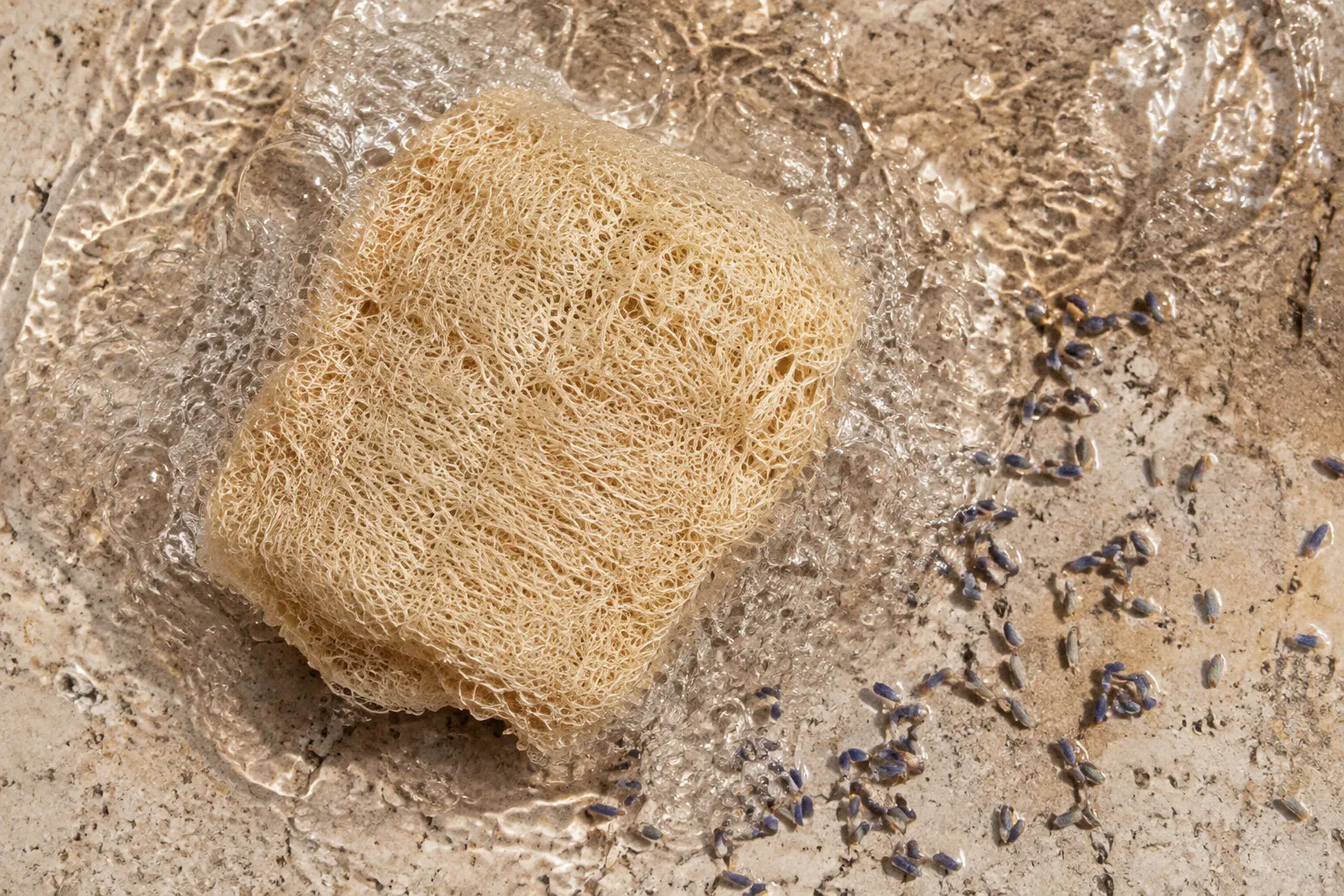
That structure explains both their exfoliating action and their hygiene problem: a porous network can retain water, soap residue, shed skin cells, and organic material after use.
A natural loofah therefore requires a defined maintenance routine. Rinsing alone is not equivalent to sanitizing. Drying is not optional. Disinfection does not make the sponge permanent. The practical sequence is simple: flush the fibers after every shower, remove excess water without damaging the cellulose, perform a weekly deep treatment, and replace the loofah on a short schedule.
The anatomy of Luffa aegyptiaca and why it needs care
The commercial bath loofah is produced from the mature gourd of Luffa aegyptiaca. Once the outer material and seeds are removed, the remaining internal structure forms a lightweight lattice of interconnected fibers. This lattice creates the familiar rough surface used for mechanical exfoliation.
It also creates multiple retention points. Water can remain inside the fiber matrix after the surface appears dry. Soap lather may collect between strands. Skin residue can become embedded rather than simply resting on the exterior.
This is a materials problem before it is a cosmetic one.
A natural loofah differs from a closed-cell synthetic sponge in its composition and handling requirements:
- Its fibers are plant-derived cellulose rather than petroleum-based foam or molded plastic.
- Its open structure can hold water and residue between the strands.
- Its surface becomes less hygienic when it remains wet for prolonged periods.
- Aggressive twisting can weaken or break the cellulose fibers.
- Oil-based cleaners may leave a film that is difficult to remove from the porous matrix.
The loofah is used in a wet environment, but it should not be stored in a permanently wet environment. The distinction determines the entire care protocol.
A bathroom with limited ventilation increases the drying burden. Direct shower spray also extends the time required for the fibers to lose moisture. Hanging the loofah from a hook inside the active spray zone is therefore a poor storage arrangement, even if the sponge is rinsed thoroughly.
A natural loofah is not self-cleaning. Its plant-fiber structure requires water removal, airflow, and scheduled replacement.
The goal of maintenance is not to create a sterile medical instrument. Home sanitation cannot establish that standard consistently, and no routine should imply otherwise. The goal is to reduce retained residue and limit the conditions that support persistent odor, discoloration, and slimy surface development.
Step 1: Rinse the loofah after every shower
Daily post-shower rinsing is the first control point in natural loofah cleaning and sanitizing steps. It removes the material that would otherwise remain inside the sponge until the next use.
Run the loofah under warm water. Do not rinse only the outer surface. Rotate and compress the sponge repeatedly so that water passes through the internal fibers. Continue until visible soap lather and skin residue have been flushed out.
The sequence is mechanical:
1. Hold the loofah under warm running water.
2. Compress it several times while the water passes through the fiber network.
3. Release the compression and allow fresh water to enter the interior.
4. Repeat until no visible lather remains.
5. Inspect the center and thicker sections, where residue is more likely to persist.
A quick splash under the faucet is insufficient. The objective is not to wet the sponge. It is to exchange the contaminated internal water for clean running water.
Water temperature should remain comfortable to handle during the daily rinse. The weekly disinfection options described below use separate exposure times and methods. Do not treat a routine rinse as a substitute for those procedures.
The loofah should also be rinsed before it is placed in storage if it has been used with a dense body wash, a cold-process soap containing a high level of superfat, or an exfoliating product with suspended particles. These formulas can leave more residue than a simple low-residue cleanser. The issue is not that one product category is automatically unsuitable. The issue is the quantity and composition of material left in the fibers.
What the rinse removes
A proper rinse reduces several types of residue:
- Surfactant-rich lather from body wash or handmade soap.
- Loose skin cells removed during washing.
- Particles from scrubs or botanical exfoliants.
- Sebum and other skin lipids transferred to the sponge.
- Fragments of soap that have softened inside the wet fibers.
The loofah does not need to feel clinically dry immediately after rinsing. It does need to be free of avoidable residue before drying begins.
Step 2: Remove water without damaging the fibers
After rinsing, squeeze out excess water. Use repeated compression rather than aggressive twisting.
Twisting applies uneven mechanical stress to the cellulose network. Over time, this can distort the shape, fracture strands, and create weak points in the loofah. A damaged fiber structure can also become more difficult to rinse because broken or compacted sections may retain residue.
Use this method:
1. Support the loofah in both hands.
2. Compress it firmly but gradually.
3. Release it and allow the sponge to expand.
4. Repeat from different sections.
5. Stop when free water is no longer dripping heavily.
Do not wring the loofah as if it were a towel. The objective is water reduction, not maximum mechanical force.
Air-drying protocol
Hang the loofah in a cool, well-ventilated location outside direct shower spray. Air movement matters because evaporation from the internal fibers is slower than evaporation from the outer surface.
A suitable location has three properties:
- It is not repeatedly wetted by the shower.
- Air can reach several sides of the loofah.
- The sponge is not compressed against a wall, shelf, or dense pile of bathroom textiles.
A closed container is unsuitable for routine storage unless the loofah is already fully dry and the container allows adequate ventilation. Sealing a damp plant-fiber sponge traps moisture inside the matrix.
Do not leave the loofah crumpled on the floor of the shower or in a puddle on a bath ledge. These locations extend the wet phase and expose the fibers to additional residue. The same applies to hanging it behind a curtain where air circulation is minimal.
The natural loofah sponge maintenance steps are therefore sequential rather than interchangeable:
- Rinse first.
- Squeeze without harsh twisting.
- Hang in moving air.
- Keep it outside the main water path.
Skipping the drying stage undermines the rinse. A clean but saturated sponge remains a damp organic material in a warm room.
Step 3: Perform weekly deep disinfection
A weekly treatment provides a deeper intervention than daily rinsing. Three home methods are available for natural loofah sanitizing: a diluted white vinegar soak, a 3% hydrogen peroxide soak, or brief boiling-water immersion.
These methods should be used separately. Do not mix vinegar and hydrogen peroxide. Do not combine cleaning agents in an attempt to increase efficacy.
Method A: Diluted white vinegar
Prepare a solution using:
- 1 part white vinegar
- 2 parts warm water
Submerge the loofah for 5 to 10 minutes. The sponge should be fully wetted by the solution. After the soak, rinse it thoroughly under running water to remove residual acidity and loosened material.
Then squeeze out the water without aggressive twisting and hang the loofah in a ventilated location until fully dry.
This method uses dilution rather than undiluted vinegar. A concentrated acidic soak is not required for routine home care and may increase material stress without providing a clear practical advantage.
Method B: 3% hydrogen peroxide
Submerge the loofah in 3% hydrogen peroxide for 10 minutes. Use the solution as supplied at that concentration. Do not improvise a stronger mixture.
After the exposure period, rinse the loofah thoroughly with clean running water. Remove excess water by compression and allow complete air-drying.
Hydrogen peroxide is an oxidizing agent. Its use here is limited to the stated concentration and contact time. Longer exposure is not automatically better. A longer soak can increase degradation of organic fibers while offering no established guarantee of superior household sanitation.
Method C: Boiling water
Submerge the natural loofah in boiling water for 3 to 5 minutes. Keep the exposure brief and controlled. Remove it carefully, allow it to cool enough to handle safely, then squeeze out excess water and air-dry it completely.
Boiling water is a heat treatment, not a certification of sterility. Its effectiveness can vary with water temperature, exposure uniformity, the thickness of the loofah, and the amount of organic material remaining in the fibers. A loofah that has not been rinsed first may not respond to the treatment in the same way as a thoroughly flushed sponge.
A practical weekly schedule can use one method at a time. There is no need to apply vinegar, hydrogen peroxide, and boiling water in the same session. Repeated chemical and thermal stress may shorten fiber life.
Choosing between the three methods
| Parameter | White vinegar soak | 3% hydrogen peroxide | Boiling water |
|---|---|---|---|
| Mixture or concentration | 1 part vinegar to 2 parts warm water | 3% solution | Boiling water |
| Contact time | 5–10 minutes | 10 minutes | 3–5 minutes |
| Main mechanism | Acidic soak | Oxidizing treatment | Thermal exposure |
| Required follow-up | Thorough rinse and air-drying | Thorough rinse and air-drying | Cooling, squeezing, and air-drying |
| Main handling concern | Avoid using it undiluted as a routine step | Do not mix with vinegar or other cleaners | Prevent burns and avoid prolonged exposure |
| What it does not establish | Sterility or indefinite usability | Sterility or indefinite usability | Sterility across all household conditions |
The exact bacterial reduction achieved by these methods can vary across natural fiber types and home conditions. Household users should not convert the routine into a numerical microbial guarantee. The practical measure is consistent residue removal, drying, controlled weekly treatment, and timely replacement.
Weekly disinfection extends the useful hygiene window. It does not cancel the replacement schedule.
Step 4: Retire the loofah before deterioration becomes persistent
A natural loofah has a limited service life. Replace it every 3 to 4 weeks, or earlier if it develops persistent musty odor, discoloration, dark spots, or a slimy texture.
These signs indicate that the fiber matrix is no longer responding adequately to routine cleaning. Repeated soaking may temporarily reduce odor without restoring the original condition of the material. A loofah that repeatedly becomes slimy after rinsing and drying should not be kept in service because it has already failed the basic maintenance test.
Retire the loofah immediately when you observe:
- Musty odor that returns after washing and complete drying.
- Dark spots or localized discoloration.
- A slimy coating on the fibers.
- Persistent residue that does not flush out.
- Structural breakdown, excessive fraying, or compacted sections.
The three-to-four-week replacement cycle is short by design. Natural fibers exposed to water, soap, skin material, and repeated compression are consumable bath materials. Weekly sanitation can support maintenance, but it cannot transform a plant-based loofah into a durable, indefinitely reusable tool.
Do not rely only on odor as an indicator. Odor may appear after the condition has already developed, and some forms of residue are not strongly scented. The replacement interval provides a predictable limit even when the loofah appears visually acceptable.
If the sponge is used by more than one person, replacement should be more conservative. A personal bath tool has a simpler contamination profile than a shared one. Separate storage is also preferable because it prevents wet fibers from contacting other bathroom items.
Chemicals to avoid: protecting cellulose integrity
Some cleaning products are inappropriate for natural loofah care because they damage the plant-fiber structure or leave residues inside it.
Concentrated bleach
Avoid concentrated bleach for routine home care. Bleach can degrade natural plant cellulose. The material may become brittle, lose structural integrity, or break down more rapidly.
A harsher chemical is not automatically a more effective maintenance choice. The relevant question is whether the treatment reduces residue while preserving the object’s intended function. Concentrated bleach performs poorly on that balance for a natural loofah.
Fabric softener
Fabric softener has no useful role in bath-loofah sanitation. It is designed to deposit conditioning agents onto textile fibers. On a porous plant-fiber sponge, those substances may remain as a film and become difficult to flush out.
The result is counterproductive: a product intended to modify fiber feel can add residue to the same structure that needs to remain rinsable.
Oil-based cleaning products
Avoid oil-based cleaners. Oils can coat cellulose fibers and create a residue that traps additional material. They are also difficult to remove from an open, absorbent structure with a brief water rinse.
This includes fragranced oil blends and undiluted botanical oils. Essential oils may be used in some bath products for aroma, but that does not make them suitable as loofah-cleaning agents. The loofah should be cleaned with a method designed for residue removal, not treated with a concentrated oil mixture.
Mixing household chemicals
Never combine vinegar with hydrogen peroxide or other cleaning agents. Use one weekly method, rinse thoroughly, and allow the sponge to dry. The routine does not require chemical escalation.
Common maintenance errors
Most failures occur through storage and replacement rather than through a lack of specialized products.
Rinsing only the surface
A surface rinse leaves the internal lattice untreated. Compress the loofah repeatedly under running water so the clean water moves through the sponge.
Leaving it in the shower stream
A loofah that is repeatedly wetted between uses cannot complete the drying phase. Move it outside direct spray and provide airflow.
Twisting it aggressively
Hard wringing damages the cellulose fibers. Use controlled compression from several sections instead.
Storing it while damp
A closed or poorly ventilated location extends moisture retention. Hang the loofah until it is fully dry before storage.
Using several disinfectants together
More products do not create a proportionally better result. Combining agents introduces unnecessary chemical exposure and can damage the material.
Keeping it because it still looks usable
Appearance is not a sufficient service-life test. The recommended replacement cycle remains relevant even if the loofah has no obvious defect. Musty odor, dark spots, discoloration, and sliminess justify earlier disposal.
A practical weekly routine
For a consistent natural loofah sponge maintenance schedule, use the same order each week:
1. Rinse the loofah thoroughly under warm running water.
2. Compress it repeatedly until soap lather and visible residue are removed.
3. Select one deep-treatment method: diluted vinegar, 3% hydrogen peroxide, or boiling water.
4. Follow the specified concentration and contact time.
5. Rinse again with clean water.
6. Squeeze out excess water without aggressive twisting.
7. Hang the loofah in a cool, well-ventilated location outside direct shower spray.
8. Replace it after 3 to 4 weeks, or sooner if deterioration signs appear.
This routine is compatible with handmade cold-process soap, body washes, and ordinary bath products. The product category matters less than the amount of material retained in the sponge and the speed at which it dries.
Final verdict
Natural loofah cleaning and sanitizing steps are effective only when they address both residue and moisture. Daily rinsing removes the immediate load. Gentle squeezing protects the cellulose network. Ventilated drying limits prolonged wetness. Weekly treatment provides deeper maintenance. Replacement every 3 to 4 weeks prevents the routine from becoming an excuse to keep a deteriorating sponge indefinitely.
The scientifically defensible position is narrow: a natural loofah can be maintained hygienically for a limited period, but it is not sterile and it is not permanent. Treat it as a short-life botanical bath tool. Rinse it completely, dry it properly, sanitize it with one controlled method, and discard it when the material shows persistent deterioration.