Handmade Lotion Separation: Why Batches Split and Fixes
Your lotion was silky yesterday. Today there is a slick of oil floating on top and a watery pool underneath. Do not toss it immediately, but do not assume that stirring it back together with a spoon has solved anything either.
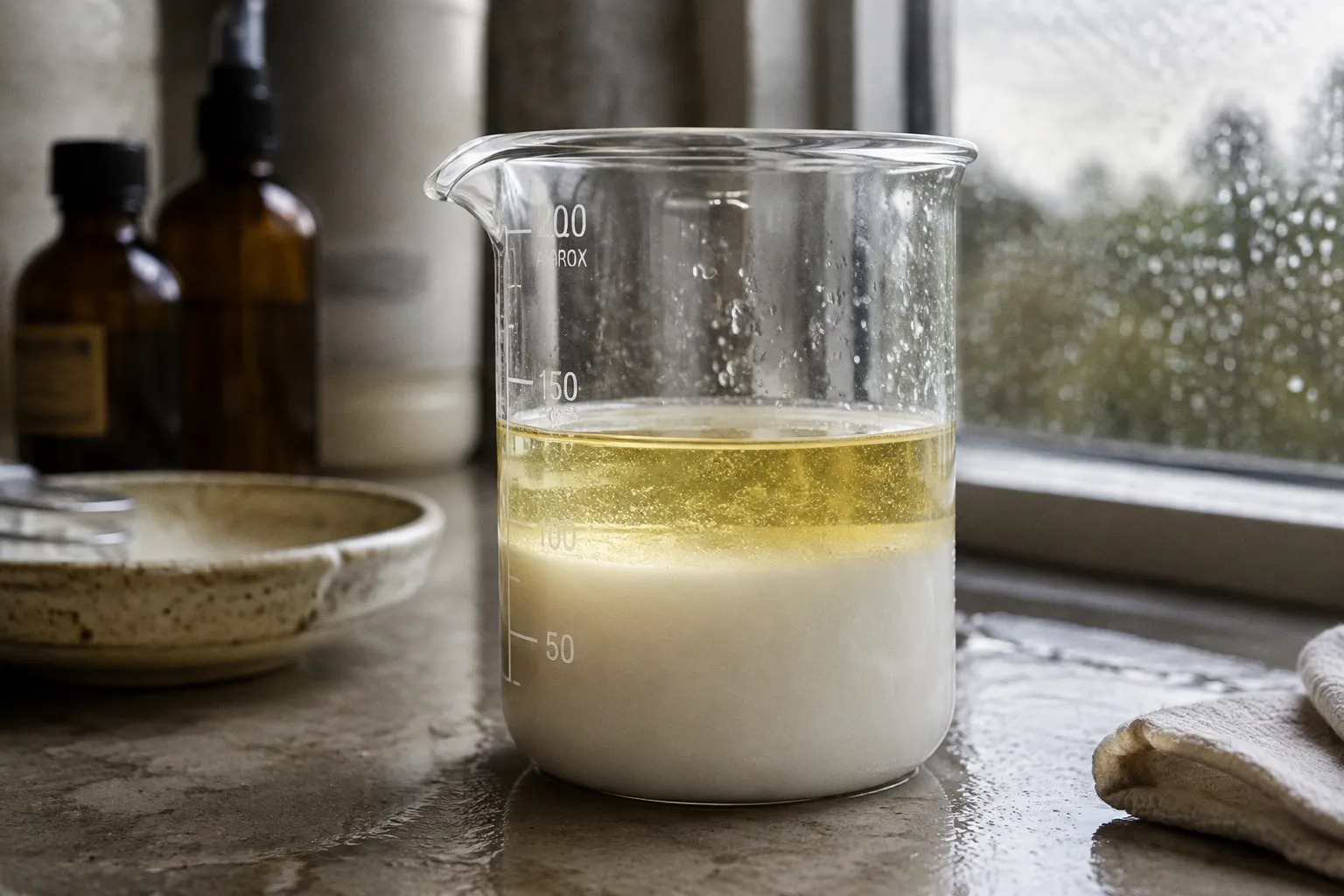
What you are looking at is an emulsion that has lost part of its structure, and the correct response depends on where in the breakdown process the batch currently sits.
When oil and water phases split in a handmade cream, you are watching physical chemistry fail in real time. Sometimes the problem is reversible. Sometimes the batch has crossed a point where reworking it only makes an unsafe product look acceptable. The useful question is not simply “how do I make this look smooth again?” It is “what failed, and can the emulsion, texture, and preservation system still be trusted after the repair?”
That distinction matters in small-batch skincare. A rescued appearance is not the same thing as a stable lotion. A batch can look uniform after reblending and still separate again during storage, lose viscosity as the pH drifts, or develop a preservation problem in the water phase.
A splitting lotion is not a ruined lotion — it is a recipe showing you exactly where its structure is weak.
The Physics of Emulsion Failure: From Creaming to Coalescence
An emulsion is a forced truce between oil and water. The two phases naturally prefer to separate, while an emulsifier helps them coexist by collecting at the oil–water interface. One part of the emulsifier has an affinity for water and another for oil. In a properly made oil-in-water lotion, the emulsifier surrounds dispersed oil droplets and helps keep them apart inside the continuous water phase.
That protective film is only one part of the system. Droplet size, viscosity, temperature history, the composition of the oil phase, mixing energy, pH, electrolytes, and preservation all influence whether the lotion holds together. This is why two formulas with the same nominal emulsifier percentage can behave very differently.
Emulsion failure usually develops in stages.
Creaming is often the first visible warning. The dispersed droplets migrate upward or downward because of density differences between the phases. In an oil-in-water lotion, oil droplets commonly move upward, forming a lighter or richer-looking layer near the surface. The batch may still pour as one product, but its texture is no longer consistent from top to bottom.
Creaming is not the same as complete breaking. The droplets have moved closer together, but they have not necessarily merged. If the formula still has an intact interfacial film and enough viscosity, careful re-homogenization may restore a uniform appearance. That does not prove long-term stability, however. It only tells you that the failure may still be reversible.
Flocculation occurs when droplets gather into loose clusters. The clusters can make a lotion feel grainy, uneven, or oddly thick in one part of the jar and thin in another. The individual droplets remain separate, but they are no longer distributed as evenly as they were after manufacture. In some systems, flocculation can be reduced with better shear or a more suitable rheology modifier. In others, it is a sign that the emulsifier or the continuous phase was poorly matched to the formula.
Coalescence is more serious. Droplets begin to merge into larger droplets, and the total interfacial area that the emulsifier must protect changes. Once enough droplets have fused, oil can reappear as a distinct slick or layer. A spoon can disperse that oil temporarily, but it cannot reliably rebuild the original droplet population or the interfacial film.
Complete breaking, or phase separation, is the final visible state: a clear oil layer, a watery layer, or both, sometimes with a curd-like or waxy band between them. At that point, the batch is no longer behaving as the intended emulsion. The water phase may be exposed, the preservative may no longer be distributed as designed, and the product should be treated as a failed batch until it has been properly assessed.
The appearance gives you a starting diagnosis, not a complete safety decision:
- A thin, slightly richer surface with no free water may indicate creaming.
- A grainy or uneven texture without obvious layers may point to flocculation, cooling problems, or partially crystallized waxes.
- A visible oil slick over a watery base indicates substantial coalescence or breaking.
- A layer that returns soon after mixing suggests that the original structure has not been restored.
The same symptom can have more than one cause. For example, low viscosity can accelerate creaming, but low viscosity may itself result from insufficient gum hydration, pH damage to a polymer, overheating, or microbial activity. Diagnose the whole formula rather than treating the surface appearance alone.
Mastering the HLB Scale for Stable Oil-in-Water Formulations
The HLB, or Hydrophilic–Lipophilic Balance, is a useful way to think about emulsifier selection. In the traditional scale, lower values generally correspond to more oil-soluble, water-in-oil-oriented materials, while higher values are associated with more hydrophilic materials used in oil-in-water systems.
For a simple oil phase, each oil or butter can be assigned a required HLB value. You can then calculate a weighted average for the oil phase and compare it with the emulsifier or emulsifier blend you are considering. The calculation is conceptually straightforward:
1. List the oils, butters, and other oil-soluble materials that make up the relevant oil phase.
2. Multiply each ingredient’s proportion within that phase by its required HLB.
3. Add the results to estimate the oil phase’s weighted required HLB.
4. Compare that result with the emulsifier system’s working range.
That calculation is a useful screening tool, not a guarantee. Natural waxes, esters, fatty alcohols, botanical extracts, and structured emulsifying blends do not always behave like simple entries in an HLB table. Some self-emulsifying systems are designed to work through a combination of interfacial film formation, lamellar structures, fatty alcohol networks, and viscosity building. Their performance cannot be predicted by matching one number alone.
| Parameter | O/W lotion | W/O butter or balm |
|---|---|---|
| Continuous phase | Water surrounds dispersed oil droplets | Oil surrounds dispersed water droplets |
| Typical feel | Lotion to light or rich cream | Dense, occlusive, often more emollient |
| Main stability concern | Oil droplet movement, coalescence, viscosity loss | Water droplet migration, sweating, and microbial protection |
| Useful HLB question | Does the emulsifier support the chosen oil phase in an O/W system? | Does the system support water droplets inside an oil-continuous base? |
| Common failure appearance | Oil rise, thinning, watery separation | Water beads, sweating, or pockets of water |
| First investigation | Emulsifier compatibility, phase process, shear, and viscosity | W/O emulsifier choice, water incorporation, and preservation |
An HLB mismatch is one possible reason a formula separates, but it is not the only explanation. A correctly selected emulsifier can still fail if the oil phase is too complex, the emulsifier is below the supplier’s recommended use range, the phases were combined at the wrong temperature, or the batch was not exposed to enough shear.
The reverse is also true: adding more emulsifier does not automatically fix a weak formula. Excess emulsifier can create draggy skin feel, soaping during application, waxiness, irritation potential, or a different kind of instability. The correct amount depends on the emulsifier chemistry, the total oil phase, the presence of fatty alcohols and co-emulsifiers, and the manufacturer’s technical guidance.
When investigating why a handmade cream splits, record the formula by phase rather than looking only at the total batch weight. Ask:
- What percentage of the formula is oil, butter, wax, ester, or oil-soluble active?
- Is the emulsifier intended for an oil-in-water or water-in-oil system?
- Does the supplier provide a recommended use range and processing temperature?
- Is the emulsifier a single material or a pre-balanced blend?
- Are the oil-phase ingredients compatible with the chosen emulsifier?
- Did the formula change while the emulsifier percentage stayed the same?
This is where many emulsifier ratio mistakes in handmade skincare begin. A maker changes the oil blend, adds a butter, removes a fatty alcohol, or substitutes a different emulsifier, then keeps the old percentage as if the formula had remained chemically identical.
The Role of Mechanical Shear and Temperature in Batch Integrity
Two emulsifiers with similar HLB behavior can produce very different lotions in the same beaker. One of the most underestimated variables is mechanical shear: the physical energy used to break the internal phase into smaller droplets and distribute them through the continuous phase.
Droplet size matters because smaller, more evenly distributed droplets are generally less likely to rise rapidly and easier for the emulsifier system to protect. Shear is not a magic number, though. A high-speed tool used in the wrong vessel can pull in air, create foam, heat the batch locally, or leave material unmixed around the sides. A slow tool used for a thick formula may never provide enough energy to disperse the phases properly.
For a typical hot-process oil-in-water lotion, the process often includes the following decisions:
1. Heat compatible phases according to the emulsifier’s instructions. The oil and water phases usually need to be brought into a suitable temperature range before combining, but the correct range is formula-specific. Some systems require a hotter process; others are designed for lower-temperature or cold processing.
2. Make sure the oil phase is fully melted. Solid butters, waxes, and fatty alcohols must be uniformly molten if they are part of the emulsifying structure. Partially melted material can create graininess and local areas with too little emulsifier.
3. Combine the phases in the intended direction. Most conventional O/W lotions are made by adding the water phase to the oil phase or the oil phase to the water phase under controlled mixing, depending on the system. Follow the emulsifier supplier’s process rather than assuming every O/W formula should be handled identically.
4. Apply enough shear for the equipment and batch size. A small immersion blender can be effective in a narrow vessel where the head is fully covered. A wide bowl, a shallow batch, or a very thick cream may need different equipment to achieve uniform circulation.
5. Continue controlled mixing during cool-down. A lotion can look emulsified while hot and then fail as waxes crystallize or the viscosity network develops. Gentle agitation during cooling helps distribute those structural changes.
Temperature mismatch is a common cause of failure. If the oil phase is substantially cooler than the water phase, butters and waxes may begin to solidify before they are properly distributed. If the water phase is overheated, water loss can change the final percentages, and heat-sensitive actives or preservatives may be damaged if they are added too early.
Cooling also deserves attention. Rapid cooling can create a coarse crystal structure in butters, waxes, or fatty alcohols. That may feel like separation even when the main phases are still present, or it may weaken the emulsion by creating uneven regions throughout the cream. On the other hand, prolonged heating can increase water loss and alter the concentration of the remaining ingredients.
For small batches, the vessel is part of the process. A narrow, tall container often gives an immersion blender better circulation than a wide beaker. Keep the head submerged to avoid drawing air into the product, and move it enough to reach the bottom and sides without splashing. If the batch is too small for the tool to work effectively, scaling the batch down further may make the process less reliable rather than more precise.
The goal is not simply to blend harder. It is to create consistent circulation, an appropriate droplet size, and a controlled temperature history without introducing new defects.
Heat, phase compatibility, shear, and cool-down are one process — not four separate boxes to tick.
pH Sensitivity and the Impact on Hydrocolloid Thickeners
A lotion’s stability depends on more than the emulsifier. Hydrocolloids and polymeric thickeners help increase the viscosity of the continuous phase, slow droplet movement, and sometimes create a network that supports the emulsion. If that network collapses, a previously stable lotion can thin and begin to cream or separate.
pH is one possible trigger, but pH behavior depends on the specific material. There is no single safe pH window for every emulsifier or gum.
Some broad tendencies are useful:
- Certain anionic systems can be sensitive to low pH, salts, and cationic ingredients.
- Cationic emulsifiers and conditioning agents may be incompatible with anionic polymers or negatively charged ingredients.
- Xanthan gum is broadly tolerant compared with some other polymers, but its viscosity and feel still depend on grade, concentration, electrolytes, and pH.
- Carbomer-type polymers usually require neutralization to develop their intended viscosity. The neutralizer, the order of addition, and the final pH all matter.
- Hydroxyethylcellulose is often more forgiving than some acrylic polymers, but it can still lose viscosity under harsh conditions or in the presence of incompatible ingredients.
A final pH that looks reasonable does not guarantee that the thickener has performed correctly. Local pockets of acid or alkali can damage a polymer before the batch is fully mixed. Poor hydration can leave clumps that later swell, collapse, or release unevenly. Electrolytes from botanical extracts, aloe materials, mineral-rich waters, or active ingredients can also change viscosity without producing an obvious pH alarm.
If the lotion was stable for several days and then began to split, review every change made after the original successful batch:
- Was an acid, exfoliant, vitamin derivative, or botanical extract added?
- Was a hydrosol or infusion obtained from a different supplier?
- Did the water source change?
- Was the preservative added at the correct stage and within its recommended pH range?
- Did the batch lose water during heating?
- Was the final pH measured after the product had cooled completely?
- Did the formula contain an ingredient that changed viscosity over time?
Measure pH with a suitable, calibrated meter or another method appropriate for the product. Strips can provide rough orientation, but they may not distinguish closely spaced values in an opaque cream. For a new formula, measure after the batch has equilibrated and record the result. If the pH needs adjustment, make small, well-dispersed changes and allow the product to mix before measuring again.
Preservation needs the same discipline. A preservative is not interchangeable with a pH adjuster, and a pH value is not evidence that preservation is working. The preservative must be compatible with the formula, used at the supplier’s recommended level, and added at the appropriate temperature and stage. If the lotion has visibly separated, the preservative may no longer be distributed in the way the original formula assumed. Reworking the texture does not automatically restore preservative efficacy.
Practical Troubleshooting: Adjusting Emulsifiers and Gums to Save a Batch
When a batch splits, resist the urge to add ingredients immediately. First document what happened: the formula, batch size, phase temperatures, mixing equipment, pH, time to failure, storage conditions, and the appearance of the separation. That record often reveals more than an improvised rescue.
Step 1 — Diagnose the stage
Is the lotion merely creaming, showing loose flocculation, or fully separated into oil and water? Photograph the batch before touching it. If the texture changes after a few minutes of stirring, note how quickly it returns to the failed state.
Creaming or mild unevenness may respond to re-homogenization. A clear oil layer over a watery base should be treated as a substantial emulsion failure. The more dramatic the separation, the less sensible it is to assume that a quick blend has restored the product.
Step 2 — Assess preservation and discard risk
A visibly separated lotion is not just cosmetically unattractive. The water phase may be exposed, the preservative may be unevenly distributed, and the product may have experienced conditions that were not covered by the original formula’s intended stability profile.
If the batch has been sitting separated at room temperature, especially if it contains botanicals or was not properly preserved, salvage may not be worth the risk. Do not use smell or appearance as a substitute for microbial testing. A lotion can look and smell acceptable while carrying an unacceptable microbial load.
For products intended for sale, an unvalidated rescue is particularly difficult to justify. A repaired texture is not the same as a released product with demonstrated stability and preservation.
Step 3 — Recheck the formula before changing it
Calculate the actual oil phase and compare it with the emulsifier system’s supplier guidance. Look for changes in:
- Oil and butter proportions
- Wax or fatty alcohol content
- Emulsifier identity or supplier
- Water loss during heating
- Gum or polymer concentration
- Active ingredients and electrolytes
- Preservative type, level, and addition temperature
- Final pH
Do not apply a universal rule such as “a water-heavy formula always needs a certain percentage of emulsifier.” Emulsifier demand does not rise in a simple one-to-one relationship with the water phase. It depends heavily on the type and amount of oil, the emulsifier’s chemistry, the intended emulsion type, co-emulsifiers, and the formula’s viscosity system.
A formula with a large water phase may need less emulsifier than a more oil-rich formula if the oil phase is simple and the emulsifier is highly efficient. Conversely, a complex blend of butters, waxes, esters, and powders may need a different system even when the total oil percentage is modest. Use the manufacturer’s recommended range as a starting boundary, then confirm the actual formula through stability work.
Step 4 — Decide whether a re-emulsification is technically reasonable
If the batch has not been exposed to questionable storage conditions and the ingredients are worth recovering, a controlled rework may be possible. Separate cleanly divided phases can sometimes be reheated and recombined. A small pilot portion is safer than committing the entire batch to an untested correction.
If adding emulsifier, choose one compatible with the existing system rather than adding a random second emulsifier. Adding a small amount within the supplier’s permitted processing range may help, but the amount must be calculated against the formula and the emulsifier’s function. More is not automatically better.
Likewise, a gum or cellulose thickener can slow droplet movement, but it cannot replace a missing or incompatible emulsifier. Adding gum to a broken emulsion may produce a thick, separated paste: visually impressive, structurally unsound.
Step 5 — Reheat and recombine under controlled conditions
If the chosen emulsifier allows hot processing, bring the relevant phases to the required temperature separately or in a way that prevents local overheating. Make sure the oil phase is fully melted and the water phase has not been concentrated by excessive evaporation.
Recombine using equipment that can circulate the actual batch. Keep the tool submerged, avoid pulling in air, and work the bottom and sides of the vessel. Continue with gentler agitation during cool-down while the viscosity network develops.
The exact temperature, order of addition, and shear time should come from the emulsifier system’s technical information. A process that works for one self-emulsifying wax may be wrong for a liquid polymeric emulsifier or a W/O system.
Step 6 — Verify the fix instead of declaring victory
A re-emulsified batch should be treated as a new development sample. Observe it at room temperature and under relevant stress conditions. Check for:
- Reappearance of an oil or water layer
- Changes in viscosity
- Graininess or crystallization
- pH drift
- Odor or color changes
- Container interaction
- Separation after handling or transport
- Signs that the preservative system may no longer be reliable
Freeze–thaw cycling, warm storage, centrifuge screening, and other accelerated tests can help reveal weakness, but none of them alone proves a product will remain stable in a particular package for a particular shelf life. A small-batch formulator should define the test conditions and interpret them in the context of the formula.
Preservation efficacy requires appropriate testing, not an assumption based on a smooth appearance. For a commercial product, the repaired batch should not be assigned a shelf life until the formula has completed suitable stability and preservation assessment. Even a successful-looking rescue may be useful only as a diagnostic experiment that informs the next batch.
Re-emulsification can restore texture; it cannot, by itself, certify stability or preservation.
Common Mistakes That Cause the Split in the First Place
Working through these causes in order will catch many handmade lotion failures before they become expensive:
1. Choosing an emulsifier by marketing language alone. “Natural,” “silky,” or “lightweight” describes positioning or feel, not whether the material is compatible with the oil phase. Check the technical data and intended emulsion type.
2. Skipping the oil-phase calculation. When oils and butters are changed, the required emulsifier system may change with them. A formula should be recalculated after meaningful substitutions rather than treated as chemically interchangeable.
3. Using too little or the wrong kind of shear. Hand whisking may be adequate for some low-viscosity systems, but it is not automatically enough for every batch size or emulsifier. A large, thick formula needs equipment that can create circulation throughout the vessel.
4. Combining phases at incompatible temperatures. A cooler oil phase can partially solidify waxes and butters before the emulsion forms. An overheated water phase can increase evaporation and damage heat-sensitive components.
5. Treating every gum as an emulsifier. Xanthan gum, hydroxyethylcellulose, carbomer, and similar materials can improve the continuous phase, but they do not all create or protect the oil–water interface. They support an emulsion; they do not necessarily create one.
6. Ignoring pH and electrolytes. A new active, extract, hydrosol, or neutralizer can change polymer viscosity or emulsifier compatibility. Measure the finished product rather than relying on the pH of individual ingredients.
7. Changing several variables at once. If you replace the emulsifier, add a butter, alter the gum, and change the preservative in one batch, the cause of failure becomes difficult to identify. Change one major variable at a time in development samples.
8. Assuming a smooth rescue is a finished product. A batch that looks uniform immediately after blending may separate after cooling, storage, shipping, or repeated use. The fix needs time and testing.
A Quick Reference for the Workbench
| Symptom | Possible causes | First investigation |
|---|---|---|
| Thin oily film with a thinner layer below | Creaming, coalescence, insufficient or incompatible emulsifier system | Check the oil phase, emulsifier compatibility, phase temperatures, and shear before reworking |
| Grainy texture without clear layers | Flocculation, incomplete melting, rapid cooling, or wax crystallization | Revisit the heat history and cooling process; inspect whether the graininess is structural rather than liquid separation |
| Water beads on the surface of a balm | W/O instability or unincorporated water | Confirm the emulsion type and W/O emulsifier system; do not treat it as an ordinary O/W lotion |
| Separation after several days or weeks | pH drift, viscosity loss, ingredient incompatibility, microbial activity, or storage stress | Recheck pH, preservative compatibility, formula changes, and storage conditions |
| Lotion becomes thinner over time | Polymer breakdown, poor hydration, electrolyte effects, temperature exposure, or microbial growth | Compare pH and viscosity over time; if preservation is uncertain, discard rather than mask the change |
| Batch looks smooth but fails after warming or cooling | Weak interfacial film, unsuitable crystallization pattern, or insufficient stability margin | Run a controlled stability screen on a small sample before making more product |
The reality of small-batch formulating is that separation is useful data, but it is not automatically a harmless lesson. A split batch may reveal a rushed cooling step, a changed oil phase, an unsuitable emulsifier, a gum that never hydrated, or a preservation system operating outside its intended conditions.
Read the symptom, identify the mechanism, and document the process before making a correction. If the batch can be responsibly reworked, treat the result as a new development sample. If it cannot, discarding it is not a failure of craftsmanship; it is part of making skincare responsibly.
The next batch becomes better not because separation guarantees improvement, but because the failure has been converted into a specific formulation question: which phase, ingredient, process step, or test was missing? Answer that question with controlled changes, suitable stability testing, and preservation verification. Only then can you make a defensible claim about how long the lotion is likely to remain stable.