Cosmetic Challenge Testing: What It Is and How It Works
A cream can feel perfectly fresh when it leaves the mixing vessel: cool, smooth, botanical, almost softly alive beneath the fingertips.
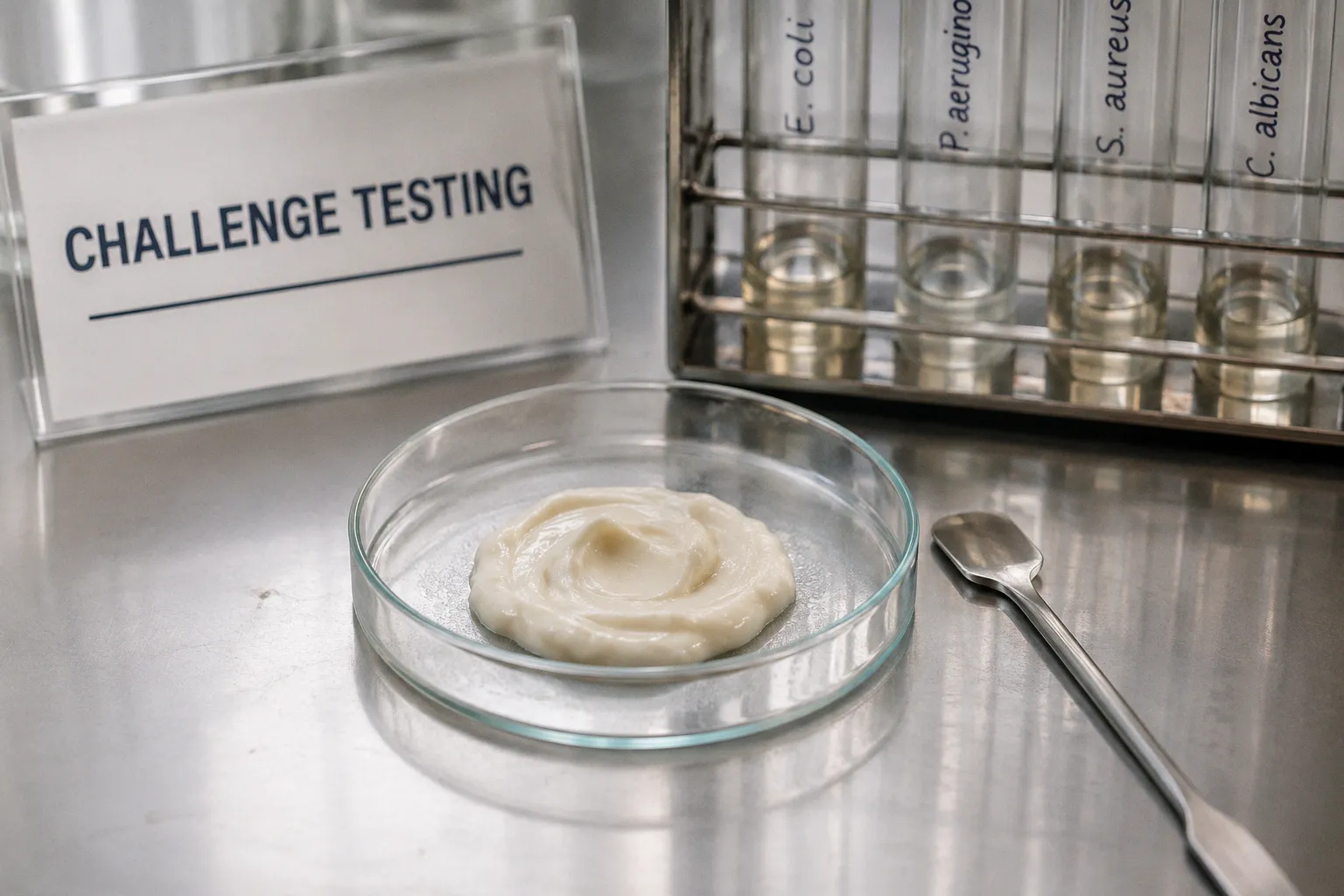
That sensory impression tells you something about texture and finish, but nothing reliable about how the formula will behave after repeated contact with wet hands, bathroom air, skin, and the small invisible transfers that come with everyday use.
For handmade skincare, this is where cosmetic challenge testing becomes essential. Also called preservative efficacy testing, or PET, it examines whether a finished product’s preservative system can control microbial contamination during simulated consumer use. The test does not ask whether a lotion feels elegant or whether a balm melts beautifully into the skin. It asks a quieter, more consequential question: can this water-containing formula resist the growth of bacteria, yeast, and mold over time?
For an indie formulator, that answer belongs to the formula as a whole. A preservative is not a magical ingredient added at the end of production. Its performance depends on the product’s water phase, pH, packaging, chelating system, botanical load, manufacturing hygiene, and the way a customer will actually use it.
The science of preservative efficacy testing
Microorganisms need the right environment to grow. Water is usually the first condition that changes the risk profile of a cosmetic product.
A pure body oil, an oil-based serum, or a solid balm contains little or no available water for microbial growth. These products are generally considered lower risk from a microbial perspective, particularly when they remain genuinely anhydrous throughout normal use. A water-based lotion, cream, cleanser, hydrosol mist, or botanical gel is different. Once water is present, the formulation must be designed to prevent contamination from becoming growth.
This distinction is especially important in small-batch skincare, where a maker may work with fresh botanicals, hydrosols, clays, plant extracts, or handmade emulsions. The more inviting the formula is to the skin, the more carefully its microbial environment needs to be understood. A soothing cream rich in aloe, oat, honey-like humectants, or botanical waters may also offer nutrients that microorganisms can use if the preservation system is incomplete.
PET deliberately places the finished cosmetic under microbial pressure. The laboratory introduces selected microorganisms into a sample of the product and then monitors whether the formula reduces or controls them over a defined period. The purpose is not to make the product unsafe; it is to observe whether the preservative system performs its intended protective role.
That means challenge testing evaluates several interacting parts of formulation design:
- The preservative system: Which antimicrobial ingredients are present, at what concentration, and in what combination?
- The pH: Many preservatives have a useful working range rather than universal activity across every pH.
- Water activity and available moisture: Total water content is not the only consideration; what microorganisms can access also matters.
- Chelation: A chelating agent can bind certain metal ions and support the broader stability of a preservation system.
- Packaging: A pump or airless container may reduce repeated exposure compared with an open jar.
- Consumer handling: Wet fingers, bathroom humidity, contact with skin, and repeated opening all influence the contamination challenge.
- The formula’s botanical and nutrient load: Extracts, proteins, sugars, and natural materials can change the microbial landscape.
In my work with restorative skincare rituals, I often remind formulators that preservation is part of the user experience, even though it is invisible. A customer experiences it through consistency: a cream that remains fresh in scent, color, texture, and performance rather than gradually becoming an uncertain product in the background of a daily routine.
A preservative system is not judged by the ingredient list alone; it is judged by how the finished formula behaves under pressure.
Challenge testing is also not the same as a general cosmetic safety assessment. PET focuses on microbial protection. It does not replace evaluation of skin irritation, sensitization, stability, packaging compatibility, raw material quality, or the broader safety documentation required for a cosmetic product.
How cosmetic challenge testing works
The laboratory begins with a representative sample of the finished product or bulk formula. For a standard challenge test, laboratories typically request approximately 200 to 250 grams of product. The sample should reflect what will actually be sold, including the final preservative concentration and, where relevant, the intended packaging format.
Testing a preliminary bench sample can be misleading if the commercial formula later changes. A shift in pH, a different botanical extract, a new emulsifier, a larger batch size, or a switch from a pump bottle to a jar may alter the preservation environment. For handmade brands, this is one reason careful batch records matter. The formula being tested needs to be the formula being made.
The basic sequence is methodical:
1. The laboratory receives the finished sample.
The product is documented, and relevant information may include its form, intended use, packaging, batch details, and preservation approach.
2. The sample is intentionally inoculated.
The laboratory introduces a defined panel of microorganisms into the cosmetic. This creates a controlled contamination challenge rather than relying on accidental contamination, which would be inconsistent and difficult to interpret.
3. The product is incubated.
The sample is held under specified conditions while the microorganisms interact with the formulation and its preservative system.
4. Microbial levels are measured at set intervals.
Standard monitoring commonly includes Day 2, Day 7, Day 14, and Day 28. The laboratory tracks whether microbial populations decline and whether the formula continues to suppress them.
5. The results are interpreted against the applicable standard.
The final report indicates how the product performed against the required acceptance criteria and whether additional development work may be needed.
The full standard cycle is generally 28 days, while the practical laboratory turnaround from sample receipt to final report is often around four to six weeks. That longer timeline includes sample handling, scheduled observations, analysis, documentation, and report preparation. It is not a test that can be responsibly compressed into an afternoon simply because a product is made in a small batch.
What the laboratory is looking for
A successful result generally shows meaningful reduction of the introduced microorganisms and continued control through the observation period. The exact interpretation depends on the standard being used, the product category, and the laboratory’s reporting framework.
A formula may fail because:
- the preservative concentration is too low;
- the preservative is poorly suited to the product’s pH;
- the ingredients interfere with antimicrobial activity;
- the emulsion is unstable and creates localized water-rich pockets;
- the packaging introduces too much contamination during use;
- the product contains a high nutrient load;
- the formula relies on a preservative but has not been adjusted with supporting ingredients such as a chelator;
- the manufacturing process introduces a microbial burden that the system cannot overcome.
A failed test is not a verdict on the maker’s skill. It is information about the relationship between the formula and its protective system. Often, the useful work begins after the report arrives: reviewing pH, preservation level, emulsification, raw material specifications, filling conditions, and packaging choice before submitting a revised sample.
The standard microbial panel
A standard cosmetic challenge test uses five microorganisms. Together, they represent several major groups that a water-containing cosmetic may need to withstand:
| Microorganism | Group | Why it matters in testing |
|---|---|---|
| Staphylococcus aureus | Bacterium | Represents a clinically relevant bacterial challenge and helps assess antibacterial protection |
| Pseudomonas aeruginosa | Bacterium | Particularly important in water-containing products because of its environmental persistence and adaptability |
| Escherichia coli | Bacterium | Represents another Gram-negative bacterial challenge |
| Candida albicans | Yeast | Tests the system’s ability to control yeast growth |
| Aspergillus brasiliensis | Mold | Represents fungal and mold contamination |
This panel includes three bacteria, one yeast, and one mold. The product is not tested against every organism that exists in the environment. Instead, standardized strains create a repeatable challenge that allows the laboratory to assess preservation performance in a consistent way.
The presence of a mold strain is particularly relevant for botanical and handmade formulas. A product can look clean and smell acceptable while still developing a microbial problem that is not immediately visible. Mold and yeast do not always announce themselves at the first sign of trouble, and fragrance can sometimes disguise early changes. Sensory inspection remains useful for routine quality control, but it cannot replace microbiological assessment.
The panel also explains why a broad claim such as natural, botanical, or clean does not predict the result. Plant-derived ingredients may contribute to a formula’s antimicrobial environment, but they do not automatically create a reliable preservation system. Conversely, a carefully designed system containing approved synthetic or naturally derived ingredients should be judged by its measured performance rather than by a marketing category.
The texture you can feel is only one layer of a cosmetic. Microbial stability lives beneath the surface, where fingertips cannot evaluate it.
PET standards and regulatory context
The main standards commonly associated with cosmetic preservative efficacy testing include ISO 11930, USP <51>, and EP 5.1.3. These standards provide structured approaches for exposing a product to microorganisms, monitoring changes, and interpreting the results.
For an indie cosmetic brand, the relevant standard depends on the market, product type, laboratory practice, and safety assessor’s requirements. A small-batch maker should not assume that one informal home procedure can stand in for a recognized laboratory method, particularly when selling across jurisdictions.
In the European Union, Regulation (EC) No 1223/2009 establishes the framework for cosmetic product safety, including the Cosmetic Product Safety Report. For water-containing skincare products, preservative efficacy or challenge testing may form part of the evidence used to demonstrate that the product is microbiologically safe and adequately preserved. The exact documentation required belongs within the complete safety assessment, rather than being treated as an isolated certificate.
This distinction matters because compliance is not simply a matter of ordering a PET report and placing a badge on a product page. The safety file may also involve:
- the qualitative and quantitative formula;
- raw material documentation;
- manufacturing and hygiene procedures;
- stability information;
- packaging compatibility;
- toxicological assessment of ingredients;
- intended use and exposure;
- microbiological quality of the finished product;
- labeling and claims;
- the preservative efficacy report where applicable.
For brands selling outside the EU, local requirements may differ. The safest path is to work with a qualified cosmetic safety assessor or regulatory professional familiar with the market in which the product will be sold. The laboratory can perform the challenge test, but it does not necessarily determine every regulatory obligation attached to the finished cosmetic.
Why ISO 11930 is often discussed
ISO 11930 is a cosmetic-specific framework for evaluating antimicrobial protection. It is designed around the reality that cosmetics are used repeatedly, handled directly, and formulated in a wide range of textures, from fluid emulsions to rich creams and gels.
The standard does not mean that every product requires the same formulation strategy. It gives the industry a way to assess whether the chosen preservation approach performs adequately in the product being examined. That product-specific nature is crucial for handmade skincare. A successful result for one lotion does not automatically transfer to another lotion simply because both use the same preservative family.
A change in any of the following may justify a new assessment or a conversation with the laboratory and safety assessor:
- pH adjustment;
- preservative percentage;
- supplier or grade of a key raw material;
- addition of a botanical extract or hydrosol;
- change in emulsifier or thickener;
- altered water content;
- new packaging;
- reformulation for fragrance-free or sensitive-skin use;
- significant change in manufacturing process.
Preparing a small-batch formula for testing
The quality of the test depends on the quality and relevance of the sample. Before sending a product to the laboratory, I would prepare the formula with the same unhurried precision used for any restorative ritual: every ingredient weighed accurately, every adjustment recorded, and every change treated as meaningful rather than cosmetic.
A practical preparation sequence looks like this:
1. Finalize the formula before testing.
Do not submit a trial version and then quietly make a different commercial version. The report will apply to the sample tested, not to an imagined future formula.
2. Measure and record the pH where relevant.
Record the pH of the finished product rather than relying only on the expected pH of individual ingredients. If the product is not intended to have a measurable aqueous phase, document that clearly for the laboratory.
3. Use representative raw materials.
The botanical extract, hydrosol, fragrance, emulsifier, and preservative should match the materials intended for production. Supplier changes can bring different microbial loads, solvents, solids, or pH characteristics.
4. Document the batch.
Keep the batch number, date, formula version, processing notes, pH, preservative lot, and packaging information together. This turns a test report into something useful for future manufacturing rather than a solitary piece of paperwork.
5. Send enough finished product.
Laboratories commonly request approximately 200–250 grams for a standard challenge test. Confirm the exact amount before preparing the sample, since requirements vary by laboratory and product type.
6. Describe the intended use honestly.
A leave-on face cream, rinse-off cleanser, beard conditioner, and water-based body mist may require different considerations. Include how the product is packaged and how consumers are expected to dispense it.
7. Allow time for the result.
Plan around a 28-day monitoring period and a typical four-to-six-week overall turnaround. Building PET into the launch calendar is far gentler than discovering at the last moment that a product cannot be released as planned.
A common mistake is to treat preservation as a final decorative decision, like choosing a label color. In reality, the preservation system belongs near the beginning of the formulation conversation. If a maker wants a low-pH lotion, a highly botanical cream, a fragrance-free emulsion, or a formula with a particular natural-preservative approach, those aims should be considered together from the first prototype.
Anhydrous products: lower risk, not zero risk
Water-free products occupy a different place in microbial assessment. Pure oils, oil serums, anhydrous scrubs, and solid balms are generally lower microbial risk under ISO 29621 principles because microorganisms require available water to multiply.
That does not mean every oil-based product is automatically protected forever. A balm used with wet fingers can receive water contamination. A sugar scrub kept in a steamy shower may collect droplets. A dry powder mask can be rehydrated repeatedly in a bathroom. A product that begins as anhydrous may no longer behave as intended if water enters during normal consumer use.
This is where packaging and ritual meet formulation science. A balm in a small twist-up tube has a different exposure pattern from a wide-mouth jar. An oil poured through a controlled dispenser is handled differently from one dipped into with fingers. A scrub used beside a bath may encounter more water than the same scrub stored in a dry cabinet.
For anhydrous products, the relevant questions include:
- Does the formula remain water-free during ordinary use?
- Can a customer introduce wet hands, shower water, or condensation?
- Does the packaging encourage repeated dipping?
- Are there powdered or botanical materials that may carry contamination?
- Is the product likely to be diluted before use?
- Does the label give clear instructions for keeping water out of the container?
- Would microbiological quality testing or another assessment be appropriate even if a standard PET is not required?
A pure body oil and a water-based body cream should not be forced into the same testing logic. Nor should a solid balm be described as incapable of microbial growth under every possible handling condition. The right question is always connected to the formula and its real use.
Preservative-free and naturally preserved formulations
The phrase preservative-free can sound appealing because it suggests simplicity, purity, and a return to the botanical cupboard. But water-containing skincare cannot become microbiologically safe merely by omitting a conventional preservative. If the product contains water, the maker still needs a credible strategy for controlling microbial growth.
That strategy might involve a carefully selected preservative system, a formulation with very low water availability, a validated packaging approach, or a product format that is genuinely anhydrous. The route should be supported by appropriate testing and professional assessment rather than by the language on the label.
Natural or plant-derived preservation systems should also be evaluated by performance. They are not inherently ineffective, and they are not guaranteed to pass. Their success can depend on pH, concentration, compatibility, solubility, chelation, water activity, packaging, and the rest of the formula. No broad-spectrum ingredient guarantees a passing challenge test simply because it appears on a supplier’s recommended usage list.
This is particularly important for small-batch brands that want to preserve the sensory character of a botanical product. A gentle aromatic profile, a soft cream texture, and a short ingredient list are all worthwhile goals, but none removes the responsibility to understand microbial safety. Sometimes the most restorative choice for the customer is the one that is least visible: a preservation system quietly doing its work in the background.
What to do if the formula does not pass
A failed PET result should be read as a formulation map. It identifies that the product, as submitted, did not demonstrate sufficient microbial control under the test conditions. The next step is not to add more of everything. More preservative can create its own problems, including irritation, incompatibility, instability, or noncompliance with permitted use levels.
Instead, review the formula in a deliberate order:
- Confirm the measured pH and whether it sits within the preservative system’s effective range.
- Check the actual preservative concentration against the supplier’s technical guidance and applicable limits.
- Review whether the formula contains ingredients that can reduce preservative availability.
- Examine the role of chelators and whether the system needs additional support.
- Reassess the water phase, botanical extracts, proteins, sugars, and other nutrient-rich ingredients.
- Consider whether the emulsification process creates instability or uneven distribution.
- Look at the packaging and the level of exposure during consumer use.
- Review manufacturing hygiene, equipment cleaning, filling conditions, and raw material handling.
- Reformulate one meaningful variable at a time where possible, so the result can be understood.
- Submit the revised finished product for appropriate reassessment rather than relying on assumptions.
This process can feel slow, particularly for a maker working toward a seasonal launch or a limited collection. Yet small-batch beauty is strongest when its intimacy is supported by discipline. The handmade quality should live in the thoughtful sourcing, the considered texture, the fresh production, and the human scale of the brand—not in an informal approach to safety.
The place of challenge testing in an artisan skincare ritual
Cosmetic challenge testing for handmade skincare is ultimately a bridge between the sensory and the scientific. One side of the work is felt: the enveloping slip of an emulsion, the grounding scent of a botanical oil, the restorative pause created by warm water and a careful massage. The other side is measured through microbial counts, reduction patterns, pH, test intervals, and documented standards.
Neither side diminishes the other.
For an indie brand, PET can help answer whether a water-containing product is protected as designed. It can also reveal where the formula needs refinement before it reaches a customer’s bathroom shelf. The standard 28-day protocol, the five-organism panel, and the laboratory’s four-to-six-week timeline give the maker a structured way to move from hopeful formulation to evidence-supported release.
Anhydrous products may carry a lower microbial risk, but they still deserve thoughtful handling guidance and a realistic assessment of water exposure. Naturally preserved products may perform beautifully, but only testing can show whether a particular formula does. And a finished product should never be judged by its preservative ingredient in isolation.
The most trustworthy handmade skincare does not ask the customer to choose between pleasure and care. It offers both: a ritual that feels beautiful in the hands, and a formulation process grounded enough to protect the person using it. Take the time to let the product prove itself. That patience is not separate from the ritual; it is part of its integrity.