Artisan Skincare pH Testing: Step-by-Step Measurement
You're not going to ship a cream that stings the face. That's the short version of why every small-batch maker needs a real pH testing procedure - not a strip tossed into a jar, not a guess, not…
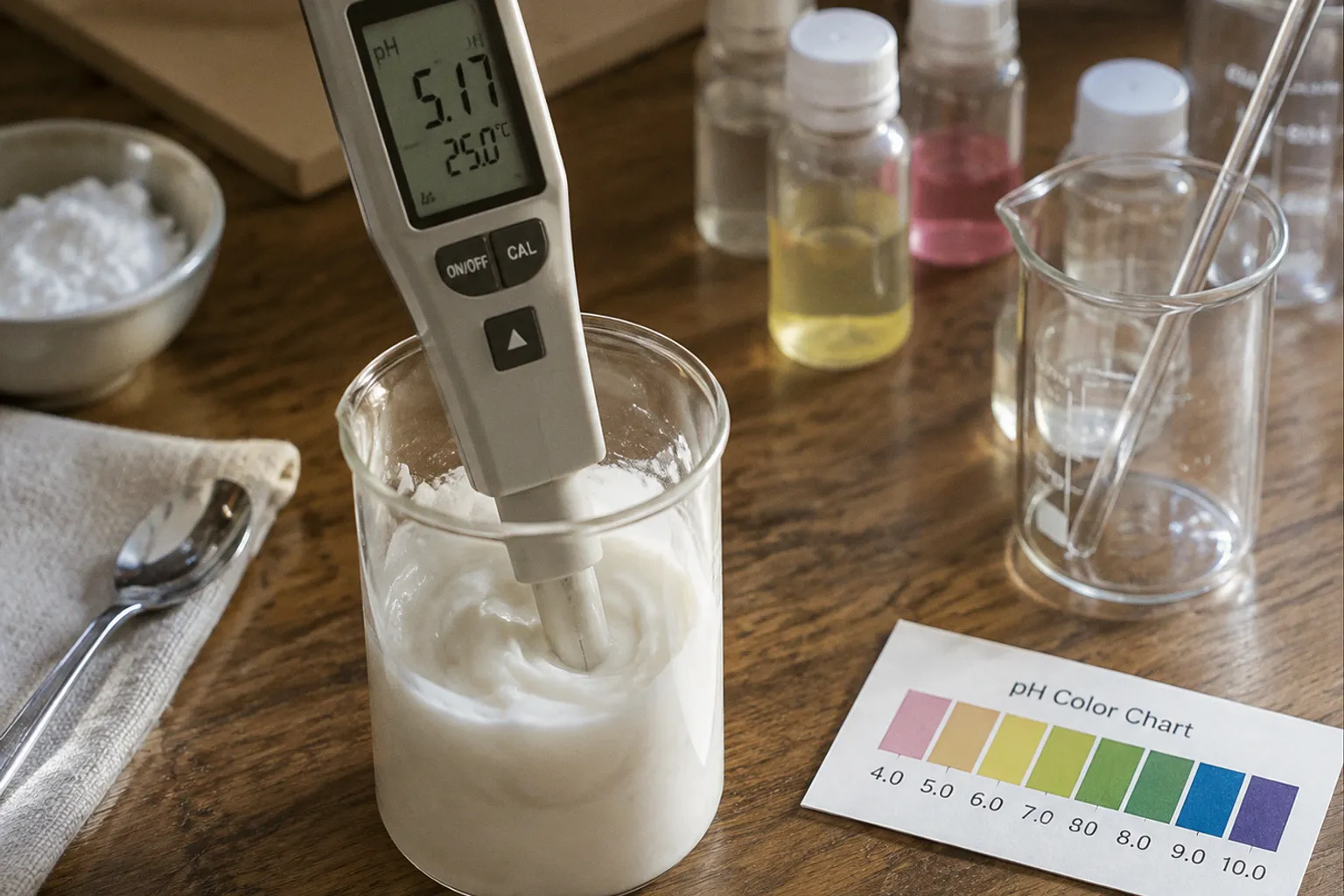
You're not going to ship a cream that stings the face. That's the short version of why every small-batch maker needs a real pH testing procedure - not a strip tossed into a jar, not a guess, not "I'll check it later." If your formula contains water, pH decides whether your preservative system works, whether the product sits comfortably on skin, and whether you're bottling something that turns into a microbial playground in three weeks.
Most indie formulators I work alongside skip the step, or run it once and never again. That is the mistake. pH drifts. Ingredients age. Suppliers swap a raw material for a "similar" version and your buffer system can no longer hold the line. A reliable testing routine is the difference between a hobby kitchen and a brand customers come back to twice.
Why pH Matters in Water-Based Formulations
pH measures hydrogen ion concentration in an aqueous solution. That is the technical line, and it carries a practical consequence: only water-containing cosmetics have a meaningful pH. Leave-on emulsions, toners, gels, water-based serums, and any lotion you whip up in the workshop all qualify. Once water is in the formula, pH becomes the master variable that holds stability, safety, and skin compatibility together.
A formula outside its target range does not just feel off. It compromises the preservative system. Most cosmetic preservatives - the broad-spectrum ones indie makers actually rely on - work inside a defined pH window. Push the product too far alkaline or too far acidic, and you are no longer preserving the cream. You are feeding bacteria a stable culture medium.
Skin sits naturally on the acidic side. The surface of healthy human skin typically ranges from pH 4.5 to 5.5 - this is the acid mantle, the thin film of sebum, sweat, and natural moisturizing factors that defends against pathogens and keeps the barrier intact. Leave-on facial and body products are usually designed to land inside that range so they don't strip the mantle or trigger reactivity on application.
Anhydrous vs. Water-Based: Know What You Can Actually Test
Before you grab a meter, identify whether your formula is even testable. Anhydrous products - lip balms, oil serums, body butters, salves, whipped shea with no water phase - do not have a measurable pH. pH is a property of aqueous solutions, full stop. Measuring an oil blend tells you nothing useful and produces a number that has no bearing on safety or skin compatibility.
This trips up new formulators constantly. They run a strip across a balm, get a color, and try to interpret it. Ignore that number. It is noise.
Water-based or water-containing products are testable. Lotions, creams, serums, gel cleansers, floral waters, hydrosols, conditioners with water, shampoo bars, even some soap pastes all qualify. Solid soap bars require a special dilution step, which I will cover below.
If water isn't in the formula, pH isn't a meaningful measurement. Save the strips for the next batch.
Calibrating Your Digital pH Meter
Digital pH meters are the standard for serious formulation work. Strips have a place for rough checks, but a calibrated meter is what you need for repeatable, defensible numbers.
To get trustworthy readings, calibrate before every session - not once a year, not "when I remember." The standard calibration uses three buffer solutions: pH 4.01, pH 7.00, and pH 10.01. Run a two-point calibration at minimum (4.01 and 7.00 for acidic skincare, 7.00 and 10.01 if your range includes alkaline products like soap), three-point if you want full coverage.
Here is the part many home formulators miss: distilled water alone cannot be used to calibrate a meter to pH 7.0. Atmospheric carbon dioxide absorbs into the water, dropping its actual pH and lowering ionic strength. The probe reads unstable numbers. Use proper buffer solution, not water. This is a small step that makes or breaks your calibration.
Rinse the electrode with distilled water between buffer dips and blot - do not wipe - dry with lint-free tissue. Wiping can scratch the glass and damage the sensitive membrane. Store the probe in proper storage solution, never dry.
| Step | Action | Why it matters |
|---|---|---|
| 1 | Power on meter, remove storage cap | Probe must be in working condition |
| 2 | Rinse with distilled water, blot dry | Residue from storage skews readings |
| 3 | Dip into pH 7.00 buffer, adjust to reading | Midpoint calibration anchors the scale |
| 4 | Rinse, blot, dip into pH 4.01 buffer, adjust | Acid-side calibration for skincare range |
| 5 | (Optional) Rinse, blot, dip into pH 10.01 buffer | Full-range coverage |
| 6 | Rinse, blot, store properly between uses | Probe longevity and accuracy |
Replace the probe when readings drift, response slows, or the slope falls outside manufacturer specs. A tired probe produces numbers that look real but aren't.
The 10% Dilution Method for Creams and Solid Soaps
You can't stick a probe into a thick emulsion and call it a day. The reading won't stabilize, the probe surface won't contact the water phase evenly, and you will get a number that doesn't represent anything reproducible. The standard practice across professional cosmetic labs is a 10% dilution in distilled water.
For a thick cream, lotion, or solid bar soap:
1. Weigh 10 grams of the product.
2. Add 90 grams of distilled water (room temperature).
3. That is a 1:9 ratio - one part product to nine parts water.
For solid soap bars specifically, shave or grate a representative slice, weigh it accurately, and disperse it into the 90 grams of distilled water. Some makers gently warm the mixture to fully incorporate; allow it to cool to room temperature before testing. Warm samples skew readings. Test once cooled.
Stir or shake gently to disperse. Let the solution settle so the probe sees a homogeneous liquid. Then test.
Use distilled water, not tap, not filtered. Tap water carries minerals and chlorine that throw off the reading and contaminate your test, and the contamination also shortens probe life.
For thin toners, serums, and other low-viscosity water-based products, you can test directly - no dilution needed. Rinse the probe with distilled water, blot, and dip. Wait for the reading to stabilize. Most meters need 30 to 60 seconds. For anhydrous products, skip the test entirely. No water, no pH.
Reading the Number and Adjusting Safely
The target range for leave-on skincare applied to the face and body is pH 4.5 to 5.5. That window aligns with the skin's natural surface pH and supports the barrier function. Products sitting comfortably inside this range are generally well-tolerated; products that drift too far alkaline can disrupt the acid mantle, while products that go too acidic risk irritation and stinging, especially on compromised skin.
For specific product types:
| Product type | Typical target pH | Notes |
|---|---|---|
| Facial serum (leave-on) | 4.5–5.5 | Skin-compatible, supports acid mantle |
| Moisturizer / cream (leave-on) | 4.5–5.5 | Standard leave-on target |
| Body lotion | 4.5–6.0 | Slightly higher end for sensitive users |
| Foaming cleanser (rinse-off) | 5.0–6.5 | Surfactant performance range |
| Cold process soap (cured) | 8–10 typical | Chemistry-bound; do not force down |
| Anhydrous balm or oil | Not applicable | No water phase; no meaningful pH |
Cold process soap bars deserve a special callout. These do not adjust cleanly down to pH 5.5. The soap molecule itself is alkaline. Trying to "pH down" a cured bar destroys the structure of the soap you just made. Soap bars are alkaline by chemistry. Test for documentation, label them honestly, and stop chasing an acidic number on a product that is fundamentally a sodium salt of a fatty acid.
If your reading lands outside target, adjust incrementally. The typical approach is to add pH adjusters - citric acid solution for lowering, sodium hydroxide solution or triethanolamine for raising - at 0.05% to 0.10% of the total formula weight, stir thoroughly, retest, and repeat. Going by the dropper and guessing is how formulas overshoot and emulsions break.
Document every adjustment. The number, the time, the temperature of the sample. pH shifts with temperature, and a reading at 40°C looks different from a reading at 25°C. Standardize your testing temperature or note it on every batch record. For emulsions especially, pH adjustment often goes into the water phase during the cool-down stage, after the emulsion has formed. Adding acid or base to a hot mixture before emulsification can break the system. Different rules apply to different formulas - this is where your batch notes and formulation journal earn their keep.
Common Mistakes That Skew Your Results
Most indie pH mistakes fall into a few repeatable patterns. Catch these and you will save yourself ruined batches and confused customers.
1. Testing anhydrous products. No water, no measurement. Move on.
2. Using tap water for dilution. Minerals contaminate the sample and the probe.
3. Skipping calibration. An uncalibrated meter is a random number generator with a screen.
4. Testing a hot sample. Heat skews pH. Cool to room temperature first.
5. Wiping the probe. Blot it. Wiping scratches the glass membrane and ruins accuracy over time.
6. Forgetting storage solution. Letting the probe dry out kills it within weeks.
7. Testing once and trusting forever. pH drifts. Re-test each batch and any time a supplier changes.
8. Forcing soap bars to pH 5.5. The chemistry does not bend that way, and trying breaks the bar.
9. Ignoring temperature. A reading at 35°C is not the same as a reading at 25°C. Standardize or note it.
The Rule
Test every water-containing batch before it goes into a jar. Calibration before the session, 10% dilution for thick formulas, distilled water only, and a final read at room temperature. Document the number on the batch record. If the reading sits inside the target range for your product type, the batch is cleared. If it does not, adjust incrementally and re-test until it does.
If water is in the formula, pH is non-negotiable. No exceptions, no shortcuts, no "I'll check the next batch."
That is the whole job: calibrated meter, clean technique, honest record. Run that routine and your small-batch line holds its quality from the first jar to the hundredth, and your customers never have to wonder whether the cream they just opened is safe to put on their face.