Cold-Pressed Rosehip Oil: What to Check Before Buying
Cold-pressed rosehip oil is not defined by its orange color or by the word “natural” on the label.
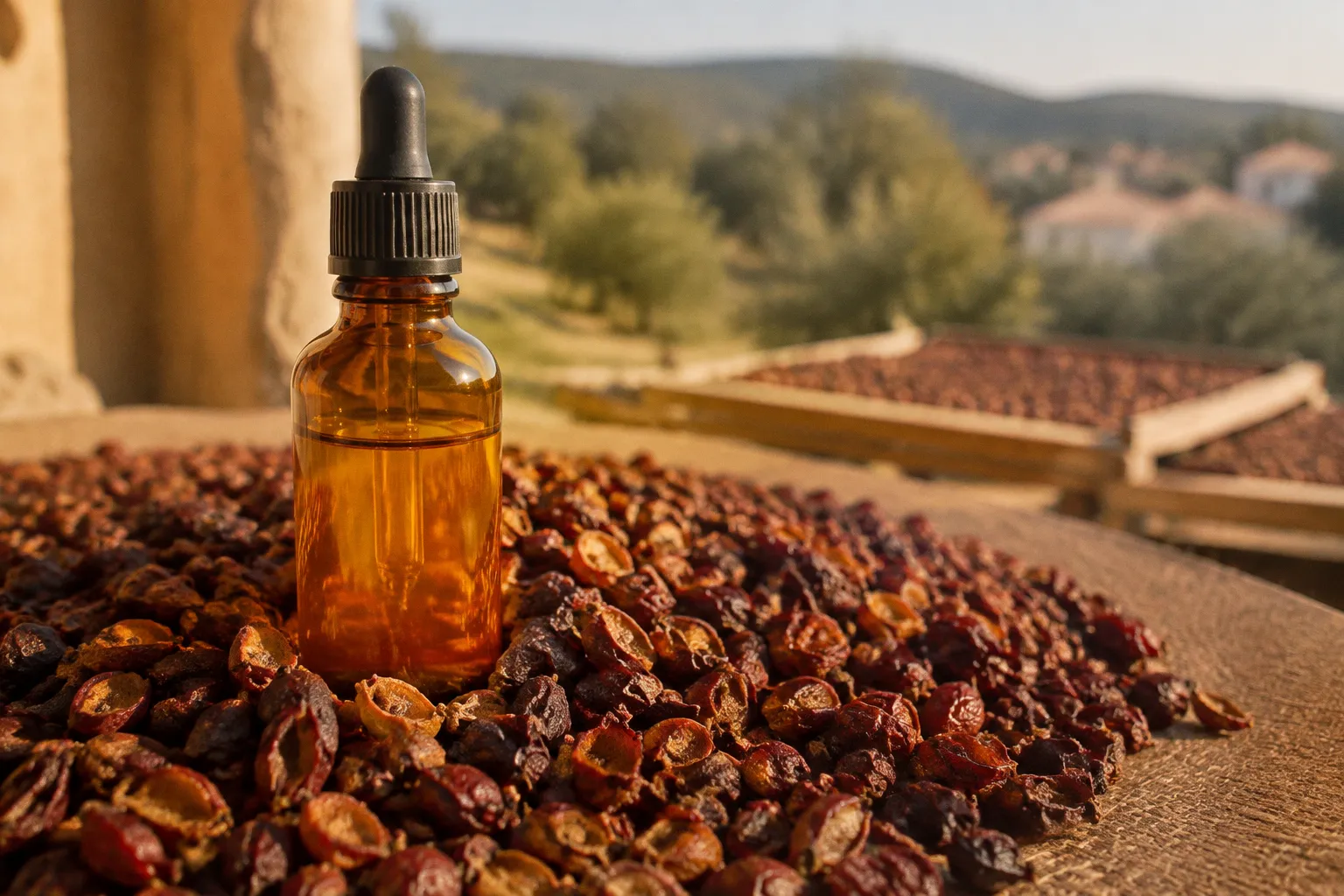
Its quality depends on a chain of variables: botanical species, extraction temperature, fatty-acid profile, oxidation control, packaging, and the time elapsed since production.
The main chemical problem is instability. Rosehip seed oil contains a high proportion of polyunsaturated fatty acids. Linoleic acid generally accounts for 35%–60% of the oil, alpha-linolenic acid for 17%–38%, and oleic acid for 13%–22%. More than 70% of the total lipid fraction may be polyunsaturated. These lipids can support a lightweight skin-conditioning profile, but they also oxidize more readily than the predominantly monounsaturated lipids found in oils such as jojoba.
That is why the cold pressed rosehip oil quality indicators are mostly related to preservation and processing. A pleasant label is not evidence of a stable formula.
The chemistry of cold-pressed integrity
Cold pressing is a mechanical extraction method. Seeds are cleaned, mechanically crushed, and pressed to release the oil. The process does not automatically guarantee superior quality, but it can preserve heat-sensitive botanical compounds more effectively than aggressive heat extraction or solvent refining.
Rosehip oil contains several components that are vulnerable to processing conditions:
- Polyunsaturated fatty acids, particularly alpha-linolenic acid.
- Carotenoids, which contribute to the natural orange or red-orange color.
- Tocopherols and other minor antioxidant compounds.
- Volatile compounds responsible for part of the characteristic scent.
- Other unsaponifiable materials that may be reduced by refining.
Heat and solvent processing are not interchangeable with cold pressing. Refining may improve clarity, reduce odor, and increase storage stability. Those changes can be useful in certain industrial formulas. They also mean that the final oil is no longer chemically equivalent to a minimally processed, unrefined product.
Some comparative material reports losses of up to 70% in sensitive botanical compounds and polyunsaturated lipid fractions when heat extraction or solvent-refining is used instead of mechanical cold pressing. The exact loss depends on the process, raw material, temperature, solvent system, and purification steps. The practical conclusion is narrower: extraction method changes the composition of the oil, and the label should disclose that method clearly.
How to read the extraction language
A useful label will distinguish between terms that are often treated as synonyms but are not identical:
- Cold-pressed: Indicates mechanical pressing carried out under controlled temperature conditions. It does not, by itself, confirm that the oil is unrefined.
- Unrefined: Indicates that the oil has not undergone extensive bleaching, deodorization, or purification. Natural color and scent are more likely to remain.
- Virgin: Often refers to mechanical extraction and limited processing, but the exact regulatory meaning varies by product category and market.
- Refined: Usually means that the oil has been processed to remove odor, color, free fatty acids, pigments, or other minor components.
- CO2 extract: Produced using supercritical carbon dioxide. This is a separate extraction category, not simply a more stable version of cold-pressed oil.
A product may be cold-pressed and then filtered, deodorized, or otherwise treated. Filtration alone is not equivalent to refining, but vague claims such as “purely extracted” provide little technical information.
Cold pressing is a processing description, not a complete quality certificate.
The ingredient list should identify the oil with a recognizable INCI name and, when available, the botanical species. “Rosehip oil” is less informative than a label that identifies the plant source and whether the product is seed oil, fruit oil, or a blend.
Rosehip seed oil and rosehip fruit oil are not necessarily the same material. The seed-derived product is the one commonly discussed for its high concentration of unsaturated fatty acids. If a bottle uses broad language but does not identify the plant part, the buyer cannot reliably infer its lipid profile.
Rosa rubiginosa, Rosa canina, and Rosa moschata
The word “rosehip” describes a group of botanical raw materials rather than one chemically uniform oil. Common species used in cosmetic formulations include:
- Rosa rubiginosa, also known as Rosa eglanteria or Rosa mosqueta.
- Rosa canina.
- Rosa moschata.
Species affect the fatty-acid distribution, color, odor, and minor compound content. For example, Rosa rubiginosa has been reported to contain approximately 78% essential unsaturated fatty acids, compared with approximately 71% in Rosa canina. These figures should not be treated as fixed specifications for every batch. Growing conditions, seed maturity, storage, pressing conditions, and filtration can all alter the final result.
A serious product description should therefore provide at least some of the following information:
- Botanical name.
- Plant part used.
- Country or region of origin.
- Extraction method.
- Batch or lot identification.
- Production date or best-before date.
- Recommended storage conditions.
The absence of one detail does not automatically mean the oil is poor. The absence of nearly all technical details makes independent evaluation difficult.
Why species identification matters
Species information has two practical uses.
First, it gives context for the fatty-acid profile. A rosehip oil with a high polyunsaturated fraction should be expected to behave like an oxidation-sensitive oil, regardless of the marketing language used around it.
Second, species identification prevents exaggerated claims. Different rosehip oils cannot be assumed to contain identical concentrations of carotenoids, tocopherols, or retinoid-related compounds. Research on one species should not automatically be transferred to another.
This is particularly relevant to Rosa rubiginosa. Some reports describe trace quantities of all-trans retinoic acid, also known as tretinoin, in the range of 0.01%–0.1%. That finding does not make rosehip oil equivalent to a prescription tretinoin product. It also does not establish that every commercial rosehip oil contains the same amount, or that Rosa canina has an identical concentration.
The correct interpretation is limited: botanical identity may influence the presence and level of specific minor compounds. It does not justify pharmaceutical claims.
Color and scent: useful observations, weak proof
Unrefined rosehip seed oil commonly ranges from vibrant golden-orange to dark orange-red. The color is associated in part with natural carotenoids such as beta-carotene. A mild earthy, herbal, or slightly acidic scent is also compatible with a minimally processed oil.
These sensory characteristics are useful for detecting obvious inconsistencies. They are not sufficient for confirming authenticity.
What the color can and cannot tell you
A pale yellow or almost clear oil is not automatically better. It may have been refined, bleached, deodorized, diluted, or produced from a batch with a different pigment profile. Pale color should not be used as a quality advantage when the product is advertised as unrefined.
At the same time, dark color is not proof of high potency. It may reflect a higher carotenoid concentration, but it can also be influenced by seed condition, oxidation, filtration, and storage. Color is a screening observation, not a laboratory specification.
Look for these patterns:
- Golden-orange to orange-red: Consistent with many unrefined rosehip seed oils.
- Very pale yellow or clear: May indicate refining, bleaching, deodorization, dilution, or naturally low pigment content.
- Unusually dark brown: May indicate heavy oxidation, thermal damage, contamination, or simply a strongly pigmented batch. Further information is required.
- Visible sediment: Can occur in minimally filtered botanical oils. It is not automatically a defect, but it should not be confused with microbial contamination or insoluble debris.
The bottle should be assessed under neutral light. Colored glass can alter the apparent shade, and product photography is unreliable because of lighting and post-processing.
The authentic rosehip oil scent profile
Fresh, minimally processed rosehip seed oil often has a distinct botanical odor. Earthy, herbal, nutty, or slightly acidic notes are plausible. The scent can vary by species and batch.
A completely odorless oil may have been deodorized or refined. That is not necessarily unsafe, but it is evidence that the original volatile profile has been changed. A sharp smell resembling old cooking oil, stale nuts, crayons, or solvent is more concerning because it may indicate oxidation or processing residues.
Do not confuse a fragrance addition with a naturally pleasant oil. Essential oils, parfum, and aromatic extracts can cover the raw material’s original odor. If the product is intended to be a single botanical oil, the ingredient list should not contain undisclosed fragrance components.
The sensory check is simple:
1. Open the bottle briefly rather than leaving it exposed to air.
2. Assess the odor at room temperature.
3. Compare it with the product’s stated processing method.
4. Examine whether the smell is botanical and mild or sharp and rancid.
5. Do not use a strongly oxidized oil on the face simply because the color appears correct.
Oxidation is the central storage problem
Polyunsaturated fatty acids contain multiple double bonds. These sites are more vulnerable to reactions with oxygen, light, and heat. The process begins with lipid oxidation and can produce peroxides and secondary breakdown products. As oxidation advances, the scent becomes sharper or stale, the color may shift, and the oil’s skin feel can become less predictable.
Rosehip oil therefore has a shorter practical shelf life than many more oxidation-resistant carrier oils. Cold-pressed oil is commonly described as having a shelf life of approximately 3–6 months, with some products lasting up to 6–9 months after opening when stored properly. The exact period depends on the initial oxidation state, packaging, headspace, filtration, antioxidant system, and storage temperature.
CO2 extracts are a different case. They may remain stable for up to 18 months because the extraction and composition differ from a conventional cold-pressed oil. That longer period should not be applied to every rosehip product.
Packaging is part of the formula
A good raw material can deteriorate in unsuitable packaging. The most useful features are:
- Dark, light-protective glass or another validated protective container.
- A small bottle size that matches the expected rate of use.
- A narrow opening, pump, or dropper that limits repeated air exchange.
- A secure cap that prevents unnecessary headspace exposure.
- A clearly stated storage recommendation.
Transparent bottles are not automatically unacceptable if they are packaged in an opaque carton and stored correctly, but direct light exposure is undesirable for an oxidation-sensitive oil.
Repeatedly opening a large bottle introduces oxygen. Buying a smaller quantity is often chemically more sensible than choosing a larger bottle at a lower unit price. The savings disappear if the final portion becomes rancid before use.
Vitamin E does not make an unstable oil permanent
Tocopherol can function as an antioxidant in an oil-based formula. It may slow oxidation, particularly when used as part of a broader preservation and packaging strategy. It does not stop oxidation indefinitely, and it does not restore an oil that has already degraded.
The label may list tocopherol, mixed tocopherols, or another antioxidant. This is useful information, but the concentration is often not disclosed. Antioxidant presence should therefore be treated as a supporting factor rather than a guarantee of long shelf life.
A certificate of analysis is more informative when it includes batch-specific oxidation data. In particular, a peroxide value can help characterize early oxidation, although a single peroxide value does not describe the entire oxidation process. Cosmetic retail products do not always publish a standardized peroxide-value cutoff, so the buyer should avoid inventing a universal number where none has been provided.
A practical buying sequence
The following sequence separates claims that can be checked from claims that require laboratory documentation.
1. Identify the raw material.
Confirm that the product is rosehip seed oil rather than a fragranced blend, rosehip fruit extract, or a formula containing a small amount of rosehip oil diluted into another carrier.
2. Find the botanical name.
Look for Rosa rubiginosa, Rosa canina, or Rosa moschata. A species name does not prove quality, but it improves traceability.
3. Check the extraction method.
Cold pressing and CO2 extraction are different processes. Do not treat them as interchangeable, and do not assume that “natural extraction” describes a technically meaningful method.
4. Review the ingredient list.
If the product is sold as a single oil, the ingredient list should be short and specific. Added fragrance or essential oils changes the product and may increase irritation risk.
5. Assess the color and scent together.
Orange color with a mild earthy or herbal odor is compatible with unrefined oil. Pale color, no odor, or a sharp rancid odor requires further explanation.
6. Check the date and package size.
An oxidation-sensitive oil should not be purchased in a volume that will remain open for a year. Production date is more useful than a distant expiry date when the oil has already spent months in storage.
7. Examine storage instructions.
The product should be protected from heat and light. Refrigeration may help extend practical usability, but condensation and repeated temperature changes should be avoided.
8. Request technical data when the claim is strong.
If a supplier claims exceptional purity, high active content, or unusually long stability, ask for batch documentation rather than relying on the wording alone.
The strongest product description usually does not promise universal results. It provides enough raw-material information for the buyer to understand what was extracted, how it was handled, and how quickly it should be used.
Cold-pressed oil versus CO2 extract
Both materials can be useful in cosmetic formulation, but they behave differently.
| Parameter | Cold-pressed rosehip seed oil | Rosehip CO2 extract |
|---|---|---|
| Production method | Mechanical pressing of rosehip seeds | Supercritical carbon dioxide extraction |
| Typical sensory profile | More noticeable botanical odor and natural color | Depends on fraction and processing; may be more concentrated |
| Oxidation concern | High because of the polyunsaturated lipid content | May have a longer reported shelf life, up to 18 months |
| Label expectation | Should identify cold pressing and, ideally, botanical species | Should identify CO2 extraction and the type of extract |
| Formulation use | Direct facial oil, balms, emulsions, anhydrous blends | Concentrated active or lipid fraction, depending on specification |
| Main buying risk | Oxidation from age, air, heat, and light | Confusing a concentrated extract with a complete carrier oil |
| Sensory interpretation | Color and scent often reflect minimal processing | Sensory properties may not match cold-pressed oil |
A CO2 extract is not automatically more effective for every skin concern. Its suitability depends on the extracted fraction, concentration, solubility, and the rest of the formula. It may be more stable, but stability and efficacy are separate variables.
The same distinction applies to refined and unrefined material. Refining can reduce color and odor while improving consistency. An unrefined oil can retain more native minor compounds while requiring stricter storage. Neither category should be treated as universally superior.
The correct question is not whether an oil is natural. It is whether its composition, stability, and intended use are compatible.
The tretinoin claim requires technical restraint
Rosehip oil is frequently marketed as a natural retinoid source. The underlying discussion requires precision.
Some data on Rosa rubiginosa describe trace all-trans retinoic acid in concentrations between 0.01% and 0.1%. All-trans retinoic acid is tretinoin, a pharmacologically active retinoid. However, several limitations matter:
- The reported range is not a guaranteed specification for commercial oil.
- The result is associated particularly with Rosa rubiginosa, not necessarily every rosehip species.
- Extraction method and analytical method can influence what is detected.
- A trace concentration in a botanical oil is not equivalent to a standardized prescription product.
- The presence of a compound does not establish a predictable clinical dose.
- The product may not be tested or labeled as a retinoid treatment.
This is also why rosehip oil should not be used to make pharmaceutical-level claims about acne, wrinkles, pigmentation, or scar remodeling. It may function as an emollient lipid and provide a source of unsaturated fatty acids and minor botanical compounds. That is a reasonable cosmetic position. Presenting it as a substitute for tretinoin is not.
People using prescription retinoids should also avoid assuming that adding a fragranced or oxidized botanical oil improves the treatment. Irritation is influenced by the entire routine, including cleanser strength, barrier condition, exfoliating acids, fragrance materials, and retinoid frequency.
Common errors when choosing rosehip oil
Several buying mistakes occur because sensory appearance is given more weight than product documentation.
Treating orange color as proof of authenticity
Carotenoids can explain the natural orange-red appearance of unrefined oil. They do not prove that the oil is undiluted, fresh, or correctly identified. Color is one observation among several.
Assuming clear oil is more purified and therefore better
Clarity can result from refining, bleaching, deodorization, or filtration. If the goal is a minimally processed oil, clarity is not a useful quality advantage.
Ignoring the opening date
The printed expiry date applies under stated storage conditions and does not eliminate the effect of repeated air exposure. Once opened, an oxidation-sensitive oil should be monitored by smell, appearance, and storage history.
Buying a large bottle because the price per milliliter is lower
This is a basic stability error. If the product is used slowly, the larger container may spend too long exposed to oxygen after opening.
Confusing a blend with a single botanical oil
A formula can contain rosehip oil alongside jojoba, sunflower, squalane, fragrance, or essential oils. That may be a well-designed product, but it should not be evaluated as pure cold-pressed rosehip seed oil.
Using the word “retinoid” without considering dose
Chemical identity and clinical efficacy are not the same. A trace compound does not create a standardized treatment.
Assuming cold pressing prevents oxidation
Cold pressing can reduce thermal stress during extraction. It does not protect the finished oil from oxygen, ultraviolet light, or heat during storage.
Applying the oil without creating a new problem
Once a suitable oil has been selected, handling determines part of its practical performance. Use a small amount on slightly damp skin or apply it over a water-based product. Rosehip oil is an anhydrous lipid. It supplies no meaningful water phase by itself.
A simple routine may involve:
- Cleansing without excessive surfactant exposure.
- Applying a compatible hydrating product if needed.
- Using a small amount of rosehip oil to reduce water loss and improve surface emollience.
- Applying sunscreen during daytime when treating concerns related to pigmentation or photoaging.
The oil should not be expected to rebuild every component of the skin barrier. The barrier includes ceramides, cholesterol, free fatty acids, corneocyte proteins, and an organized lipid structure. Rosehip oil can contribute emollient lipids, but its fatty-acid profile is not identical to the skin’s barrier lipid composition.
Patch testing is sensible, especially when the product includes fragrance or essential oils. A pure carrier oil and an essential-oil blend are different irritation categories. The latter requires separate consideration of concentration, photoreactivity, and sensitization potential.
Store the bottle tightly closed, away from direct light and heat. Refrigeration can slow oxidation, but allow the container to reach room temperature before opening if condensation is likely. Water introduced into an oil bottle is undesirable and can complicate storage.
The evidence-based verdict
The most reliable cold pressed rosehip oil quality indicators are not isolated sensory features. They are the combined presence of a clear botanical identity, a disclosed mechanical extraction method, a credible production or expiry date, protective packaging, a plausible color and scent, and storage guidance that reflects the oil’s high polyunsaturated content.
Unrefined rosehip seed oil can be a useful cosmetic emollient. Its orange color is chemically plausible. Its earthy scent can indicate that deodorization has not removed the original volatile profile. Its fatty acids may support a lightweight conditioning role. None of these observations proves therapeutic activity, long-term stability, or pharmaceutical retinoid equivalence.
The definitive selection principle is straightforward: choose the product with the most transparent raw-material information and the shortest realistic path from production to use. For rosehip oil, freshness and oxidation control are not secondary details. They are central to whether the ingredient remains chemically fit for purpose.