Bath Rituals: key facts and a clear next step
When skin feels tight across the shoulders after a bath, or the legs begin to prickle as soon as you step into the towel, the problem is often not the soap alone.
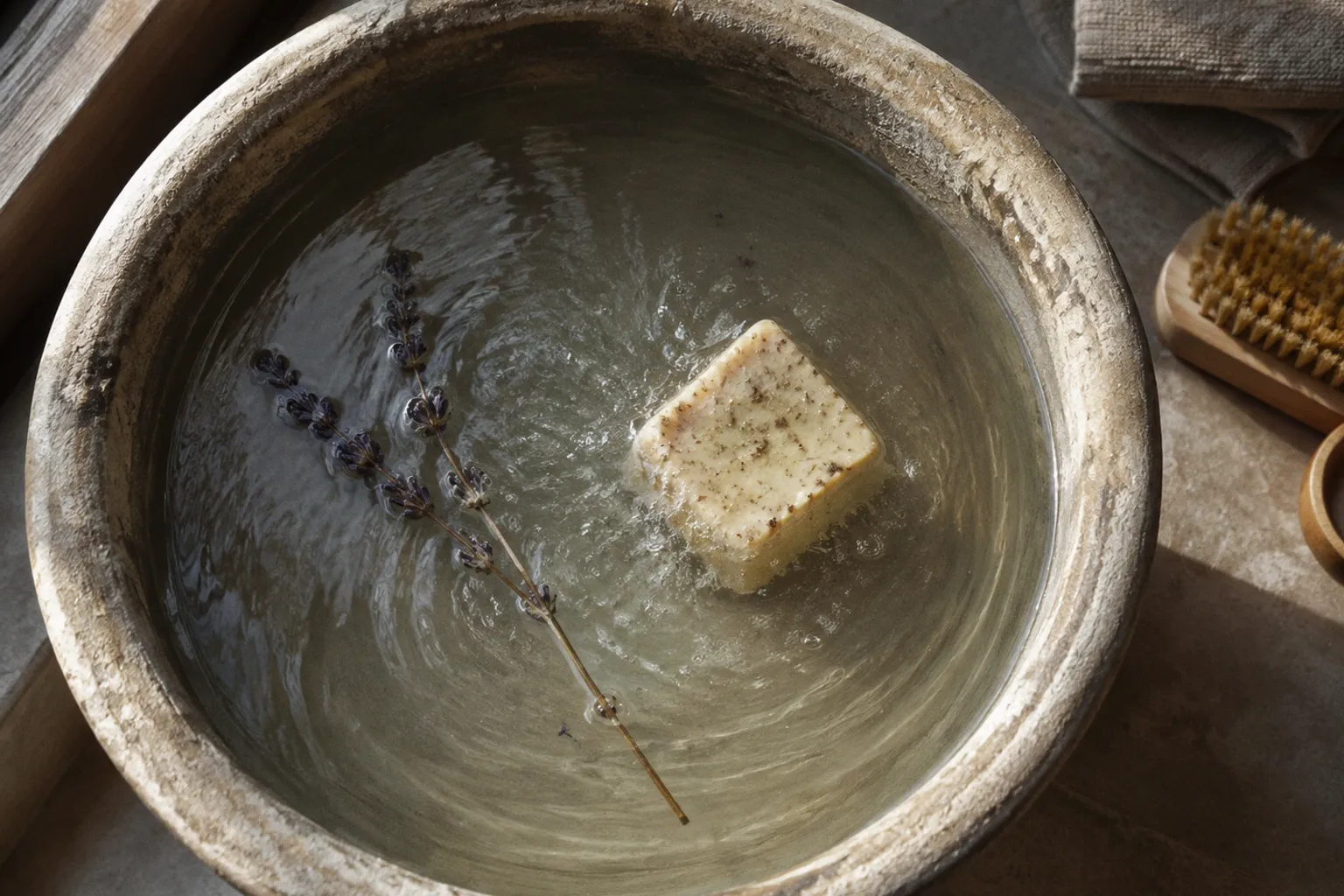
Water that is too hot, a ritual that runs too long, a damp loofah left in the shower, or a beautifully scented product used in the wrong place can quietly turn a restorative pause into repeated barrier stress.
A considered bath ritual should leave the skin softened, comfortable, and enveloped rather than stripped. In my work with clients, I return to five practical questions: how warm is the water, how long does the bathing last, has the soap cured properly, is the exfoliating tool hygienic, and has every aromatic product been placed according to its formulation? These details are modest, but they shape the entire experience of handmade skincare.
A bath ritual becomes restorative when warmth, time, texture, and scent are allowed to support the skin rather than compete with it.
The science of bathing: temperature and duration limits
Warm water can be grounding. It loosens the feeling of tension held around the neck and back, softens the hands, and creates the humid atmosphere in which a botanical soap or mineral soak feels especially comforting. Yet warmth has a narrow useful range. Once water becomes genuinely hot, the same sensation that initially feels enveloping can begin to pull moisture from the skin and disturb its protective surface.
For general relaxation and skin comfort, a bath temperature around 37–39°C (98.6–102.2°F) is a practical range. This is warm enough to feel soothing without creating the intense heat associated with flushing, dizziness, or excessive dehydration. Water above 42°C (107.6°F) carries a greater risk of discomfort, barrier disruption, and light-headedness, particularly when the bather is already tired, dehydrated, or prone to sensitivity.
The American Academy of Dermatology generally recommends keeping baths and showers to approximately 5–10 minutes. Some specific hydration-focused regimens may extend to 10–15 minutes, but longer immersion is not automatically more nourishing. The skin does not continue receiving benefits in a simple, linear way as the bath stretches on. After a certain point, heat and prolonged exposure can leave the surface more vulnerable, especially when followed by vigorous drying or repeated cleansing.
A practical comparison
| Bathing choice | Likely effect on the skin | More restorative approach |
|---|---|---|
| Very hot water | Can increase dryness, flushing, dizziness, and barrier stress | Use comfortably warm water around 37–39°C |
| Long immersion | May leave skin waterlogged and more prone to post-bath tightness | Keep the ritual concise, usually 5–10 minutes |
| Vigorous scrubbing afterward | Can intensify irritation and remove surface lipids | Pat the skin gently and moisturize while it is still damp |
| Strongly fragranced cleanser over the whole body | May be uncomfortable for dry or reactive skin | Use a mild handmade soap selectively and rinse thoroughly |
| No moisturizer after bathing | Allows water to evaporate from the skin without sealing in comfort | Apply a restorative cream, balm, or body oil immediately |
The final step matters as much as the bath itself. Pat the body dry rather than rubbing it briskly, leaving a slight trace of dampness on the skin. Then apply moisturizer promptly. A botanical body butter, fragrance-free cream, or simple emollient can help hold on to the water remaining at the surface. If you prefer a body oil, press it into damp skin rather than applying it to completely dry skin and expecting it to create hydration on its own.
Where handmade bath products fit
Handmade products can make the ritual more tactile and personal, but natural does not automatically mean gentle for every skin type. A cold-process soap may contain nourishing plant oils and a carefully chosen botanical blend, yet its cleansing action still needs to suit the area being washed. The face, underarms, hands, feet, and body do not always need the same frequency or intensity of cleansing.
For dry skin, use soap where sweat, odor, and buildup genuinely require it rather than treating the entire body as though it needs vigorous degreasing. The bar should glide over the skin with a creamy lather, not leave a squeaking sensation. That squeak is often interpreted as cleanliness, but in practice it can signal that too much surface oil has been removed.
Cold-process soap: curing is not the same as saponification
Cold-process soap has a particular character that mass-produced cleansing bars often lack. The lather may feel dense and silky, the scent may unfold gradually in the steam, and the bar itself can become more distinctive as it ages. That character depends not only on the recipe but also on the curing period.
Two different processes are often confused:
1. Saponification is the chemical reaction between oils or fats and lye. In a properly made cold-process bar, this reaction is generally complete within approximately 24–48 hours.
2. Curing is the longer period in which water continues to evaporate and the bar develops a harder, more stable crystalline structure.
A bar may therefore be chemically transformed while still being too soft, quick-melting, or unpleasantly short-lived for daily use. The usual curing period is 4–6 weeks, and some formulas benefit from longer. During this time, a cold-process soap bar can lose roughly 10–15% of its weight, largely because water leaves the bar.
This distinction is more than a maker’s technical footnote. It changes how the soap behaves in your bath ritual. A properly cured bar usually lasts longer, releases a more controlled amount of lather, and feels less prone to dissolving into a soft paste on the soap dish.
How to recognize a well-cured bar
There is no single visual feature that proves a bar is ready, but several practical signs can guide you:
- The bar feels firm rather than yielding easily beneath the thumb.
- Its surface is dry and settled, without a damp or tacky impression.
- It lathers without collapsing immediately into watery foam.
- It does not dissolve rapidly when placed on a flat, wet surface.
- The maker can clearly state when the bar was poured and when it became available for use.
A handmade soap does not need to look perfectly uniform. Natural color variation, small botanical marks, and a softly uneven edge are part of its character. What matters more is whether the formula has had enough time to mature and whether the bar has been stored in a way that allows air to circulate.
Storage determines how long the ritual lasts
Even an excellent soap can become disappointing when it sits in a pool of water. Use a draining dish, slatted soap tray, or raised holder that allows air to reach the underside. Keep the bar away from the direct stream of the shower whenever possible. If several people share the bathroom, give each bar room to dry between uses.
The comparison is simple:
| Soap condition | What happens in use | Best practice |
|---|---|---|
| Freshly made and still soft | Melts quickly and may feel overly yielding | Allow the full curing period |
| Fully cured but left in standing water | Becomes soggy and loses longevity | Use a draining dish |
| Cured and kept dry between uses | Produces more controlled lather and lasts longer | Let air circulate around the bar |
| Stored in a sealed, damp container | Can remain clammy and develop an unpleasant surface | Use sealed storage only when the bar is completely dry |
If a maker describes curing as though it were merely optional aging, ask for more detail. Curing is not required because saponification remains unfinished for six weeks; it is required because the physical qualities of the bar continue to develop after the main chemical reaction has occurred.
A cold-process bar can be safe from the standpoint of completed saponification and still be unready for a satisfying bath. Chemistry and craftsmanship move on different clocks.
Natural loofahs and the hidden life of damp tools
A natural loofah brings an appealing texture to body care. Its fibrous surface can create a generous lather, and the gentle resistance may make the washing ritual feel more deliberate. Used with care, it can help remove loose surface flakes without demanding aggressive pressure.
The difficulty is that a loofah is an organic, absorbent structure that stays damp in a warm bathroom. Water, soap residue, skin cells, and limited airflow create conditions in which microorganisms can multiply. Rinsing the loofah with soap does not make it permanently hygienic, and a tool that looks clean may still hold moisture deep inside its fibers.
Natural loofahs should generally be replaced every 3–4 weeks. That interval is especially important when the loofah remains wet for long periods, is shared, or is used on areas with broken skin. If the fibers become discolored, develop an unusual odor, stay slimy, or fail to dry between uses, replace it sooner.
A more hygienic loofah routine
1. Rinse it thoroughly after every use. Remove lather and loosened skin rather than leaving residue inside the fibers.
2. Press out excess water. Do not twist aggressively, as this can damage the structure and create a rougher surface.
3. Hang it where air moves freely. The edge of the tub is usually a poor drying location because it stays humid and receives limited circulation.
4. Do not share it. Each person should have an individual exfoliating tool.
5. Use light pressure. A loofah should polish the skin, not produce redness that lasts after rinsing.
6. Replace it regularly. A fresh loofah is part of responsible body care, not an unnecessary indulgence.
Exfoliation is not required at every bath. If the skin is itchy, inflamed, freshly shaved, sun-exposed, or already tight, leave the loofah aside. A creamy washcloth or the hands may provide enough cleansing without adding friction. The most restorative texture is the one that leaves the skin comfortable several hours later, not the one that feels most vigorous in the moment.
Aromatherapy shower steamers: placement is part of safety
Shower steamers are often mistaken for bath bombs because both may be molded, fragranced, and handmade. Their purpose is different. A shower steamer is formulated to release aromatic ingredients into the steam around you. It is not intended to dissolve against the body, and it should not automatically be dropped into bathwater.
These products can contain higher concentrations of essential oils than bath bombs because they are designed for vapor diffusion rather than direct immersion. Placing one where the full force of the shower hits it may release the scent too quickly and create an intense aromatic cloud. Placing it on the floor where bare feet will stand can also increase direct contact with concentrated ingredients.
A better arrangement is usually the shower floor or a ledge where the steamer receives intermittent splashes rather than constant water. The goal is gradual activation: the tablet softens, the steam carries the aroma, and the scent remains present without becoming overpowering.
Shower steamer versus bath bomb
| Product | Intended environment | Main sensory effect | Misuse to avoid |
|---|---|---|---|
| Shower steamer | Shower floor or splash zone | Essential-oil aroma carried through steam | Do not rub it on skin or place it in bathwater |
| Bath bomb | Bathwater | Dissolving color, fragrance, salts, or skin-conditioning oils | Avoid using heavily fragranced formulas on irritated skin |
| Mineral bath salt | Bathwater | Warming, dissolving, mineral-rich bathing experience | Do not assume salts replace post-bath moisturizing |
| Botanical bath soak | Bathwater, often in a pouch or strainer | Soft plant material, scent, and a gentle sensory ritual | Keep loose botanicals from clogging drains and rinse the tub |
The evidence for essential-oil inhalation should be described carefully. A shower steamer can make the bathroom smell beautiful and can contribute to a calming routine, but that does not establish a medical treatment. Aromatic comfort is not the same as a proven therapeutic claim.
Use extra care if you have asthma, fragrance sensitivity, migraines, or a history of skin reactions. Leave the shower if the aroma causes coughing, chest tightness, headache, nausea, or eye discomfort. Essential oils are concentrated substances; botanical origin does not remove the possibility of irritation.
For a broader look at essential oil safety in personal care, it is useful to distinguish between inhalation, leave-on application, and rinse-off exposure rather than treating all aromatic products as interchangeable.
Building a restorative bath ritual
The most reliable routine is not the one with the greatest number of products. It is the one in which each element has a clear role and the skin is given enough time to respond comfortably.
Begin with the water, not the fragrance
Set the water to a warm, comfortable temperature before adding salts, a soak, or a bath bomb. If the water already feels hot on the hands, it is likely to be too intense for prolonged immersion. The scent should arrive after the physical environment feels settled; fragrance cannot compensate for water that is irritating or uncomfortable.
Choose one main sensory focus
A bath can include a cold-process soap, mineral salt, botanical soak, exfoliating tool, and aromatic product, but using all of them at once can make it difficult to understand what the skin is responding to. Choose one central focus:
- A creamy handmade soap for a simple cleansing ritual.
- Mineral salts for a quiet, dissolving bath.
- A botanical soak for texture and fragrance.
- A bath bomb for a more decorative, effervescent experience.
- A loofah for occasional, deliberate exfoliation.
This approach is especially helpful when introducing a new handmade product. If the skin becomes dry or reactive, you can identify the likely source rather than investigating a crowded routine.
Keep cleansing and exfoliation separate
A common mistake is to combine a strongly cleansing bar with vigorous loofah use, followed by a hot, prolonged bath. Each step may feel pleasant individually, but together they can create more friction and cleansing pressure than the barrier can comfortably manage.
Wash with the hands or a soft cloth first. If exfoliation is appropriate, use the loofah briefly and lightly on areas such as elbows, knees, or the soles of the feet. Do not use it as a daily requirement for smooth skin. Smoothness achieved through repeated abrasion is often temporary; comfort and barrier stability are more durable goals.
End with moisture while the skin is damp
Once the bath is finished, pat rather than scrub. Apply moisturizer while the skin still has a slight dampness. A richer balm may suit rough elbows and heels, while a lighter lotion can feel more comfortable over the arms, chest, and legs. If using a scented product, keep the fragrance level low enough that it does not compete with the clean, warm sensation of the bath.
For a barrier-first routine, the sequence can remain beautifully simple:
1. Warm the water to a comfortable temperature.
2. Keep the bath or shower within a moderate duration.
3. Use a properly cured soap with a draining dish.
4. Exfoliate only when the skin is calm and intact.
5. Place shower steamers where they diffuse through steam without touching the body.
6. Pat dry and moisturize immediately.
7. Rinse, dry, and air the tools used during the ritual.
The clearest next step
If your current bath ritual leaves your skin tight, begin with the change most likely to reduce stress: lower the water temperature and shorten the bathing time. Do not replace every product at once. Give the skin a quieter week, using a well-cured soap, no loofah on irritated areas, and moisturizer applied to damp skin.
If the skin feels comfortable, reintroduce one sensory element at a time. A mineral salt, botanical soak, or shower steamer can then be appreciated for what it contributes—texture, scent, atmosphere—without being asked to repair a routine that is already too hot, too long, or too abrasive.
Bath rituals work best when they are paced like care rather than consumption. The warm water should soften the body, the soap should cleanse without leaving it taut, the fragrance should remain breathable, and the final moisturizer should close the ritual with a quiet layer of protection. That is the practical standard: not the most elaborate bath, but the one you can leave feeling restored.