Aromatherapy Shower Steamers: 4 Placement Steps
A shower steamer is an effervescent compressed tablet made to release fragrance into a warm, humid shower environment.
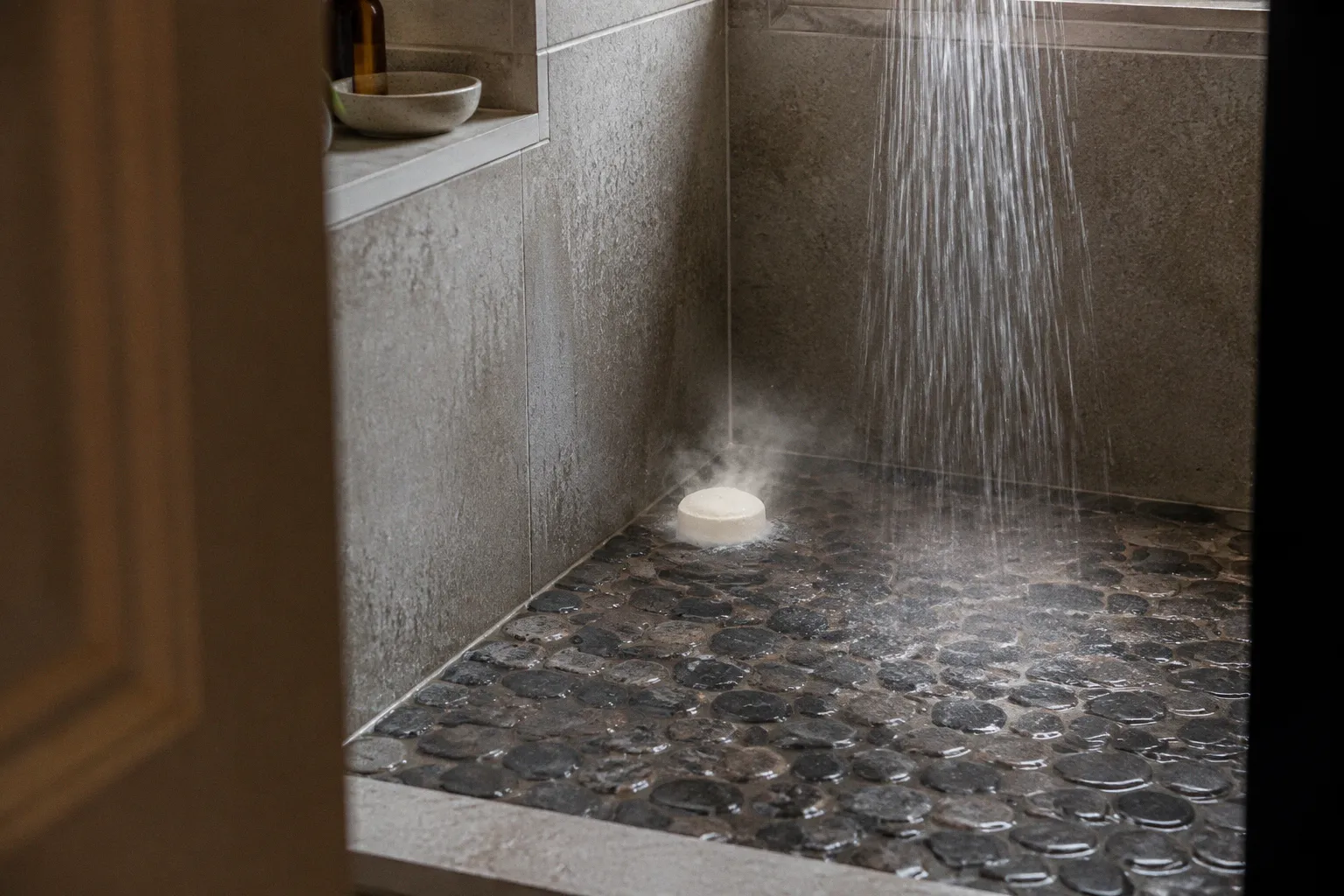
Its core usually combines sodium bicarbonate and citric acid with a dry binder, essential oils, and sometimes menthol crystals or other aromatic materials. Water starts the reaction, carbon dioxide creates the fizz, and the warmth of the shower helps volatile compounds move through the surrounding air.
The important detail is that a shower steamer is not simply a bath bomb used vertically. The tablet is supposed to meet water gradually. Place it beneath the main spray and the reaction may be over before the shower has properly warmed up. Move it too far from the water and the tablet may barely activate at all. The useful middle ground is an indirect splash zone: close enough for repeated droplets, but protected from continuous immersion.
Dissolution is not controlled by placement alone. The tablet’s formulation, size, hardness, binder, amount of aromatic material, and the pressure and temperature of the shower water all matter. Placement changes how those factors play out inside a particular shower enclosure; it does not create one universal release time for every tablet.
A shower steamer is an inhalation-oriented bath product, but the water still sets the pace: placement is how you manage the release.
The Science of Steam: Why Placement Dictates Potency
The fizzing reaction is familiar:
3 NaHCO₃ + C₆H₈O₇ → Na₃C₆H₅O₇ + 3 H₂O + 3 CO₂
In stoichiometric terms, three moles of sodium bicarbonate react with one mole of citric acid. That is a molar relationship, not a universal recipe for a finished tablet. Formulators often discuss an approximate two-to-one bicarbonate-to-acid ratio by weight in bath-bomb-style products, but shower steamers vary considerably. The final balance depends on the desired hardness, moisture resistance, texture, fragrance load, and the other ingredients holding the tablet together.
What matters in the shower is the rate at which water reaches a fresh part of the tablet. A strong, continuous stream does several things at once:
- wets a larger surface area;
- washes dissolved material away from the tablet;
- mechanically erodes the compressed surface;
- keeps supplying relatively fresh water to the reaction;
- can carry fragrance and residue directly toward the drain.
A few scattered splashes behave differently. The tablet gets wet, fizzes, and then has a chance to dry slightly before the next contact. The reaction continues, but in pulses rather than as one uninterrupted burst. That usually creates a more gradual aromatic release, provided the tablet has been designed to withstand intermittent moisture.
The formulation remains part of the equation. A dense, highly compressed tablet may resist splash contact longer than a softer one. A small tablet has less material to release than a large tablet, even if both contain a similar fragrance blend. A tablet with a more water-soluble binder may respond quickly in a sheltered location, while a harder or more moisture-resistant tablet may need a more active splash zone.
The same is true of the shower itself. A powerful overhead spray can reach a shelf that would remain almost dry under a gentler shower. A handheld showerhead changes the splash pattern every time it is moved. A narrow enclosure may hold steam efficiently but also expose the tablet to more reflected droplets. A wide, well-ventilated space may need a closer placement simply because the humid air disperses more quickly.
The aromatic fraction is released through more than one pathway. Some volatile compounds leave the tablet from the wet surface as the shower warms the surrounding air. Others become carried in humid air and steam. The exact balance depends on the oils, menthol or other aromatic materials, the tablet matrix, and the temperature of the enclosure.
This is also why a larger fragrance load does not automatically solve poor placement. If the tablet is hit by the main stream, more fragrance may simply be released in a shorter period. The first few minutes can feel intense, followed by a sharp drop as the easily released aromatic fraction is depleted and the nose begins to adapt. A moderate release sustained over the useful part of the shower can feel stronger overall than a concentrated burst that disappears almost immediately.
Some formulas include a surfactant such as polysorbate 80 to help disperse oils in the rinse water. That can reduce the tendency of free oil to remain as a slick on the surface, but it does not make every shower steamer floor-safe in every situation. Residue, excess oil, tile finish, and the amount of water reaching the tablet still matter. A product intended for the shower should not be treated as harmless simply because it fizzes cleanly.
Step 1: Preparing the Ambient Shower Environment
Steamers work best when the enclosure is already warm and humid. This does not mean turning the bathroom into a sealed sauna. It means giving the air enough time to warm before asking the tablet to release its aromatic payload.
Start the shower and allow the enclosure to develop a comfortable amount of steam before placing the tablet, or place it in a sheltered position just before entering if the shower warms quickly. There is no single pre-steam duration that works for every bathroom. A small enclosed shower may become humid within a short time; a larger room with strong extraction may need longer.
The practical aim is simple:
- the air should feel warm rather than cool;
- the walls should no longer be completely dry;
- the main spray should be stable before you choose the tablet’s position;
- the bathroom should still have enough ventilation for comfortable breathing.
Keeping every door and vent closed is not automatically better. Steam retention helps the sensory experience, but poor ventilation can make the room uncomfortable and may be unsuitable for people who are sensitive to heat, humidity, fragrance, or respiratory irritants. Use the fan according to the bathroom and the user, not as an absolute rule. A fan running at full speed may clear aromatic humid air faster, but turning it off entirely can create its own problems.
Water temperature also changes the experience. Warmer water generally creates more humidity and encourages volatile materials to move into the air. Very hot water is not a better activation method if it makes the shower unpleasant or causes the user to leave quickly. It can also increase irritation for sensitive skin and airways. The right temperature is the one that produces a comfortable, humid environment without forcing the tablet into an unnecessarily aggressive release.
Place the tablet only after identifying where the water actually travels. Watch the floor, ledges, and walls for a few seconds. Reflected droplets can reach much farther than the obvious spray cone, especially in a compact enclosure. The dry-looking corner may not stay dry once the shower curtain is closed and water begins bouncing from the user and the walls.
A shallow, clean dish can be useful if it is stable and does not collect enough water to submerge the tablet. The dish should not block drainage or become a slippery object underfoot. A steamer that has softened in standing water should be moved only if doing so can be done safely; otherwise, rinse the area and deal with the residue after the shower.
Step 2: Selecting the Optimal Splash Zone
The best placement is usually neither the wettest point nor the driest point. It is the place where the tablet receives occasional droplets without sitting in a stream or pool.
This is the central rule for how to position shower steamers:
1. Keep the tablet out of the main showerhead stream.
2. Keep it away from standing water and the drain.
3. Place it within the outer reach of splash.
4. Adjust after observing how quickly the surface becomes wet.
5. Move the tablet farther from the water if it starts collapsing immediately; move it slightly closer if it remains dry and inactive.
The most useful zones are often a soap ledge, a built-in corner shelf, the outer edge of the shower floor, or a stable dish positioned just beyond the main spray. A mesh or organza bag can slow direct water contact, but it must be securely hung and kept away from the user’s feet. It should not become a swinging object or fall into the drain.
Rather than assigning every location a universal number of minutes, think in terms of exposure:
| Placement | Water exposure | Expected release pattern | What to watch for |
|---|---|---|---|
| Directly beneath the showerhead | Continuous and forceful | Fastest reaction and the shortest release window | Excess fizz, fragments, residue, and a sudden fragrance burst |
| Edge of the main splash pattern | Intermittent | Usually the most balanced activation | Tablet should wet in patches rather than remain constantly flooded |
| Sheltered ledge or corner shelf | Light and irregular | Slower or less predictable release | It may need a small adjustment if almost no droplets reach it |
| Stable dish near the outer splash area | Adjustable | Controlled contact if the dish drains freely | Do not allow water to pool around the tablet |
| Hanging mesh bag away from the spray | Reduced direct contact | Gradual release when droplets reach the bag | Secure the bag and keep it away from faces, fixtures, and feet |
| Drain or standing water | Immersion | Rapid reaction with poor control | Avoid: the tablet can dissolve before the aromatic experience develops |
The table describes tendencies, not promises. A compact tablet under a high-pressure shower may disappear quickly even in a supposedly indirect zone. A large, hard tablet may remain intact much longer in the same position. Water pressure, spray angle, tablet composition, and the amount of water bouncing around the enclosure can change the result.
The drain is a particularly poor location. Even when the tablet is not fully submerged, water collecting around it creates a continuous wet environment. The reaction becomes harder to control, and oils or residue may spread across the floor. The drain is designed to remove water, not to serve as a dosing chamber.
A bathtub creates a similar problem. A shower steamer placed at the edge of a tub may work if it remains above the waterline and receives only occasional splash. Dropping it into the bath turns the product into something closer to a bath-bomb application, with a different exposure pattern and a greater chance of concentrated residue contacting skin.
The enclosure’s geometry matters more than people expect. A tablet placed on the far side of a curved shower floor may receive repeated rebound from the wall. A ledge located just outside the visible spray may be drenched by water hitting the user’s shoulders. If the showerhead is handheld, the optimal zone can shift during use. A placement that works with the head fixed overhead may become a direct stream when the user points the spray toward a wall.
Step 3: Managing Proximity for Scent Intensity
Once the tablet is in a suitable splash zone, distance from the user becomes the next adjustment. This is not a precise volume control. The steam, air movement, enclosure size, and the user’s position all affect how fragrance is perceived. Still, height and proximity offer useful practical options.
A floor-level placement often creates a stronger first impression because the tablet is close to the feet and receives more reflected splash. That can be pleasant for someone who wants an immediate aromatic presence, but it also carries the greatest risk of being washed into standing water or stepped on. Floor placement should be at the perimeter of the usable shower area, never where the user needs to stand.
A mid-height shelf or ledge usually offers the most even compromise. It keeps the tablet visible and away from feet while allowing the steam to move the fragrance through the breathing zone. It is also easier to inspect: you can tell whether the tablet is getting a few droplets or being hit by a steady stream.
A higher position can produce a slower onset, especially if little water reaches it. The tablet may remain intact for longer, but that is not necessarily the same as a better or stronger experience. If it stays completely dry, the aromatic release may be minimal. Height is useful for reducing direct spray, not for guaranteeing a longer duration.
A simple way to choose is to match the position to the desired experience:
- Immediate and more pronounced: place the tablet near the outer edge of the floor splash zone, while keeping it out of pooled water.
- Balanced and sustained: use a mid-height ledge or a stable dish that receives occasional droplets.
- Gentle and gradual: choose a sheltered shelf or mesh bag, then move it closer only if the reaction is too slow.
- Longer shower: use a larger or more moisture-resistant tablet, if the product is designed that way, rather than assuming that the driest possible corner will extend the fragrance indefinitely.
Moving a tablet during the shower changes more than its distance from the nose. It changes the water exposure, the reaction rate, the amount of fragrance released per unit of time, and the amount of residue that may be carried across the surface. That makes relocation a useful adjustment, but not a neutral one. If the tablet is already soft or breaking apart, moving it can scatter residue and increase contact with the floor.
Move the tablet only after you have identified what is wrong: too much water, too little water, or too much distance from the breathing zone.
Breaking a tablet into pieces is also not a guaranteed duration extender. It increases the total exposed surface area and may make the reaction faster, not slower. Dividing the tablet can distribute fragrance between two protected areas, but it can also create several small pieces that are more vulnerable to splash. If the goal is a gentler release, a formula designed for that purpose or a more sheltered placement is usually more predictable than crushing the product.
Proximity should never mean placing the tablet against the face, under the nose, on the chest, or directly on the skin. Essential oils, menthol, and concentrated fragrance materials can irritate skin and mucous membranes. The steam carries the aroma; the tablet does not need to touch the body to work as intended.
Step 4: The 4-2-6 Breathing Ritual for Maximum Inhalation
Breathing is the final part of the routine, but it should be treated as a comfort practice rather than a way to force a chemical dose. The aromatic compounds in a shower steamer are perceived through the nose and upper airway. How strongly they are noticed depends on concentration, airflow, nasal sensitivity, congestion, habituation, and the individual fragrance blend.
The 4-2-6 pattern is a simple paced-breathing option:
1. Inhale gently through the nose for four counts. Keep the breath comfortable rather than pulling in as much air as possible. The aim is to notice the aroma, not to inhale deeply into discomfort.
2. Pause for two counts if it feels natural. The pause is optional. Anyone who finds breath-holding unpleasant should omit it.
3. Exhale slowly through the mouth for six counts. A longer exhale can make the rhythm feel calmer and helps prevent hurried breathing.
One cycle lasts twelve counts, but there is no need to calculate how many cycles fit into a shower. A few comfortable repetitions are enough to establish a slower rhythm. If the scent feels sharp, the nose tingles, the throat feels dry, or breathing becomes uncomfortable, stop the exercise and move away from the steam.
The shower environment can make paced breathing feel different from practicing it in a dry room. Warm, humid air may feel soothing to some people, while heat, fragrance, or menthol may aggravate others. Menthol can create a cooling sensation that feels like clearer airflow without necessarily removing physical congestion. That distinction matters: a sensory impression is not the same as treatment for a respiratory condition.
Begin the breathing routine after the enclosure has warmed and the scent is present, not automatically at the first moment the tablet touches water. If the tablet is releasing quickly, early breathing may coincide with the strongest burst. If the tablet is activating slowly, waiting until a noticeable aroma develops may make the practice more comfortable. The best timing depends on the tablet and placement rather than a fixed point on the clock.
Do not use deliberate deep inhalation to compensate for weak placement. If the tablet is under the spray and the scent is overwhelming, deeper breathing only increases discomfort. If the tablet is too far from water and almost no aroma is present, forced inhalation will not correct the underlying problem. Adjust the environment or placement instead.
People with asthma, fragrance sensitivity, migraine triggers, or other respiratory concerns should approach essential-oil and menthol products cautiously. A shower steamer is not a substitute for prescribed treatment, and a product marketed for a relaxing ritual should not be used as a reason to ignore wheezing, chest tightness, persistent coughing, or other concerning symptoms.
Common Errors in Aromatherapy Shower Steamer Placement
Treating the steamer as a bath bomb. Submerging the tablet in a tub or leaving it in a puddle removes the intermittent-contact principle. The reaction becomes much harder to control, and concentrated residue may spread through the water or across the shower floor. The product should be used according to its label and kept out of standing water unless it is specifically made for that application.
Placing it directly under the main spray. This is the fastest way to turn a gradual shower ritual into a short burst. The tablet may soften, fracture, and lose its aromatic material quickly. The exact duration will vary with formulation, tablet size, and pressure, but the pattern is consistent: continuous water contact produces the most aggressive activation.
Assuming the driest location is the best location. A tablet protected from every droplet cannot release its water-activated fragrance effectively. If no fizzing or scent develops after the shower has warmed, move it closer to the edge of the splash pattern next time.
Ignoring reflected water. The visible spray is only part of the water map. Walls, the shower curtain, the user’s body, and the floor can redirect droplets into apparently sheltered corners. Check the actual surface around the tablet rather than relying on the position of the showerhead alone.
Using a dish that holds water. A dish can help control splash, but only if it drains. A bowl-shaped container turns a sheltered placement into a small soaking bath. Choose a shallow, stable surface and keep it away from the drain path and standing water.
Applying the tablet to skin. Shower steamers are not automatically topical products. Essential oils, menthol crystals, acids, and alkaline residues may sting or irritate, particularly around the eyes, nose, lips, broken skin, and freshly shaved areas. Let the product dissolve in the shower environment without rubbing it onto the body.
Expecting the aroma to remain equally strong throughout the shower. Fragrance perception changes as the tablet releases material and the nose adapts. A quieter scent later in the shower does not necessarily mean the product failed. It may reflect a lower release rate, ventilation, a change in water exposure, or ordinary olfactory fatigue.
Adding water to a spent tablet. More water can restart fizzing if unreacted material remains, but it does not guarantee renewed fragrance. Once the readily volatile portion has been released, the remaining bicarbonate, acid, binder, and residue may produce little aromatic effect.
Using more than one tablet to compensate for poor airflow. Extra product increases fragrance exposure and residue without solving the underlying ventilation or placement issue. One tablet in a sensible splash zone is easier to assess and safer to adjust.
Making the Four Steps Work Together
The four steps are not separate tricks. They form one delivery system.
First, warm the enclosure enough for the shower to feel humid and comfortable. Second, identify the edge of the actual splash pattern rather than guessing from the showerhead position. Third, use height and distance to moderate how quickly the fragrance enters the breathing zone. Finally, breathe at a comfortable pace, treating the 4-2-6 rhythm as an optional way to slow down and notice the scent.
The release window cannot be specified independently of the product. A small, soft tablet under strong water may be largely spent quickly. A larger, denser tablet in a sheltered corner may remain active much longer. A medium tablet can behave differently from one shower to the next if the showerhead angle, water pressure, ventilation, or placement changes. These variables are not flaws in the concept; they are the reason a placement routine needs observation rather than a rigid timing chart.
The most useful sign of correct placement is not a particular number of minutes. It is a stable pattern: the tablet receives occasional moisture, develops a controlled fizz, releases a noticeable but tolerable aroma, and does not sit in a pool or send oily residue across the floor. If the reaction is violent and immediate, reduce water exposure. If nothing happens, increase it slightly. If the aroma is strong but unpleasant, improve ventilation or choose a different fragrance profile rather than inhaling more deeply.
Shower steamers can create a pleasant sensory ritual, but they remain small water-activated delivery systems, not medical devices. Menthol may create a cooling sensation, and warm humid air may feel comforting, yet neither should be confused with treating an infection, curing respiratory disease, or replacing clinical care. The experience is real as a sensory and relaxation practice; the medical claims often attached to it require much more caution.
Good aromatherapy shower steamer placement is therefore less about finding a magical spot and more about managing variables. Keep the tablet out of direct immersion, let the shower provide intermittent splash, account for the tablet’s formulation and size, observe the pressure and spray pattern, and use breathing to make the ritual calmer rather than more forceful.
The chemistry will do what the water allows. Placement is how you decide what that looks like.