Mustache Wax Styling: 4 Steps for a Clean Hold
Here's the mistake I see every week in the chair: a guy pushes a wax tin across the counter, scoops out a glob with his finger, and tries to rake it through a damp mustache. Then he wonders why it flakes by lunch and his comb drags like it's fighting him.
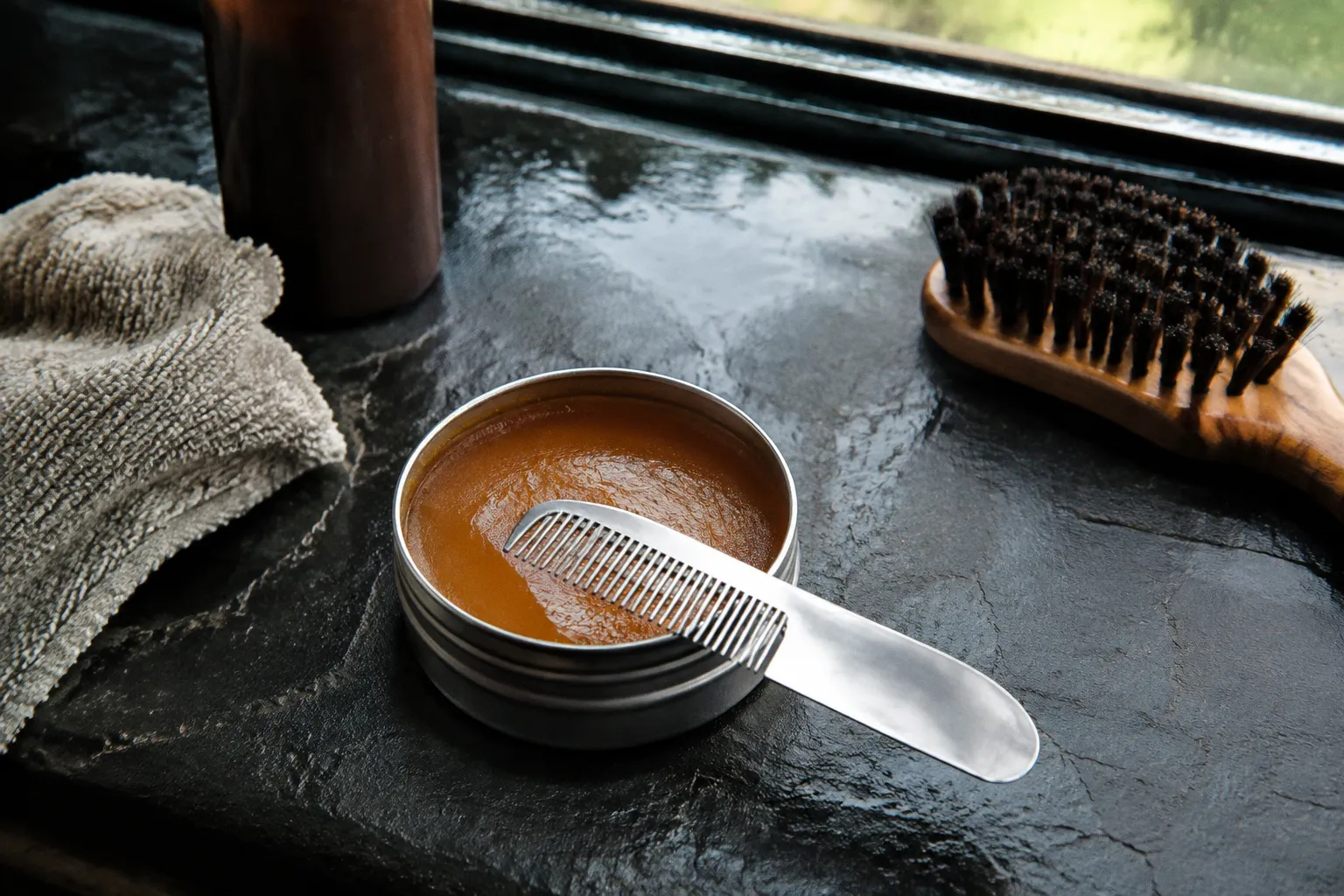
The product isn't broken. His prep is. Mustache wax only does its job when you set the conditions right, and those conditions aren't complicated—they're just non-negotiable.
Most men think mustache wax is a one-step product: smear, shape, walk out the door. It isn't. It's a four-step discipline. Clean baseline. Correct dose. Proper warmth. Controlled application. Skip any of those, and you're not styling—you're just moving product around and hoping for the best.
Let me walk you through the technique I use on clients daily. This isn't theory. It's shop-floor method, refined on hundreds of faces, from the executive who wants his handlebar sharp at 7 a.m. to the weekend tinkerer growing his first serious 'stache. Four steps. Done right, you'll get a hold that lasts through your day without that stiff, painted-on look that screams "I'm trying too hard."
Step 1: The Foundation — Why Dry Hair Is Non-Negotiable
Before you touch that tin, your mustache needs to be clean and completely dry. Not damp. Not "mostly dry." Bone dry. This is the single biggest mistake I see, and it's the one that ruins everything downstream.
Wax adheres to hair through a mechanical grip—it needs dry fibers to grab onto. When your mustache is wet or even slightly damp, there's a thin film of water sitting on every strand. That film acts like a barrier. The wax slides across it instead of sinking into the hair cuticle. Result? Patchy hold, flaking within an hour, and that greasy-shiny look that no one wants.
Wash your mustache first. Use a natural beard wash or a mild, sulfate-free cleanser—nothing harsh that strips the hair completely. Work the cleanser through thoroughly, then rinse until the water runs clear. Pat dry with a clean towel, then give it time. Air dry for at least ten to fifteen minutes. If you're in a rush, hit it with a blow dryer on low heat, but keep the dryer moving so you're not concentrating heat on one section.
Here's the test I tell every client: the mustache should feel completely dry to the touch, with zero coolness when you run your fingers through it. If you can feel any hint of moisture, you're not ready for wax. Wait another five minutes. Patience here pays off for the next eight hours of your day.
Dry hair is the canvas. Wax won't grip what it can't reach.
Step 2: Precision Extraction — Managing the Pea-Sized Amount
Now we get to the tin. Open it up and resist the urge to dig in. Most men over-apply, and that's where the greasiness comes from—a mustache loaded with wax doesn't look styled, it looks lacquered.
The correct dose is pea-sized. About half a pea to a full pea, depending on the thickness and length of your mustache. If you're running a full, dense handlebar, lean toward the full pea. If you've got a thinner, more minimal 'stache, half a pea is plenty.
Here's the technique for getting it out cleanly: use the back of your thumbnail. Press the nail into the wax at a slight angle and drag forward. The wax will curl up onto your nail in a clean strip. This gives you control. Digging with your fingertip pulls up too much and warms the wax unevenly, which means you'll struggle to distribute it properly in the next step.
Scrape that small amount onto the pad of your index finger or the tips of both thumbs—wherever you're most comfortable working from. The key is keeping the amount consistent every time. Once you build the habit, you won't even need to look at the tin. Your hand will know the dose.
A quick note on storage: keep your tin at room temperature, away from direct sunlight or a hot bathroom. Wax that's been sitting in a steamy environment will be softer than wax kept in a cool drawer. Soft wax is harder to dose precisely because it smears instead of scraping clean. Consistency of the product matters as much as consistency of your technique.
| Mustache Type | Recommended Dose | Why |
|---|---|---|
| Thin or sparse | Half a pea | Less hair means less surface area to coat; over-application creates heaviness |
| Medium density | Three-quarters pea | Balanced coverage for everyday shaping |
| Thick or full handlebar | Full pea | Dense hair requires more product to achieve uniform hold and shape |
Step 3: Thermal Activation — Softening Beeswax for Smooth Distribution
Beeswax-based mustache waxes are firm by design. That's what gives them their hold. But that firmness means you can't just smear cold wax onto your mustache and expect it to spread evenly. It will clump, stick to the first few hairs it touches, and leave everything else bare.
You need to soften the wax before it touches your face. The standard method: work it between your fingertips. Rub your thumb against your index and middle fingers, pressing and rolling the wax until it transitions from a solid scrape to a translucent, pliable layer. This usually takes five to ten seconds of consistent friction. You'll feel the wax "give" under your fingers—that's the signal it's ready.
If you're working in a cold environment or your wax is particularly firm (some formulations run stiffer than others), you can use gentle external heat. A hairdryer on low, held a few inches from your fingertips for a few seconds, will soften the wax without melting it. Pocket heat works too—just close your hand around the wax for thirty seconds before extracting your dose. The body heat from your palm starts the warming process.
What you don't want to do is rush this step. Cold wax applied to hair creates those telltale white flakes you sometimes see on a poorly styled mustache. Those flakes are bits of wax that never fully integrated with the hair. They sit on the surface, dry out, and fall off within an hour or two. Warming the wax completely eliminates this problem.
If the wax feels gritty or stiff between your fingers, it's not ready. Keep working it until it's smooth and tacky.
Step 4: The Center-Outward Technique — Shaping and Final Grooming
Now the application itself. This is where most guys go wrong—they start at the tips and work backward, or they try to coat the entire mustache at once with broad swipes. Both approaches leave you with uneven distribution and weak hold at the roots.
Start at the center under your nose. Place your warmed wax at the midpoint of your mustache, right where the hair grows densest. Use both thumbs and index fingers to work the wax into the hair, pressing gently so it reaches the roots. Then work outward toward the tips, one side at a time. The motion is a combination of pressing and stroking—down into the hair, then along the length of the strand.
Why center-outward? Because the center of your mustache is the structural anchor for any style you build. That's where the hair is thickest, where shape originates, and where hold needs to be strongest. If you start at the tips and work backward, you're depositing most of your product at the thinnest, weakest point. The center never gets enough wax, and your style collapses from the inside out.
As you work outward, use your fingers to shape the hair into the style you're going for. Handlebar? Twist the tips gently upward and outward as you apply. Chevron? Press the hair downward and slightly to the sides. Walrus? Comb everything forward and down. Your fingers are your primary tool here—let them feel how the wax is setting and adjust the shape as you go.
Once the wax is fully distributed and your shape is roughly set, grab a fine-toothed mustache comb. Run it through the hair from root to tip with light, even strokes. The comb accomplishes two things: it distributes any remaining wax evenly across strands you might have missed, and it refines the shape by removing excess product and aligning every hair in the same direction.
A few strokes are usually enough. Don't over-comb. Each pass removes a small amount of wax, and you want to keep as much product in the hair as possible. Two or three passes per side, then stop.
The Oil Question: Timing Matters
I get asked about this constantly: should I use beard oil with mustache wax? The answer is yes—but timing is everything.
Applying natural beard oil directly before wax will break down the wax formulation. Oil and wax don't mix well on the hair shaft. The oil creates a slippery layer that prevents the wax from gripping, and it also softens the wax itself, reducing hold. If you've oiled your mustache in the last hour, skip the wax or wash and dry the mustache again before styling.
The correct sequence: apply beard oil to the skin underneath your beard (the face, not the mustache hair itself), wait at least thirty minutes for it to absorb, then wash and dry your mustache before waxing. Or, if you're using oil purely as a conditioning treatment, do it at night and style with wax in the morning on a clean, dry baseline.
Some men alternate: oil on days off, wax on workdays. That's a perfectly valid routine. Just don't layer them within the same styling session unless you want weak hold and a greasy finish.
Holding Time: What to Expect
How long will your style last? That depends on three variables: your climate, your wax formulation, and your hair thickness.
A beeswax-heavy wax in moderate humidity on medium-thick hair will typically hold six to ten hours without needing a touch-up. If you're in a hot, humid environment or your wax has a softer base (more shea butter, less beeswax), expect four to six hours. In cold, dry conditions with a stiff wax, you can push ten to twelve hours.
Hair thickness matters because coarse, dense hair provides more structure for the wax to grip. Fine or thin hair releases wax faster because there's less fiber mass holding the product in place.
If you find your hold fading midday, resist the urge to apply more wax over the existing layer. That creates buildup and that painted-on look. Instead, use a fingertip to reactivate the wax you already have in place. Rub the spot that's losing shape gently between your thumb and forefinger—the heat from friction will soften the existing wax and reset the hold. No additional product needed.
Common Mistakes That Kill Your Hold
Beyond the damp-hair disaster, there are a few other errors I see regularly:
Over-application. More wax does not mean more hold. It means heavier, greasier hair that looks unnatural and flakes more as it dries out. Stick to the pea-sized rule.
Skipping the warm-up. Cold wax applied to hair clumps. Always work it between your fingers until it's smooth and pliable before it touches your face.
Touching your mustache throughout the day. Every time you run your fingers through it, you're removing wax and redistributing oils from your skin into the hair. Hands off once it's set.
Combing too aggressively. The fine-toothed comb is for refinement, not for sculpting major shape. If you need to reshape significantly, use your fingers and add a tiny amount of wax if necessary. The comb is the final step, not the primary tool.
Building the Habit
The first few times you run through these four steps, it'll feel slow. That's fine. You're building muscle memory. By the end of the second week, you'll be doing it in under three minutes—clean, dry, dose, warm, apply, comb. Out the door.
Mustache wax isn't complicated. It's just disciplined. Four steps, done in order, every time. That's what separates a styled mustache from a neglected one. Treat the wax like a tool that needs proper handling, not a magic product that fixes everything on contact. Your face will thank you, and your hold will last from your first meeting to your last drink of the night.