Hot Beard Oil Treatment: 4 Steps for Deep Conditioning
A warm beard oil treatment does not create new follicles or permanently repair damaged hair.
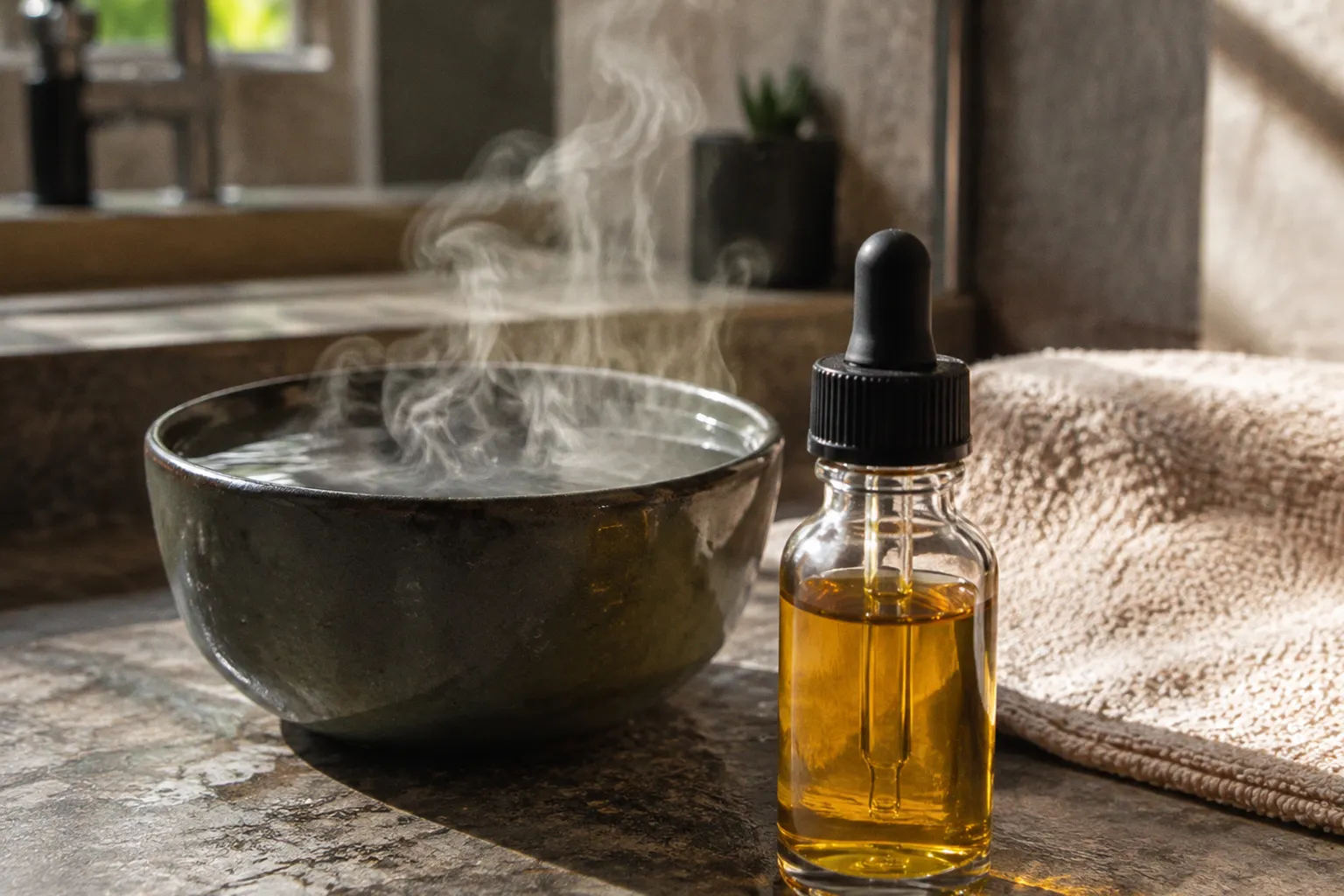
Its function is narrower and more measurable: it reduces friction, improves the flexibility of coarse facial hair, and replenishes some of the lipids removed by washing and environmental exposure.
Heat is also easy to misuse. Oil that is merely warm can make application more comfortable and help distribute the product through dense facial hair. Oil that is too hot can irritate or burn the skin. The difference is not cosmetic. It is a safety parameter.
A practical warm beard oil treatment routine has four stages:
1. Warm the oil gently.
2. Apply it to clean skin and beard hair.
3. Allow the oil to remain under a warm towel.
4. Rinse thoroughly with cool or lukewarm water.
The method is suitable for coarse, brittle, dry, or difficult-to-control beards. It is not a substitute for cleansing, treatment of inflammatory skin disease, or professional care when persistent irritation is present.
The science of heat: why warm oil can improve conditioning
Beard oil is primarily an anhydrous lipid mixture. It contains no meaningful water phase unless the formulation has been emulsified, which is uncommon for conventional beard oils. Typical ingredients include plant oils, esters, and sometimes essential oils or fragrance materials.
The relevant effects come from the lipid phase, not from a special reaction caused by heat.
Facial hair is made largely of keratinized protein. Unlike living skin tissue, the visible hair shaft cannot regenerate itself. Repeated washing, ultraviolet exposure, friction from clothing, and mechanical pulling can increase surface roughness and leave the shaft more prone to tangling and breakage. Oils do not reverse this structural damage. They coat the fiber and reduce the force required for adjacent hairs to slide against one another.
Gentle warming can improve the process in several ways:
- Lower viscosity: Many oils become less viscous as temperature rises. A thinner oil spreads more readily across the hair shaft and through a dense beard.
- Better distribution: Warm oil is easier to work from the surface toward the underside of the beard and the skin beneath it.
- Improved contact: A warm towel can soften compacted hair and maintain a stable temperature while the product remains in place.
- Reduced product waste: When an oil spreads efficiently, less of it remains concentrated on the fingertips or outermost hairs.
These effects should not be confused with deep penetration in the pharmaceutical sense. A beard oil does not need to travel through the entire hair shaft to be useful. Surface lubrication and partial diffusion into the outer layers can change combability and tactile roughness.
Heat improves spread and contact. It does not turn a beard oil into a follicle-growth treatment.
The molecular weight and composition of the oil also matter. Lightweight esters and oils rich in smaller lipid fractions generally spread faster than highly viscous oils. Heavier materials may provide longer-lasting lubrication but can feel occlusive or leave more residue on short facial hair. There is no universally superior oil. The correct choice depends on beard density, skin tolerance, cleansing frequency, and the amount of product applied.
What the treatment can and cannot do
A warm beard oil treatment can:
- soften coarse strands temporarily;
- reduce friction during brushing or combing;
- improve the flexibility of dry facial hair;
- reduce the appearance of surface roughness and minor split ends;
- make a dense beard easier to detangle;
- reduce the feeling of tightness caused by a dry skin barrier.
It cannot:
- stimulate new follicle growth where hair does not naturally grow;
- repair a split end permanently;
- correct an allergic reaction to fragrance or essential oil;
- replace a beard wash;
- remove embedded sebum, dead skin, or environmental particles;
- compensate for excessive mechanical tension from aggressive brushing.
The distinction is important because conditioning and growth are different cosmetic claims. Conditioning changes the behavior of existing hair. Growth requires changes at the follicle level, which a topical oil treatment is not established to provide.
Prepare the beard: oil needs a clean canvas
Applying oil over unwashed facial hair is one of the most common procedural errors. The beard accumulates sebum, dead skin cells, dust, food particles, and residue from styling products. Oil applied on top of that material can trap it against the skin and distribute it through the hair.
This does not mean the beard should be aggressively stripped before every treatment. Strong cleansing can remove too much surface lipid and increase dryness, particularly in people with a compromised skin barrier. The objective is clean hair and skin without prolonged scrubbing.
Use a mild beard wash or a gentle facial cleanser, depending on how the beard and skin respond. Rinse until no cleanser remains. Then press the beard with a towel rather than rubbing it forcefully. The ideal starting condition is damp, not dripping wet.
Water and oil do not form a stable mixture without an emulsifier. Damp hair can still be conditioned effectively, but excess water may prevent the oil from coating the surface evenly. A beard that is saturated with water will dilute the practical feel of the treatment and may increase the amount of oil required for distribution.
Before applying the warm oil
Complete these steps:
- Wash the beard and the skin underneath it.
- Rinse away all cleanser and loose debris.
- Pat the beard until it is damp or nearly dry.
- Detangle obvious knots with a wide-tooth comb.
- Inspect the skin for cuts, active irritation, or areas of unusual sensitivity.
- Prepare a clean towel and a heat-safe container or vial.
Do not apply the treatment over broken skin, a fresh razor burn, or an active flare of dermatitis. Lipid materials can increase occlusion, while fragrance compounds and essential oils can add irritation. The beard itself may tolerate a product that the facial skin does not.
Product selection for a warm beard oil treatment
A simple formula is easier to evaluate than a heavily fragranced blend with many botanical extracts. Consider the product in terms of function:
| Formulation characteristic | Practical effect | Main limitation |
|---|---|---|
| Lightweight liquid oils or cosmetic esters | Fast spread and lower surface residue | May require more frequent reapplication |
| More viscous oils | Longer-lasting slip and a heavier conditioning feel | Can weigh down short beards or feel greasy |
| Fragrance-free formula | Lower exposure to common fragrance irritants | May have a less distinctive sensory profile |
| Essential-oil fragrance blend | Adds scent and may alter the sensory experience | Can irritate sensitive facial skin |
| Oil with antioxidant protection | May slow oxidation of vulnerable lipids | Does not make the product immune to rancidity |
| Multi-oil blend | Can combine different spreading and coating properties | More ingredients mean more possible irritants |
Oxidation is a separate concern from heat safety. Plant oils exposed to oxygen, light, and repeated temperature changes can gradually develop off-odors and altered performance. Store the product tightly closed and away from direct sunlight. Do not continue using an oil that smells rancid, sharp, or noticeably different from when it was fresh.
The four-step thermal conditioning process
A hot oil treatment for a beard at home should use controlled, indirect heat. The purpose is to warm the product gently, not to cook it or raise its temperature as high as possible.
Step 1: Warm the oil indirectly
Place a single-use amount of beard oil in a heat-safe vial or container and stand it in hot water for approximately two minutes. Indirect warming is preferable because it reduces the risk of localized overheating.
Do not place a commercial beard oil vial in a microwave unless the manufacturer specifically states that the packaging and formulation are suitable for it. Do not heat oil over a direct flame. Both methods can create hot spots, damage packaging, or alter volatile fragrance components.
The correct temperature is comfortable on the inside of the wrist. This is a practical screening method, not a laboratory measurement. If the oil feels hot, stings, or requires hesitation before contact, it is too hot for the face.
A useful preparation sequence is:
1. Fill a cup or bowl with hot water.
2. Place the sealed oil vial or heat-safe container in the water.
3. Wait about two minutes.
4. Remove the container and mix the oil gently if the product allows it.
5. Test a small amount on the wrist.
6. Apply immediately if the temperature is comfortable.
Do not assume that the same heating time will produce the same result with every container. Glass, plastic, metal, container volume, and starting temperature all change the rate of heat transfer.
Step 2: Apply to the skin and beard hair
Use enough oil to create even coverage, not a saturated surface layer. The required amount depends on beard length and density. Short stubble may need only a few drops. A long, dense beard requires more, but adding a large quantity at once usually creates residue on the outer hairs while leaving the skin underneath unevenly treated.
Warm the oil between the palms for a few seconds, then work it into the beard in sections. Start at the skin and roots of the beard, then move through the mid-lengths and ends. The underside of the beard is often neglected because the visible outer layer receives most of the contact.
Use the fingertips, not the nails. Massage with moderate pressure for several minutes. The aim is to distribute the formula and loosen compacted hair, not to abrade the skin.
A practical application order is:
- spread the oil over the palms and fingertips;
- press the fingertips into the beard near the skin;
- massage along the growth direction;
- work through the underside and jawline;
- distribute the remaining oil through the mid-lengths and ends;
- comb gently with a wide-tooth comb if the beard is long enough to tangle.
Moustache hair can be treated with a smaller amount. Avoid allowing oil to migrate into the eyes or directly across the eyelids. Essential oils and fragrance materials are particularly unsuitable for accidental eye contact.
Step 3: Maintain contact with a warm towel
Once the beard is evenly coated, cover it with a clean towel that has been soaked in warm water and thoroughly wrung out. The towel should be warm and damp, not hot enough to cause discomfort.
Leave it in place for several minutes. The towel performs two functions: it retains heat near the beard and prevents the oil from transferring immediately to clothing or surrounding surfaces. It also keeps the hair slightly more flexible during the conditioning phase.
The towel does not force oil through the skin or create a guaranteed increase in follicular absorption. Facial skin is a biological barrier with its own permeability limits. The useful outcome is prolonged, evenly distributed contact with the hair and superficial skin surface.
Replace the towel if it cools rapidly, but do not repeatedly reheat it to a high temperature. A stable, moderate temperature is safer and sufficient. Stop immediately if the skin begins to sting, burn, itch, or develop marked redness.
People with sensitive skin should shorten the contact time and use a fragrance-free formula. A warm treatment should not be used to test whether the skin can tolerate a product. Patch testing a small amount of the unheated product on a limited area is a more controlled approach, although it cannot predict every reaction.
Step 4: Rinse and finish
Rinse the beard with cool or lukewarm water. The purpose is to remove excess oil without stripping the hair with an additional aggressive cleansing cycle.
Cool water can make the hair feel smoother after rinsing and may help reduce surface swelling of the fiber. However, it does not literally seal a biological cuticle in the way some grooming claims imply. The improvement in feel is more plausibly related to reduced residue, reduced friction, and the physical state of the hair after drying.
If the beard remains visibly greasy, use a small amount of gentle cleanser and rinse again. Avoid trying to remove every trace of conditioning lipid through repeated washing. The treatment is successful when excess surface oil is gone and the beard remains flexible rather than squeaky or stripped.
Press the beard dry with a towel. Let it air-dry partially before combing, or use a dryer on a low and moderate setting. High heat can increase dryness and roughness, undermining the purpose of the treatment.
Warm towel technique: how to improve absorption without overheating
A warm towel is useful only when it is controlled. More heat is not equivalent to better conditioning.
The towel should meet four conditions:
- it is clean;
- it is warm rather than hot;
- it is damp but not dripping;
- it remains comfortable on the skin for the entire contact period.
Avoid wrapping the beard so tightly that it pulls on the hair or compresses the skin. Mechanical tension is unnecessary. The towel should rest over the beard and maintain contact.
For a particularly dense beard, divide the application into sections before wrapping. Oil applied only to the exterior will not distribute efficiently through a compact beard. Use the fingers to separate the hair at the cheeks, jawline, chin, and underside. This is more effective than simply adding more product to the visible surface.
A common error is to apply the towel immediately after pouring a large amount of oil over the beard. This creates an occlusive layer that can be difficult to rinse and may increase the likelihood of follicular congestion. Distribution comes first. Heat retention comes second.
Another error is combining the treatment with vigorous brushing. Wet or heavily oiled hair has less friction, but it is not indestructible. Pulling through knots can still stress the fiber and irritate the follicles. Detangle progressively, starting at the ends and moving toward the roots.
The towel should extend contact time, not increase the temperature beyond the skin’s tolerance.
Frequency and maintenance
Deep conditioning is not a daily requirement for most beards. A warm beard oil treatment is generally used once a week for very coarse or brittle facial hair, or once to twice per month when the beard is moderately dry and maintained with regular conditioner or leave-in oil.
Frequency should follow the response of the skin and hair rather than a fixed grooming schedule.
Use the treatment less often if:
- the beard becomes heavy or greasy;
- the skin develops small clogged bumps;
- itching increases after application;
- the product leaves persistent residue;
- the hair feels coated rather than conditioned.
A weekly treatment may be reasonable when the beard is coarse, long, dry, or exposed to frequent washing and friction. A shorter beard often receives enough lubrication from a small amount of leave-in product and does not need a separate hot oil session.
Daily maintenance should remain simple. Cleanse according to sweat, oil production, styling-product use, and skin tolerance. Apply a small amount of beard oil to damp or dry hair when needed. Use a balm when hold is required, but do not confuse waxes and high-molecular-weight structuring agents with deep conditioning. A balm can reduce flyaways and improve styling control while leaving a different residue profile from a liquid oil.
The condition of the skin under the beard determines whether the routine is sustainable. If the skin is dry and tight, harsh cleansing may be the underlying problem. If it is oily, inflamed, or prone to bumps, repeated occlusion may worsen the situation. Beard length alone does not identify the correct regimen.
Common formulation and technique errors
Heating the oil directly
Direct heating can create uneven temperatures. The outer portion of the oil may feel acceptable while a small localized area is much hotter. Indirect warming in hot water is more controllable.
Using boiling water or excessive heat
The formulation may tolerate more heat than facial skin, but the user’s skin is the limiting factor. Excess heat increases the risk of irritation without providing a proportional conditioning benefit.
Applying over a dirty beard
Oil can trap particles and sebum against the skin. Clean first, then condition.
Treating the roots as the only target
The skin and roots receive attention because that is where massage begins, but the dry ends of a long beard often need the most lubrication. Distribute the product across the full length.
Applying too much product
More oil does not produce unlimited improvement. Once the surface is coated, additional material mainly increases residue and rinse time.
Leaving fragranced oil on irritated skin
Fragrance compounds and essential oils can be tolerated by some users and problematic for others. A burning sensation is not evidence that the product is working. It is a reason to remove it.
Using heat to compensate for a poor formulation
A warm treatment cannot correct oxidation, an unsuitable viscosity, or an irritating ingredient. If the product smells rancid or repeatedly causes redness, change the formula rather than increasing the treatment temperature.
Expecting a permanent result
The improvement is temporary and cumulative only through consistent, low-damage grooming. Conditioning does not rebuild a worn hair shaft. It changes surface behavior until the product is removed or displaced.
A practical warm beard oil treatment routine
For a straightforward session, follow this order:
1. Cleanse the beard and the skin beneath it.
2. Rinse completely and pat until damp.
3. Place the oil container in hot water for about two minutes.
4. Test the warmed oil on the inside of the wrist.
5. Apply a moderate amount from the skin outward through the hair.
6. Massage gently with the fingertips, including the underside of the beard.
7. Cover the beard with a clean, warm, wrung-out towel.
8. Leave the towel in place for several minutes while monitoring skin comfort.
9. Rinse with cool or lukewarm water.
10. Press dry and comb gently once the hair is no longer saturated.
The method is uncomplicated because the chemistry does not require elaborate equipment. Its effectiveness depends on clean application, suitable temperature, controlled quantity, and an oil that the skin can tolerate.
Final assessment
A hot oil treatment for the beard is a valid conditioning procedure when its claims remain modest. Gentle warmth improves spreadability and maintains contact. Lipids reduce friction and can make coarse facial hair feel more flexible. A warm towel extends the treatment without requiring aggressive manipulation.
The procedure does not stimulate absent growth, repair internal fiber damage, or replace a sound cleansing routine. Use indirect heat, apply the oil to a clean beard, rinse away the excess, and adjust the frequency to the response of the hair and skin.
The evidence-based verdict is direct: a warm beard oil treatment can improve the manageability and surface condition of existing facial hair, but the result is cosmetic conditioning, not follicle-level transformation.