Why Japan’s Expanding Men’s Grooming Market Matters for Indie Skincare Brands
According to Phnom Penh Post, Japan's men's beauty segment is drawing renewed attention from manufacturers, with companies reportedly expanding product lines in response to measurable market growth.
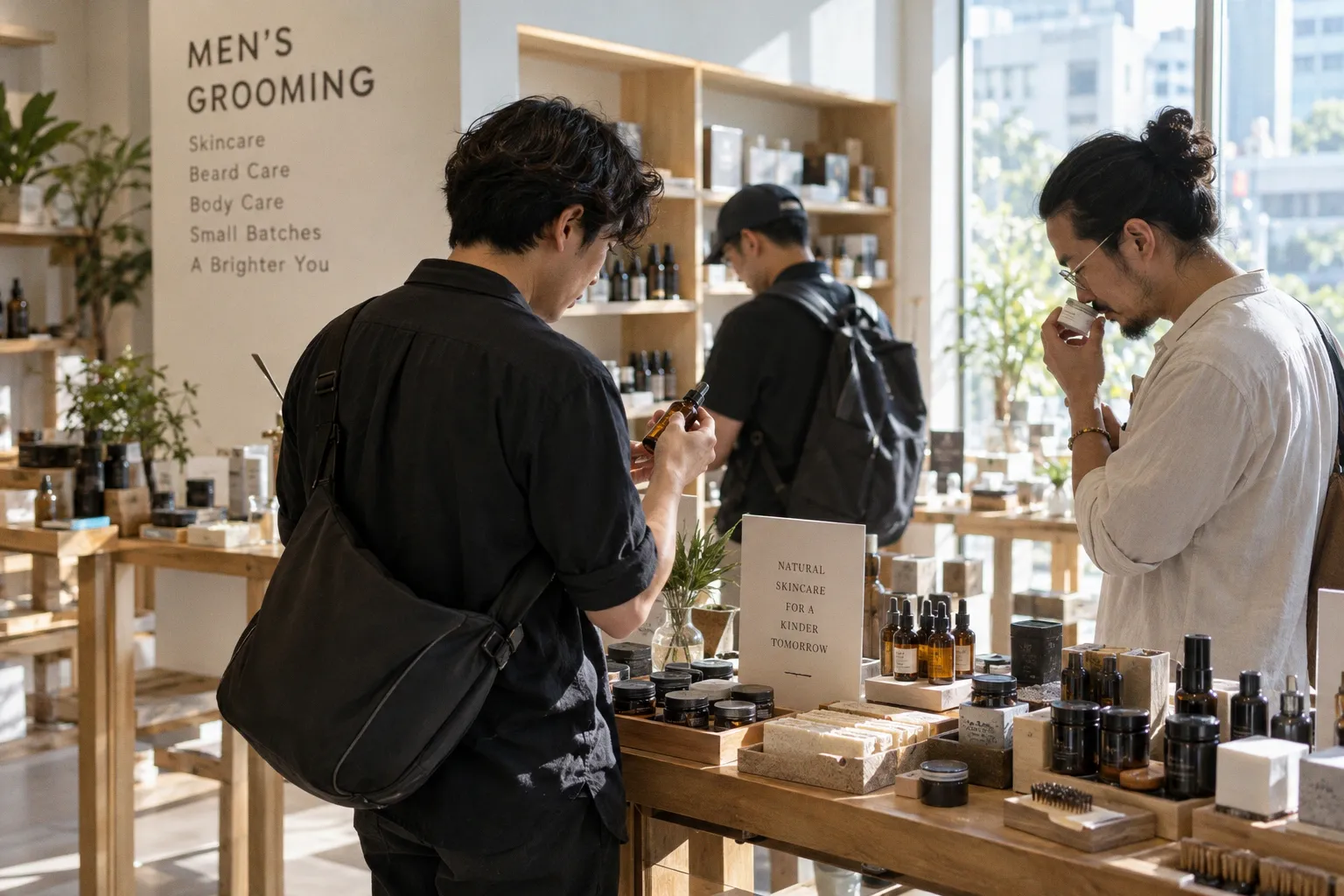
The Japanese Men's Grooming Signal
For indie formulators working in small-batch beard and skincare, the development matters less as a cultural curiosity and more as a data point on where barrier-first, low-friction routines are gaining traction.
Why This Resonates Beyond Japan
Japan's male grooming category has historically centered on a narrow ingredient palette: light lotions, oil-control cleansers, and post-shave lotions with minimal fragrance. The reported expansion suggests formulations are diversifying into serums, exfoliating acids, and treatment-oriented products traditionally associated with female-leaning skincare. The underlying driver — a consumer base seeking measurable outcomes rather than sensorial marketing — aligns with what evidence-based small-batch brands already build around.
Three formulation directions the signal points toward:
- Lighter emulsions. Lower oil phase percentages (often 8–15%) suitable for humid climates and combination skin, using esters like isoamyl laurate or C12-15 alkyl benzoate over heavier mineral oil.
- Post-shave barrier repair. Inclusion of ceramides, cholesterol, and fatty acids in near-equimolar ratios to mimic the intercellular lipid matrix.
- Gentle exfoliation. Mandelic or lactobionic acid at 2–5% concentrations, chosen for larger molecular weight and slower epidermal penetration compared to glycolic acid.
What Small-Batch Makers Should Track
A growing men's category in a mature market like Japan typically precedes two things indie producers will feel: (1) larger brands formalizing ingredient lists around a few hero actives, raising consumer expectations for transparency, and (2) distributor interest in brands that can document INCI rationale, pH range, and stability data. Neither is confirmed in the source material, but both are common downstream effects of the corporate attention the report describes.
The practical question for a hand-craft formulator is not whether to enter men's grooming, but whether existing products meet three measurable criteria: a documented pH appropriate to the skin area (4.5–5.5 for leave-on facial products, up to 6.5 for cleansers), a full ingredient disclosure including extraction method for botanical actives, and stability data covering at least one thermal cycle. Brands that can answer those questions cleanly are the ones positioned to convert distributor interest into retail placement when the category continues its reported expansion.